

Article
Marc Pierini
{
  "authors": [
    "Marc Pierini"
  ],
  "type": "legacyinthemedia",
  "centerAffiliationAll": "dc",
  "centers": [
    "Carnegie Endowment for International Peace",
    "Carnegie Europe",
    "Malcolm H. Kerr Carnegie Middle East Center",
    "Carnegie Russia Eurasia Center"
  ],
  "collections": [
    "Europe’s Southern Neighborhood"
  ],
  "englishNewsletterAll": "ctw",
  "nonEnglishNewsletterAll": "",
  "primaryCenter": "Carnegie Europe",
  "programAffiliation": "EP",
  "programs": [
    "Europe"
  ],
  "projects": [
    "Eurasia in Transition"
  ],
  "regions": [
    "Middle East",
    "Levant",
    "Syria",
    "Russia",
    "Iran"
  ],
  "topics": [
    "Political Reform",
    "Security",
    "Foreign Policy"
  ]
}
Source: Getty
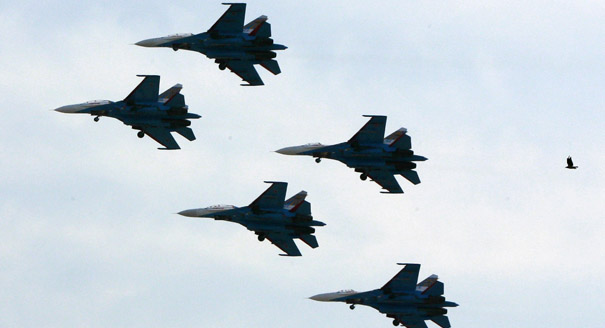
By establishing a strategic presence in Syria, Russian President Vladimir Putin is securing the future of a vital ally in the Middle East.
Source: Hürriyet Daily News
Only a few weeks ago, the al-Assad regime seemed in danger of losing the swath of land from Latakia to Damascus to the assaults of the Islamic State of Iraq and the Levant (ISIL), Jabat al-Nusra and others. Today, Russia has taken over and brought in heavy weapons. Not only can Bashar al-Assad breathe a sigh of relief, but the entire Syrian scene should now be revisited from three different angles.
First, this is about rescuing al-Assad from the edge of a cliff. The hypothesis of the entire country falling to ISIL and the al-Assads fleeing to Sochi is now implausible. Al-Assad is in safe hands. If ever rebel groups still want to conquer Syria’s west, their unlimited violence will be met by the Russian army, not the teetering regime forces.But this is not just about rescuing one man. By establishing a strategic presence in Syria, President Vladimir Putin is securing the future of a vital ally in the Middle East, one that has long had its military trained and equipped by Russia, and making western Syria into Russia’s strategic base in the Middle East.
This new situation raises a number of questions.
One is the anti-terrorist branding of the operation. Officially, Moscow presents its support to al-Assad, past and present, as its contribution to fighting terrorism, especially from ISIL. This is a faint excuse as al-Assad not only created the jihadist group by freeing dozens of prisoners from the Sednaya Prison near Damascus but also failed to take on ISIL seriously. Deep down, is Russia really intent on eliminating ISIL, or does it want to use it as the scarecrow that makes al-Assad look tolerable?
Another question is the de facto alliance this situation creates between the U.S.-led coalition, Iran, and Russia against ISIL. Will these “allies” now coordinate strikes against ISIL targets? Or will they only try avoiding accidental mishaps? How will Iran’s Pasdaran and Hezbollah fighters present on Syrian soil interact with Russian forces? How will the U.S.-trained and equipped rebels, or what’s left of this embarrassing venture, fit into this new equation? Will this alter the (limited) French and British plans for striking ISIL in Syria? How will Israel tolerate more sophisticated weaponry so close to home?
As a side effect, Russia’s move neutralizes Ankara’s adamant ambitions to remove al-Assad from power. Ironically, it also provides a sigh of relief for President François Hollande, who narrowly avoided the embarrassment of seeing the French-built Mistral ships participating in the buildup, had the sale not been canceled.
The second angle is Russia’s strategic military presence in the Middle East. So far, Russia has had only a limited footprint in Syria, mainly the naval maintenance facility in Tartus. This is now being expanded into a more strategic foothold. Predictably, the runway at Latakia airport will be doubled in length to make it usable by the heaviest Antonov cargo planes and the fastest fighter-bomber aircraft; air defenses will be beefed up; heavy armor will be deployed; air control capacity will be enhanced; and new air-to-ground missiles will be provided to the Syrian air force.
In this way, Putin, who had accurately analyzed President Barack Obama’s “reluctant warrior” attitude in August 2013, can safely consider that the scenario of a full-scale Western intervention in Syria, if it ever seriously existed, is now shelved. In U.S. Senator John McCain’s words, Russia is “capitalizing on American inaction.” To put it differently, Putin has eliminated his nightmare scenario of a Western intervention like that in Libya in 2011, and the risk of seeing his ally murdered by unruly rebels in unspeakable conditions, as Moammar Gadhafi was. Gone also is the option for the Turkish Air Force to make forays into al-Assad’s airspace, as in June 2012.
The third angle is the worldwide diplomatic dimension of the Russian takeover of sorts in Syria. Even before the military buildup is fully documented, the Russian “protectorate” of western Syria gives a tangible reality to Moscow’s concept of a new international order. Or, expressed in a Russian perspective, it puts an end to the Western propensity to unilaterally impose its own world order.
To its snap annexation of Crimea and dominance of eastern Ukraine, Russia is now adding “Assadland.” In doing so, it is showing the rest of the world that it has the capacity to redefine the international order, or at least the guts to act as spoiler in chief.
Whether ISIL is quickly defeated along the way has little importance for Russia. Moscow’s presence in western Syria will simply be used internationally, first and foremost at the forthcoming U.N. General Assembly, to prove that Russia can propose its own solutions, in this case, a “new peace plan” for Syria with none other than al-Assad at the helm.
On Sept. 28, Putin’s U.N. speech on “the joint struggle against terrorism” (as branded by TASS agency) will no doubt be seen as utterly cynical by many Western politicians. But for Putin, it will be a glorious moment. Brace for impact.

Senior Fellow, Carnegie Europe
Marc Pierini is a senior fellow at Carnegie Europe, where his research focuses on developments in the Middle East and Turkey from a European perspective.
Recent Work
Marc Pierini
Marc Pierini
Carnegie does not take institutional positions on public policy issues; the views represented herein are those of the author(s) and do not necessarily reflect the views of Carnegie, its staff, or its trustees.

Huawei pushed hard to enter the Egyptian data centers market, until the Americans made a better offer.

Angie Omar

Middle Eastern states should welcome an accelerated U.S. disengagement from their region.

Michael Young

In an interview, former ambassador Charles Freeman assesses the Trump administration’s war against Iran.
Michael Young

The accord represents a pivotal moment in the region to avert a security vacuum in the Gulf.


Azeema Cheema, Mohanad Hage Ali

In an interview, Jason Burke discusses his sweeping account of the “revolutionists” who so shaped the 1970s and early 1980s.
Michael Young