

Q&A
Suzanne Maloney, Aaron David Miller, Karim Sadjadpour
{
  "authors": [
    "Karim Sadjadpour"
  ],
  "type": "legacyinthemedia",
  "centerAffiliationAll": "dc",
  "centers": [
    "Carnegie Endowment for International Peace"
  ],
  "collections": [
    "Arab Awakening"
  ],
  "englishNewsletterAll": "menaTransitions",
  "nonEnglishNewsletterAll": "",
  "primaryCenter": "Carnegie Endowment for International Peace",
  "programAffiliation": "MEP",
  "programs": [
    "Middle East"
  ],
  "projects": [],
  "regions": [
    "Middle East",
    "Iran",
    "Saudi Arabia"
  ],
  "topics": [
    "Security",
    "Religion",
    "Foreign Policy"
  ]
}
Source: Getty
Iran and Saudi Arabia will always be competitors, but they aren’t destined to be sectarian adversaries.
Source: Slate
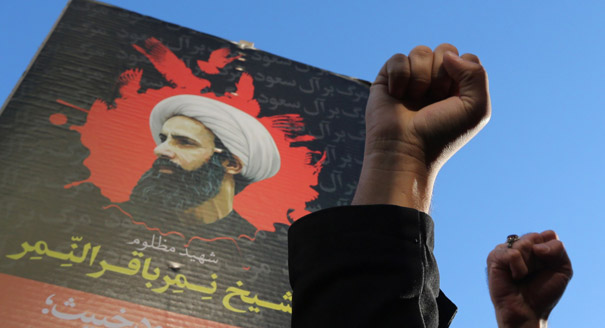
Last week, the government of Saudi Arabia executed Sheikh Nimr al-Nimr, a Shiite cleric who had protested against the regime. Forty-six other people were also put to death on “terrorism-related” charges. The Sunni monarchy that runs Saudi Arabia has a long and poor record of dealing with the country’s Shiite minority, but the brazenness of this execution, amidst Sunni-Shiite conflicts in Syria, Bahrain, Iraq, and Yemen, was shocking to both the country’s allies and adversaries. Indeed, the country’s principle adversary, Iran, encouraged or allowed a number of its citizens to attack the Saudi embassy in Tehran. The Iranian government also does not have a great record on the death penalty or sectarianism: It not only backs Bashar al-Assad’s Sunni-massacring dictatorship in Syria but also executes more people than any country on Earth besides China.
In response to the embassy attack, Saudi Arabia cut off diplomatic relations with Iran; a couple of Saudi allies have now done the same. For some insights into all of this, and the broader turmoil in the region, I called up Karim Sadjadpour, an analyst at the Carnegie Endowment who is an expert on Iran and the Middle East and who used to be based in Iran with the International Crisis Group. We discussed America’s relationship with Saudi Arabia, why ISIS has very few true enemies in the Middle East, and whether the Sunni-Shiite split is fixable. The conversation has been condensed and edited for clarity.
I think when you look at the arenas where Saudi Arabia and Iran are in conflict, whether Syria or Bahrain or Lebanon or Yemen or Iraq, Iran has an upper hand. When you look at it in a broader regional context, the increasing prevalence of sectarianism benefits Saudi Arabia because they have more numbers. Eighty-five percent of the region’s Muslims are Sunni. For the Saudis, if sectarian politics outweigh anti-imperialist politics, that is beneficial. But at the same time, we are not talking about a Saudi government run by Wahhabi Kissingers or Brzezinskis. This government does not have a deep bench of strategic thinkers. They are not playing a game of chess.
We have to look at each situation in its own context. In Iraq, there is a Shia majority. But that certainly isn’t the case in Syria, where the Alawites only represent 15 percent or so of the population. But Iran has now almost 40 years of experience building militias in the Middle East, starting with Hezbollah. They have a committed ideology and worldview. They have a very clear goal in Syria, which is the continuation of the Assad regime. The Saudis don’t really have a clear alternative worldview, and they have often been compromised by the fact that they are aligned with the United States. It’s tough for them to win an ideological battle. It’s easier to win a sectarian one.
I am not sure they are feeling existential angst at home. Four or five years ago, people had romantic thoughts about the Arab Spring. Now I don’t think many Arabs watching television think popular uprisings will be successful. So except for the Shia population in the East, there are no signs that they feel they have to quell a popular uprising. Oil prices are trouble, but they have billions more in reserves than Iran.
But in the region it has been a time of humiliation for them. In today’s Middle East, everyone feels like they are the oppressed victim. Shiites have long felt repressed. But now Sunnis feel that way.
Absolutely. The Saudi population watches television every night, which shows Sunnis being massacred by an Iranian-supported president.
Given how many embassies Iran has ransacked, I don’t think that was uncharacteristic either.
If there were a group of 50 Iranians who got together to protest the government’s human rights or labor rights practices, they would be crushed in a matter of minutes. Nonsanctioned protests in Iran are now rare. Policemen in Iran were told not to interfere. Starting with the U.S. Embassy in Iran in the 1970s, and continuing with the Saudi and Kuwaiti embassies in the following decades, there is a precedent.
Yeah.
President [Hassan] Rouhani is not in charge of the Revolutionary Guards. He is a protégé of former President Rafsanjani, who was long an advocate of better Iran-Saudi relations. So I have no doubt that he did not order or approve this. It is detrimental to the interests of his government, which is trying to open Iran up to business. The hard-liners benefit.
The Saudis have long had an inferiority complex. The paradox of Iran and Saudi Arabia is that the Saudis have a superiority complex vis-à-vis the Shia and an inferiority complex vis-à-vis the Persians. The Saudis have long felt that America favors Iran and that Obama has less respect for Saudi Arabia. I think there will be normalization between Iran and Europe, but as long as the supreme leader remains in power, I don’t think Iran and American will normalize relations. But many gulf rulers think the rapprochement has already taken place, whether it was the U.S. removal of Saddam [Hussein], or the refusal to attack Assad. That is a mainstream conspiracy theory in the gulf.
Countries often choose allies based on shared values, whether those values are tolerance or free-market economics. Saudi Arabia is an ally who doesn’t share our values.
Yeah, Iran is No. 1 per capita.
I just read a piece that said we should abandon Saudi Arabia and commence an alliance with Iran. And yet the Saudi government wants to ally with the United States, and Iran’s official slogan remains “Death to America.” I think Obama and [Secretary of State John] Kerry would love to normalize relations, but it takes two to have an alliance. As for what we can do now: The Obama administration doesn’t want to do anything to mess up the nuclear deal. We have long been a bulwark against Iran but have said that other regimes should do some of the work. But now that the Saudis have, in Yemen, it is doing more damage than good. It’s a dilemma with no good answers.
Before this week, I would have given the odds of success 4 out of 10. Now I would say it’s 3 out of 10 or 2 out of 10. There is an old proverb that states when two elephants fight, the grass suffers. The people who are most going to be hurt are Syrians, Yemenis, Iraqis, Lebanese. They are living through the proxy war.
Where does this end? Is sectarian violence just going to get worse?
If you look over the past four decades, 40 years ago the most notorious terrorist group was considered to be the PLO. Then Hezbollah made the PLO look moderate, and then came al-Qaida, which made Hezbollah look moderate. And now we have ISIS. The trend lines haven’t been in positive directions.
Sectarianism wasn’t as prominent an issue three decades ago. Journalists who covered the Lebanese civil war would say that they didn’t know who was Sunni or Shiite. … There is a notion that the Saudi-Iran sectarian war is fueling all these conflicts. I think the reality is the opposite. You have these regional conflicts, which have their own dynamics, and are driven by many of the factors that led to the uprisings in Tunisia and elsewhere. Saudi Arabia and Iran are on opposite ends of those conflicts, and exacerbated them. But when there aren’t regional conflicts, such as in the 1990s, there was a relatively peaceful modus vivendi between Iran and Saudi Arabia. Iran and Saudi Arabia will always be competitors, but they aren’t destined to be sectarian adversaries.
The spread of ISIS poses much more of an existential threat to the Gulf states than it does to Iran. Iran is a country that is 90 percent Shia. And ISIS has provided Iran a useful pretext to expand its influence. The dilemma that Saudi Arabia faces is that its citizens watch television images of Sunnis being slaughtered, and it is tough for them to side with Iran.
It is often difficult to distinguish between official government funding and private citizens. I have seen no evidence that the Saudi government is actually providing money to ISIS or al-Qaida. But yes, Saudi Arabia hates Iran more than it hates ISIS. The conventional wisdom is that ISIS is a radical Sunni group that is being funded by Sunnis in the gulf and opposed by Iran. But Iran is the arsonist and the fire brigade. Iran’s support for Assad and the [Nouri al-]Maliki government in Iraq led to many Sunnis supporting ISIS. It will have to be Sunnis who put out the ISIS fire.
They pour more gasoline.
Everyone has bigger enemies.

Senior Fellow, Middle East Program
Karim Sadjadpour is a senior fellow at the Carnegie Endowment for International Peace, where he focuses on Iran and U.S. foreign policy toward the Middle East.
Recent Work


Suzanne Maloney, Aaron David Miller, Karim Sadjadpour

Aaron David Miller, Karim Sadjadpour, Robin Wright
Carnegie does not take institutional positions on public policy issues; the views represented herein are those of the author(s) and do not necessarily reflect the views of Carnegie, its staff, or its trustees.
This will be the region’s most representative tournament, amid broad changes in its footballing landscape.

Issam Kayssi
In an interview, Marc Lynch discusses his new book decrying the post-1990 U.S.-dominated order in the Middle East.

Michael Young

Because perpetual conflict enhances control, offers economic benefits, and allows leaders to ignore popular preferences.

Angie Omar
In an interview, Jim Lamson discusses the ongoing regional conflict and sees an unclear picture when it comes to winners and losers.
Michael Young
Cairo’s efforts send a message to the United States and the region that it still has a place at the diplomatic table.
Angie Omar