

Commentary
Aron Lund
{
  "authors": [
    "Aron Lund"
  ],
  "type": "other",
  "centerAffiliationAll": "dc",
  "centers": [
    "Carnegie Endowment for International Peace",
    "Malcolm H. Kerr Carnegie Middle East Center"
  ],
  "collections": [
    "Arab Awakening"
  ],
  "englishNewsletterAll": "menaTransitions",
  "nonEnglishNewsletterAll": "",
  "primaryCenter": "Carnegie Endowment for International Peace",
  "programAffiliation": "MEP",
  "programs": [
    "Middle East"
  ],
  "projects": [],
  "regions": [
    "Middle East",
    "North Africa",
    "Iraq",
    "Syria",
    "Levant"
  ],
  "topics": [
    "Political Reform",
    "Security",
    "Military",
    "Foreign Policy"
  ]
}
Source: Getty
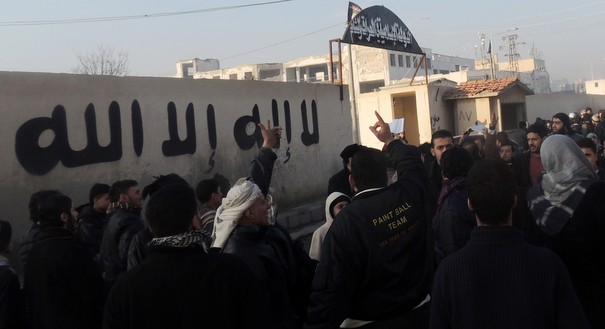
Chronic disorder among the self-proclaimed Islamic State’s many enemies may enable the extremist group to recover from a string of recent defeats and reclaim the initiative.
Source: Century Foundation
The Sunni extremist group known as Islamic State (IS, also known by an earlier acronym, ISIS) is taking a terrible beating. In the past few days, it has lost territory in both Syria and Iraq. Syrian Kurds have attacked it east of Aleppo and north of Raqqa City, while it is battling Sunni Arab rivals north of Aleppo. The Syrian army of President Bashar al-Assad is pressing into the Raqqa Governorate and taking ground in the deserts east of Palmyra. In Iraq, other Kurdish groups have struck east of Mosul, while an alliance of Shia militias and the Iraqi army is moving into its stronghold in Fallujah. Further afield, the jihadis are being purged from the Libyan city of Sirte.
Islamic State’s self-styled caliph, Abu Bakr al-Baghdadi, is nowhere to be seen or heard as his fighters face attacks on all fronts. According to the U.S.-led anti-Islamic State coalition, the jihadi group has now lost half of the area it controlled in Iraq at its peak in late 2014 and a fifth of its territory in Syria. Revenues from oil and other assets are reportedly down by a third and a U.S. government official recently claimed the coalition has “cut off entirely their revenue that’s coming from the outside.” The coalition also says that the total number of Islamic State fighters in Iraq and Syria has dropped from a peak of around 31,000 in December 2014 to between 19,000 and 25,000 today, and the influx of foreign jihadis has allegedly been reduced by three-quarters.
Islamic State has not scored a major victory on the battlefield in more than a year, and its ability to govern efficiently is withering. People with their ear to the ground in Islamic State’s Syrian stronghold of Raqqa speak of frail governance and worsening repression, since the group can no longer afford to buy civil peace. If popular discontent continues to grow, a weakening Islamic State could face internal dissent and tribal uprisings.
Still, the decline of Islamic State is certainly not irreversible and its enemies could be in for rough surprises ahead. In some areas, the forces confronting Islamic State are even more dysfunctional than the group itself, held together only by foreign influence and the fact that they face a common enemy. Now, with Islamic State’s influence finally receding, that brittle unity is being tested. Syria has long been torn asunder by civil war and regional rivalries, while Iraq suffers from a worsening political paralysis. Islamic State is weaker than at any point since it conquered Mosul two years ago, but thanks to the chronic disorder among its enemies, it may still be able to regroup and reclaim the initiative...
Former Nonresident Fellow, Middle East Program
Aron Lund was a nonresident fellow in the Middle East Program and the author of several reports and books on the Syrian opposition movement.
Recent Work
Aron Lund
Aron Lund
Carnegie does not take institutional positions on public policy issues; the views represented herein are those of the author(s) and do not necessarily reflect the views of Carnegie, its staff, or its trustees.

The accord represents a pivotal moment in the region to avert a security vacuum in the Gulf.


Azeema Cheema, Mohanad Hage Ali

In an interview, Jason Burke discusses his sweeping account of the “revolutionists” who so shaped the 1970s and early 1980s.

Michael Young
In an interview, Sohaib Jawhar analyzes the profound changes in the ties between the neighboring countries.
Michael Young

By failing to address Palestinian representation, the current process is bound to lead to just another temporary arrangement.

Nathan J. Brown

The armed forces champion a form of capitalism that is generating revenue, but its reliance on rent faces diminishing returns, leaving the country with massive sunk costs and deferred returns, deepening dependency on external borrowing.

Yezid Sayigh