

Commentary
Aron Lund
{
  "authors": [
    "Aron Lund"
  ],
  "type": "legacyinthemedia",
  "centerAffiliationAll": "dc",
  "centers": [
    "Carnegie Endowment for International Peace",
    "Malcolm H. Kerr Carnegie Middle East Center"
  ],
  "collections": [
    "Arab Awakening"
  ],
  "englishNewsletterAll": "menaTransitions",
  "nonEnglishNewsletterAll": "",
  "primaryCenter": "Carnegie Endowment for International Peace",
  "programAffiliation": "MEP",
  "programs": [
    "Middle East"
  ],
  "projects": [],
  "regions": [
    "Middle East",
    "Iraq",
    "Syria",
    "Levant"
  ],
  "topics": [
    "Political Reform",
    "Security",
    "Military"
  ]
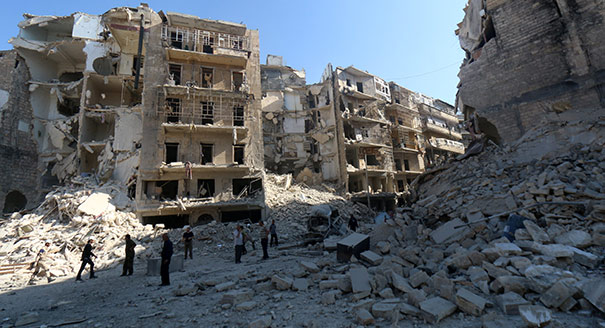
}
Source: Getty
Assad’s campaign to reconquer Aleppo could have disastrous humanitarian consequences as well as broad effects on the political and military standing of the rebellion.
Source: Syria Comment
...Unless somehow rolled back by the rebels, Assad’s reconquest of eastern Aleppo could turn into a very drawn-out siege, which would no doubt have horrifying effects for the civilian population. But the effects are not just humanitarian or even military, there’s also a political side to this. If Assad shows that he is winning Aleppo, and he’s now also advancing on the rebels in Damascus, it could trigger a more dramatic shift by finally convincing opposition groups that they have lost the war. Many thousands of them would probably fight on regardless, for ideological reasons or simply because they see no hope for survival under Assad. But some might decide to abandon the fight and flee Syria or try to negotiate a separate peace with the government.
One problem with that is that Assad has historically shown himself to be too politically inflexible to capitalize on his military victories. This has been a constant source of frustration for his allies, but it just seems to be the way the regime works. Now, there are some signs of a more intelligent political management this time around. Assad has just decreed an amnesty for rebels who hand in their guns within three months. It’s probably in the hope of triggering defections, and also to show Syrians and foreigners alike that he can in fact reintegrate former enemies and would therefore be able to reunify Syria. But given the lawless way in which his security forces have always acted, I suspect many will think twice before taking him on his word.
Perhaps most importantly, if Assad cements his hold on Aleppo through a siege or even by retaking it in part or in full, that could be the moment when certain foreign backers of the rebellion decide to call it a day. No one is going to rush to embrace Assad after all of this and nations that have developed strong proxy forces in Syria will be reluctant to abandon their investments. But it does change the political horizon for the rebels’ backers. In my view, it is not realistic to expect countries like Turkey or Saudi Arabia–never mind the United States–to first let the rebels lose Aleppo and then rally the force needed for them to take it back. They’re not going to start from scratch again. When it’s gone, it’s gone, and the only thing that can change that is if the government itself has an internal meltdown. So without Aleppo, it is a different war and probably one in which some of his enemies will think differently about Assad’s role. Not all, but some of them, and that might be enough to alter the terms of the conflict....
Former Nonresident Fellow, Middle East Program
Aron Lund was a nonresident fellow in the Middle East Program and the author of several reports and books on the Syrian opposition movement.
Recent Work
Aron Lund
Aron Lund
Carnegie does not take institutional positions on public policy issues; the views represented herein are those of the author(s) and do not necessarily reflect the views of Carnegie, its staff, or its trustees.
Reconciliation councils are emerging throughout the country to mediate in intracommunal disputes, many from the war years.
Natacha Danon
The civil war in Syria may have ended, but the country continues to serve as a source for the trafficking of illegal substances into and via Jordanian territory.


Armenak Tokmajyan, Laith Qerbaa
As the U.S.-led Coalition withdraws, the Kurds’ reliance on Baghdad, and on themselves, will only increase.
Wladimir van Wilgenburg

As the U.S. stumbles in its war with Iran, we are likely to see an acceleration of its disengagement from the region.

Michael Young
The Zaidi government’s objective to collect weapons is constrained by regional conflict, but it can take certain measures at home.
Ali Al-Mawlawi