

Article
C. Raja Mohan, Darshana M. Baruah
{
  "authors": [
    "C. Raja Mohan"
  ],
  "type": "legacyinthemedia",
  "centerAffiliationAll": "dc",
  "centers": [
    "Carnegie Endowment for International Peace",
    "Carnegie India"
  ],
  "collections": [],
  "englishNewsletterAll": "ctw",
  "nonEnglishNewsletterAll": "",
  "primaryCenter": "Carnegie India",
  "programAffiliation": "SAP",
  "programs": [
    "South Asia"
  ],
  "projects": [],
  "regions": [
    "South Asia",
    "India",
    "United Kingdom",
    "Western Europe"
  ],
  "topics": [
    "Foreign Policy"
  ]
}
Source: Getty
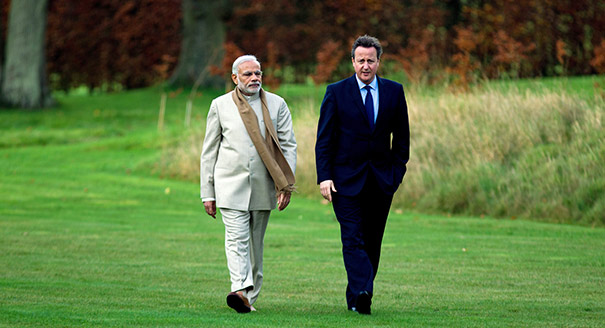
As one of the world’s largest economies with an expeditionary military tradition and deep resources of soft power, Britain can be a productive and long-term partner for a rising India.
Source: World Today
Reconnecting Britain to its old economic partners in the Commonwealth is one of the ideas that animated the Brexit movement. A strong partnership with India may not be a substitute for Britain’s continued engagement with Europe, but it must form an important element of London’s new international strategy.
If the UK can overcome the threat of Scottish secession and survive as a state, it will remain an important player in world affairs. As one of the world’s largest economies with an expeditionary military tradition and deep resources of soft power, Britain can be a productive and long-term partner for a rising India.
In Delhi, Narendra Modi, the prime minister, appears to have a special empathy for the Anglo-Saxon world. Unlike many of his predecessors from the Congress Party, who were suspicious of the United States and sneered at Britain, Modi has embraced America and is eager to revive ties with Britain and other parts of the English-speaking world.
This opens the door to two possibilities. One is the revival of the Commonwealth and the other is the construction of an expansive India-centred democratic maritime coalition in the Eastern Hemisphere with America’s strong support and Britain’s participation.
In the UK, there is no dearth of sceptics who see restoring the imperial connection as a delusion, while in India, there is little nostalgia for the Empire. But Modi, the first leader born after India’s independence, has less of an anti-imperialist chip on the shoulder. He has broken many political taboos inherited from the Congress party, taken a fresh look at India’s role in the world before independence, including its participation in the two world wars and appears more open to reviving the Commonwealth.
While independent India has sought membership of every global club, it has looked down on the Commonwealth as a colonial legacy, largely because of British blunders in India in the inter-war period and the misreading of the Second World War by the Indian national movement.
After the war, Britain saw the Commonwealth and a strong political, economic and military partnership with India as a critical element in sustaining its international role. If Jawaharlal Nehru’s refusal to accept a military role for the Commonwealth in preference for non-alignment and an emphasis on state-led socialism diminished Britain’s great power aspirations, they also limited India’s international prospects.
A rejuvenated Commonwealth, under shared leadership between Delhi and London, can help Britain maintain its international presence and help India’s rise to leading power status. Reviving a club of disparate states, from the South Pacific to the Caribbean and southern Africa to South East Asia, would be demanding but it is never too late. Consultations between India, Britain, Canada and Australia would be an important start.
The second step in building a new coalition in the East, a continuation of the Anglo-American maritime tradition, should be easier. Despite President Obama’s advice to remain in Europe, it is unlikely that Washington will want to abandon its special relationship with London. In fact, many Republicans have welcomed Brexit.
At a time when India’s prominence is rising in America’s global strategic calculus, it is not difficult to imagine Britain as an essential part of a maritime coalition in the Indo-Pacific. Recently Washington has given focus and money to the idea of building a democratic bloc in the region involving America, India, Australia and Japan. Britain would fit nicely into America’s Asian rebalance.
Although a natural partner for the West in the post-war world, independent India chose to experiment with alternative paths. The Non-Aligned Movement came to a naught during the Cold War, and Delhi’s dalliance with Moscow and Beijing in its quixotic quest for a multipolar world since then has seen India diminish at the expense of China.
Modi is more ambitious than his predecessors but faces a growing challenge from an assertive China. It is no surprise then that Modi has embraced the idea of a maritime coalition with the US, Japan and Australia and he should have no hesitation in drawing Britain into this alliance. But as a leader, who has inherited Gujarati pragmatism as well as a maritime orientation and who understands the sources of India’s vast footprint in the English-speaking world, he is well-placed to lay a new foundation for it.
Former Nonresident Senior Fellow, Carnegie India
A leading analyst of India’s foreign policy, Mohan is also an expert on South Asian security, great-power relations in Asia, and arms control.
Recent Work

C. Raja Mohan, Darshana M. Baruah


Alexander Gabuev, Paul Haenle, C. Raja Mohan, …
Carnegie does not take institutional positions on public policy issues; the views represented herein are those of the author(s) and do not necessarily reflect the views of Carnegie, its staff, or its trustees.

In an interview, Ian Lustick and Eli Clifton discuss their new book on why a prominent ally has so much influence in America.

Michael Young

By failing to address Palestinian representation, the current process is bound to lead to just another temporary arrangement.

Nathan J. Brown
In an interview, Elizabeth Thompson recalls how the country formulated a liberal constitution in 1920, before being denied by France and Britain.
Michael Young

Just look at Iraq in 1991.

Marwan Muasher

A coalition of states is seeking to avert a U.S. attack, and Israel is in the forefront of their mind.
Michael Young