

Commentary
By failing to address Palestinian representation, the current process is bound to lead to just another temporary arrangement.
Nathan J. Brown
{
  "authors": [
    "Yan Xuetong"
  ],
  "type": "legacyinthemedia",
  "centerAffiliationAll": "",
  "centers": [
    "Carnegie Endowment for International Peace",
    "Carnegie China"
  ],
  "collections": [
    "U.S.-China Relations",
    "China’s Foreign Relations"
  ],
  "englishNewsletterAll": "",
  "nonEnglishNewsletterAll": "",
  "primaryCenter": "Carnegie China",
  "programAffiliation": "",
  "programs": [],
  "projects": [],
  "regions": [
    "North America",
    "United States",
    "East Asia",
    "China"
  ],
  "topics": [
    "Economy",
    "Foreign Policy",
    "Global Governance"
  ]
}
Source: Getty
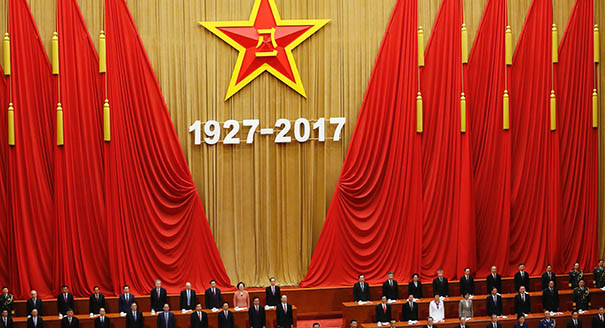
The primary interest dictating Chinese policy is the rejuvenation of the Chinese nation, which serves as the new principle guiding the relationship between China and the international community.
Source: Global Times
From 2012 to 2014, Chinese diplomacy transformed from “keeping a low profile” to “striving for achievements.” During this process, China built up its efforts to safeguard its territorial integrity in the Diaoyu Islands and the South China Sea. China also proposed the Belt and Road initiative for surrounding countries and setting up the Asian Infrastructure Investment Bank.
The achievements China made during this period prove that the diplomatic transformation was the right path.
The success of Chinese diplomacy comes as China prioritizes its national interests according to its current national strength. Economic interests are no longer the primary and overwhelming consideration in Chinese diplomacy. The primary interest shifts to the rejuvenation of the Chinese nation. That serves as the new principle guiding the relationship between China and the international community.
It is reasonable to make rejuvenation China’s primary diplomatic goal based on China’s overall strength. But concrete diplomatic strategies should be made in accordance with relevant strengths.
For example, the gap in military strength between China and the United States is larger than the gap in economic strength, so China should not have to shoulder as much international security responsibility as it does in economic issues.
Currently, Chinese scholars hold divergent views on the Korean Peninsula issue, mainly because of their different judgments of China’s relative interests on the peninsula, especially regarding whether priority should be given to avoiding a war or realizing denuclearization.
The debate is about to what extent China’s military strength can support the security interests that China claims in North Korea. Therefore, China’s denuclearization policy should match its strength in this regard. Similarly, the core of the debate over the Terminal High Altitude Area Defense anti-missile system in South Korea is also about China’s military capability.
When we have an inappropriate judgment of our strength in the international community, our definition of concrete national interests will be problematic. The policy of “keeping a low profile” proved less effective in its latter stage because our foreign policy did not adjust in accordance with the changes of China’s international status.
Before China became the world’s second-largest economy, its logic was to “keep a low profile.” When China lacked overall strength, this strategy proved effective as it provides strategic opportunities for its economic development.
However, as China rises to the second largest economy, the world is urging it to undertake more responsibilities commensurate with its strength and status. After the world financial crisis of 2008, criticism that China is not a responsible power has brought unwarranted disturbances amid China’s rise.
Both the Chinese government and the international community view China as a rising power. It is reasonable for China to claim that it is a builder of world peace, a contributor to global development, and an upholder of international order.
Nevertheless, China’s overall strength is far less than that of the United States, so China should undertake no more international responsibilities than the United States. When it comes to concrete policymaking, what China should maintain and what it should reform should be made clear.
Sometimes China’s policy toward the international order is ambiguous, and one of the reasons is that China’s foreign policymaking process lacks an explicit definition of China’s strength and status. Some policymakers fail to understand what goals China’s relevant strength in a specific issue can support or cannot do within the framework of the existing international system. This exerts a negative impact on China’s top-level design and implementation of policies.
At the global level, China cannot play the role of a superpower, as it goes beyond China’s overall strength. If China makes its foreign policy as if it were a global superpower, it will result in strategic precipitance.
China is situated in East Asia, which will become the center of the world in the future. East Asia’s strategic importance to China is greater than any other region. If China invests its limited strategic resources in East Asia, the strategic gains generated will be much more beneficial than from any other region.
If China looks beyond its own neighborhood and puts its strategic resources into regions such as Europe, Africa, the Middle East and Latin America, it will only reap a limited harvest.
If we define China’s strength as the second-largest economy in the world while highlighting the gap with the all-round power of the United States, we can successfully handle relations with neighboring countries and other major powers.
The nature of China-U.S. strategic relations is competition, which will not change in the forthcoming years. In the next decade, cooperation will not become the core part of this bilateral relationship like in the 1980s. There is a huge favorable strength gap between China and its neighboring countries, and the gap continues to expand. This means China can do a lot in the surrounding areas. Neighborhood diplomacy matters greatly to China’s rise and its national rejuvenation.
As a rising power, China’s policies should make an impact on its neighboring areas and then expand to further regions. The United States has been the world’s most powerful country since the end of WWII. The United States made too many international promises and invested too much in secondary regions, but it did not receive due returns. China, as the world’s second largest economy, should not repeat such strategies. That a country’s strategic objectives fit its national strength is the pillar of successful policymaking.
A rising power should try to grow stronger to become a dominant power. The issue concerning the foreign strategy of a rising country is not whether it should gain more international power, but about whether its expansion is too rapid. An appropriate strategy for a rising power is to make some breakthroughs, gain some power, and then stop to consolidate the power it obtained for a while. It should not recklessly seek power that is beyond its reach. A great power should rise steadily rather than at one go. The lesson of China’s Great Leap Forward should long be remembered.

Yan Xuetong
Former President, Carnegie China Management Board, Carnegie-Tsinghua Center for Global Policy
Yan Xuetong was president of the Carnegie-Tsinghua Center Management Board until June 2020.
Carnegie does not take institutional positions on public policy issues; the views represented herein are those of the author(s) and do not necessarily reflect the views of Carnegie, its staff, or its trustees.

By failing to address Palestinian representation, the current process is bound to lead to just another temporary arrangement.

Nathan J. Brown

The armed forces champion a form of capitalism that is generating revenue, but its reliance on rent faces diminishing returns, leaving the country with massive sunk costs and deferred returns, deepening dependency on external borrowing.

Yezid Sayigh

Morocco and Algeria, each in its own way, are having to navigate the global economic fallout of the U.S.-Israeli military campaign against Iran.

Yasmine Zarhloule
Any move by the United States to make good on Trump’s suggestion that Washington persuade Damascus to confront Hezbollah militarily would have catastrophic consequences.

Kheder Khaddour
As talks begin between Washington and Tehran, Beirut has an opening to advance a regional plan for the party’s disarmament.

Michael Young