

Paper
James M. Acton, Ankit Panda
{
  "authors": [
    "James M. Acton"
  ],
  "type": "legacyinthemedia",
  "centerAffiliationAll": "dc",
  "centers": [
    "Carnegie Endowment for International Peace",
    "Carnegie China"
  ],
  "collections": [
    "Korean Peninsula"
  ],
  "englishNewsletterAll": "ctw",
  "nonEnglishNewsletterAll": "",
  "primaryCenter": "Carnegie Endowment for International Peace",
  "programAffiliation": "NPP",
  "programs": [
    "Nuclear Policy"
  ],
  "projects": [],
  "regions": [
    "East Asia",
    "North Korea",
    "North America",
    "United States",
    "South Korea",
    "China",
    "Japan"
  ],
  "topics": [
    "Nuclear Policy",
    "Arms Control"
  ]
}
Source: Getty
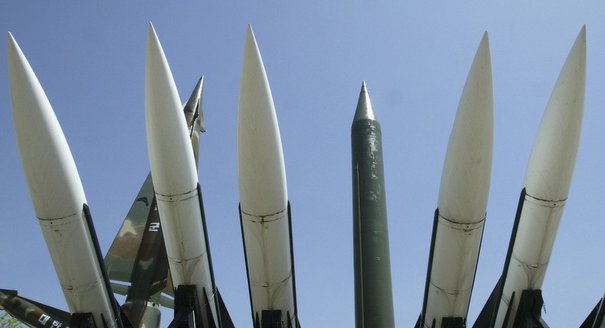
North Korea’s motivations for pursuing nuclear capabilities have changed over time, but are rooted in a sense of existential threats coming from outside the regime.
Source: WAMU
Carnegie NPP co-director James Acton speaks with WBUR on the history of and motivation behind North Korea’s nuclear program. The program, Acton explains, dates back to the 1950s and 1960s, and experienced an acceleration in technology in the 1990s. The regime's motivations for pursuing nuclear capabilities have changed over time, but are rooted in a sense of existential threats coming from outside the regime.
Though North Korean scientists originally trained in the Soviet Union, North Korea has recently reached a high degree of indigenous capability in nuclear manufacturing. The reclusive state now has the ability to produce fissile material, extract plutonium from its own reactors, and enrich uranium. Acton further elaborates on the fact that nuclear weapons technology is 1940s technology; it will become increasingly accessible to an ever larger group of states. Both political and technical solutions are going to become more effecitve, though the international community must get more serious about nonproliferation rules and regulations.
Denuclearization, though desirable, is no longer a realistic outcome, Acton explains. The United States should attempt to offer a deal to North Korea, stipulating restrictions on missile tests over Japan and South Korea; in return, Acton says, the United States may offer a cessation of stategic bomber training flights near North Korea. Despite current high tensions, such a deal may help deter future crises.

Jessica T. Mathews Chair, Co-director, Nuclear Policy Program
Acton holds the Jessica T. Mathews Chair and is co-director of the Nuclear Policy Program at the Carnegie Endowment for International Peace.
Recent Work

James M. Acton, Ankit Panda
James M. Acton
Carnegie does not take institutional positions on public policy issues; the views represented herein are those of the author(s) and do not necessarily reflect the views of Carnegie, its staff, or its trustees.

As the U.S. stumbles in its war with Iran, we are likely to see an acceleration of its disengagement from the region.

Michael Young

Huawei pushed hard to enter the Egyptian data centers market, until the Americans made a better offer.

Angie Omar

Middle Eastern states should welcome an accelerated U.S. disengagement from their region.
Michael Young

In an interview, former ambassador Charles Freeman assesses the Trump administration’s war against Iran.
Michael Young

By failing to address Palestinian representation, the current process is bound to lead to just another temporary arrangement.

Nathan J. Brown