

Commentary
Michael Pettis
{
  "authors": [
    "Michael Pettis"
  ],
  "type": "legacyinthemedia",
  "centerAffiliationAll": "dc",
  "centers": [
    "Carnegie Endowment for International Peace",
    "Carnegie China"
  ],
  "collections": [],
  "englishNewsletterAll": "asia",
  "nonEnglishNewsletterAll": "",
  "primaryCenter": "Carnegie China",
  "programAffiliation": "AP",
  "programs": [
    "Asia"
  ],
  "projects": [],
  "regions": [
    "North America",
    "United States",
    "East Asia",
    "China"
  ],
  "topics": [
    "Economy",
    "Trade"
  ]
}
Source: Getty
Simply having China buy more American goods would make little difference to overall U.S. trade imbalances, but addressing U.S. capital imbalances with the world could be a more effective approach.
Source: Bloomberg
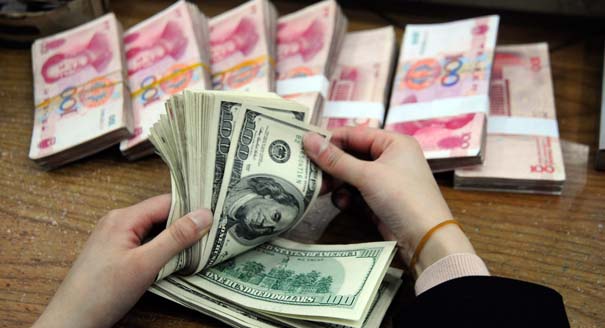
Questions remain about just how many more U.S. exports China’s promised to buy to avert a trade war: U.S. officials have floated the figure of $200 billion annually, which would cut the bilateral trade deficit in half. Even if that were true, however — and Chinese officials have denied it — that massive buying spree wouldn’t bring down the overall U.S. trade deficit one whit.
China should be able to rebalance its trade relationship with the U.S. relatively quickly by reorienting its purchases of industrial and agricultural commodities, along with some industrial products such as aircraft. As a large importer of commodities, it’s easy enough for China simply to shift its buying from one country to another. Unfortunately, any increase in U.S. exports to China will inevitably be matched by a reduction in U.S. exports to other countries.
To understand why, we must understand the role of the U.S. in stabilizing global trade and capital imbalances. Under the current global system, the distribution of income in a number of countries — not just China, but also Germany, Japan, South Korea and several others — is distorted in favor of government and businesses rather than households. This is because these economies effectively subsidize manufacturing exports with various hidden transfers from households, including low wages and low deposit rates. The household share of income is consequently too low for domestic demand to absorb everything produced domestically.
Such distortions also lead to structurally high savings rates in these countries. Income can be consumed or it can be saved. Households consume most of their income while governments and businesses typically save all or nearly all of theirs. By giving the latter a disproportionately high share of income, and households a disproportionately low share, these countries automatically force up their savings rates.
The global economy, in other words, suffers from excess savings generated by a small group of high-surplus countries. The U.S. plays a stabilizing role by absorbing nearly half of this excess of global savings. That’s not because the U.S. has any need for such huge amounts of foreign savings, but because it has completely open, deep and flexible capital markets.
If foreign countries export excess savings to the U.S., driving up its capital account surplus, then by definition the U.S. must also run a current account deficit. This means that U.S. investment must exceed U.S. savings by exactly the amount of foreign savings exported into the U.S.
If the U.S. were a developing country that needed money to invest, as was true for most of the 19th century, this imported capital would be a huge boon, allowing it to invest more than it otherwise could.
But, that’s no longer the case. Not only do American businesses have all the capital they need to invest, and at historically low interest rates, they’re sitting on piles of cash whose only use is to fund non-productive stock buybacks. The U.S., in other words, suffers from weak demand and excessive savings.
If all these foreign capital inflows don’t drive up U.S. investment, then they must drive down U.S. savings: This is an unbreakable rule of the balance of payments. They can do so in a number of ways, including by strengthening the currency, reducing lending spreads, increasing unemployment, weakening lending standards, or inflating real estate or stock market bubbles that boost consumption through a wealth effect. All of these processes force down U.S. savings to below its investment rate.
So, even if China did somehow reduce its bilateral trade surplus with the U.S. by $200 billion, it would make little difference to overall U.S. trade imbalances. As long as China and other surplus countries continue to save far more than they can invest domestically, and as long as much of the capital they export ends up in America, the U.S. will continue to run large capital account surpluses and the corresponding trade deficits.
If the Trump administration genuinely wants to reduce the overall U.S. trade deficit, it is going to have to address capital imbalances with the whole world, not just China. For their part, Chinese leaders understand that their country suffers from serious domestic imbalances that create trade surpluses harmful to its own economy. While they’ve genuinely been trying to rebalance since at least 2007, this is a difficult process and they’ve had limited success.
Rather than strong-arming China into buying more, the U.S. would be better off promoting such domestic rebalancing efforts, for example by gradually reducing the ability of foreigners to dump their excess savings in the U.S. This is the only way to force down the overall American deficit and the good news is that it can be done without highly inefficient trade intervention. That would be a deal worth touting.

Nonresident Senior Fellow, Carnegie China
Michael Pettis is a nonresident senior fellow at the Carnegie Endowment for International Peace. An expert on China’s economy, Pettis is professor of finance at Peking University’s Guanghua School of Management, where he specializes in Chinese financial markets.
Recent Work
Michael Pettis
Michael Pettis
Carnegie does not take institutional positions on public policy issues; the views represented herein are those of the author(s) and do not necessarily reflect the views of Carnegie, its staff, or its trustees.

In an interview, Rozina Ali discusses her new book on the rise and manifestations of Islamophobia in the United States.

Michael Young

In an interview, Ian Lustick and Eli Clifton discuss their new book on why a prominent ally has so much influence in America.
Michael Young

As the U.S. stumbles in its war with Iran, we are likely to see an acceleration of its disengagement from the region.
Michael Young

Middle Eastern states should welcome an accelerated U.S. disengagement from their region.
Michael Young

In an interview, former ambassador Charles Freeman assesses the Trump administration’s war against Iran.
Michael Young