

Research
- +5
Alper Coşkun, Fatih Ceylan, Tacan İldem, …
{
  "authors": [
    "Sinan Ülgen"
  ],
  "type": "legacyinthemedia",
  "centerAffiliationAll": "",
  "centers": [
    "Carnegie Endowment for International Peace",
    "Carnegie Europe",
    "Malcolm H. Kerr Carnegie Middle East Center"
  ],
  "collections": [
    "Turkey’s Transformation"
  ],
  "englishNewsletterAll": "",
  "nonEnglishNewsletterAll": "",
  "primaryCenter": "Carnegie Europe",
  "programAffiliation": "",
  "programs": [],
  "projects": [],
  "regions": [
    "Europe",
    "Türkiye",
    "Middle East"
  ],
  "topics": [
    "Political Reform",
    "Democracy"
  ]
}
Source: Getty
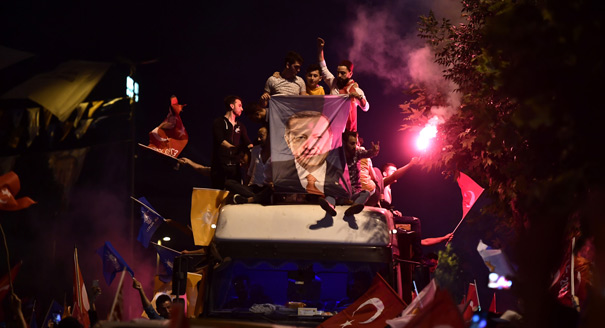
With his reelection as president, Recep Tayyip Erdogan has become Turkey’s most powerful leader since World War II. However, two key considerations will constrain how Erdogan uses his prerogatives.
Source: Project Syndicate
ISTANBUL – Turkish President Recep Tayyip Erdoğan has now fulfilled his ultimate political objective of being the country’s first ever popularly elected executive president, receiving almost 53% of the national vote in Sunday’s election. A year ago, Erdoğan pushed through constitutional amendments to transform Turkey’s parliamentary democracy into a highly centralized presidential system. Now those amendments will come fully into force.
The constitutional changes give Erdoğan new powers to appoint vice presidents, ministers, and senior officials. They also allow him to dissolve parliament, be a member of a political party, have a greater say in appointing judges to the highest courts, issue decrees with the force of law, and impose a state of emergency. Narrowly approved by voters last April, the constitutional amendments also abolished the office of the prime minister. For the next five years, Erdoğan will be Turkey’s head of state, head of its ruling Justice and Development Party (AKP), and head of government.Erdoğan is secure in his position because an early presidential election requires a two-thirds parliamentary vote – an unlikely scenario given the AKP’s near-majority. He has thus become Turkey’s most powerful leader since the country began to hold contested elections in the years immediately following World War II. Turkey’s domestic and foreign policies will now be shaped, ultimately, by one man.
This is of course the opposite of liberal democracy, a core feature of which is a robust set of institutional checks and balances designed to limit executive authority. The assignment of exceptionally broad powers to the executive president under the new constitution reflects a populist vision of government according to which the elected leader, as the true representative of the nation, should not be hindered in pursuing the nation’s interests. The nation can judge the president’s performance only every five years.
By adopting the constitutional text in a referendum, a slim majority of Turkish voters seem to have given their blessing to this populist conception of democratic politics. But two key considerations will constrain how Erdoğan uses his impressive set of new prerogatives.
First, despite winning the presidency, the AKP lost its outright majority in Parliament. With a tally of 42%, down seven points compared to the November 2015 election, the AKP was able to secure 293 of the parliament’s 600 seats. As a result, Erdoğan will be forced to seek alliances to enact legislation. Even with the parliament’s diminished role under the new constitution, control of the legislature remains important for the effective functioning of the state.
Erdoğan’s natural ally in parliament is the far-right Nationalist Movement Party (MHP). The two parties were in a pre-electoral alliance, and Erdoğan owes his election to the 11% of the vote won by his political partner. But a deeper, long-term alliance with the MHP will have significant implications for Turkey’s domestic politics and international standing. It will also constrain Erdoğan’s room for policy maneuver.
At home, the MHP stands for order and security. The alliance with MHP will therefore preclude any opening – akin to the peace initiative launched by the AKP government in 2015 – toward Turkey’s Kurds. By the same token, the MHP is not likely to be a natural partner for any large-scale democratic reforms aimed at strengthening fundamental freedoms.
On the foreign-policy front, the MHP’s inherently Euroskeptic stance will further restrict Turkey’s diplomatic space to rebuild its relations with its partners in the West. During the campaign, the MHP leadership even called for Turkey to withdraw its moribund bid for accession to the European Union.
Turkey’s economic vulnerabilities pose a second and equally important constraint on Erdoğan’s authority. Unlike commodity-based economies with current-account surpluses, like Russia and Brazil, Turkey is reliant on foreign savings. Turkey fuels its growth by tapping international capital markets to finance its annual external borrowing requirement of around $250 billion. This substantial deficit is the consequence of a chronic gap between investment and saving, and past AKP governments’ failure to enact structural reforms to raise total productivity and enhance Turkey’s international competitiveness.
An overemphasis on growth in recent years has exacerbated these difficulties. Last year, Turkey growth rate of 7% was among the highest in the OECD. But Erdoğan’s expansionary policies have compounded the country’s structural imbalances, with inflation rising to double digits, nominal interest rates reaching 16%, and the current-account deficit surpassing 6% of national income.
Erdoğan’s performance as Turkey’s executive president will therefore depend on his ability to chart a trajectory that satisfies the MHP’s main priorities and addresses the adverse consequences of economic overheating. Both constraints are likely to become stronger over time, with the MHP increasingly emboldened by its parliamentary leverage, and the economy in growing need of a potentially contractionary adjustment.
Throughout Erdoğan’s coming term, the question will nonetheless remain: Can these practical – and thus ephemeral – constraints serve as even a minimal proxy for the robust guarantees of a consolidated democratic system?

Senior Fellow, Carnegie Europe
Sinan Ülgen is a senior fellow at Carnegie Europe in Brussels, where his research focuses on Turkish foreign policy, transatlantic relations, international trade, economic security, and digital policy.
Recent Work

Alper Coşkun, Fatih Ceylan, Tacan İldem, …
Carnegie does not take institutional positions on public policy issues; the views represented herein are those of the author(s) and do not necessarily reflect the views of Carnegie, its staff, or its trustees.

Huawei pushed hard to enter the Egyptian data centers market, until the Americans made a better offer.

Angie Omar

The accord represents a pivotal moment in the region to avert a security vacuum in the Gulf.


Azeema Cheema, Mohanad Hage Ali

In an interview, Jason Burke discusses his sweeping account of the “revolutionists” who so shaped the 1970s and early 1980s.

Michael Young
There is a disturbing structural parallel between the old global energy economy and the new green transition.
Angie Omar
This will be the region’s most representative tournament, amid broad changes in its footballing landscape.
Issam Kayssi