

Commentary
Sinan Ülgen
{
  "authors": [
    "Sinan Ülgen"
  ],
  "type": "legacyinthemedia",
  "centerAffiliationAll": "dc",
  "centers": [
    "Carnegie Endowment for International Peace",
    "Carnegie Europe",
    "Malcolm H. Kerr Carnegie Middle East Center"
  ],
  "collections": [
    "Turkey’s Transformation"
  ],
  "englishNewsletterAll": "ctw",
  "nonEnglishNewsletterAll": "",
  "primaryCenter": "Carnegie Europe",
  "programAffiliation": "EP",
  "programs": [
    "Europe"
  ],
  "projects": [],
  "regions": [
    "Europe",
    "Türkiye",
    "Middle East",
    "Iran"
  ],
  "topics": [
    "Political Reform"
  ]
}
Source: Getty
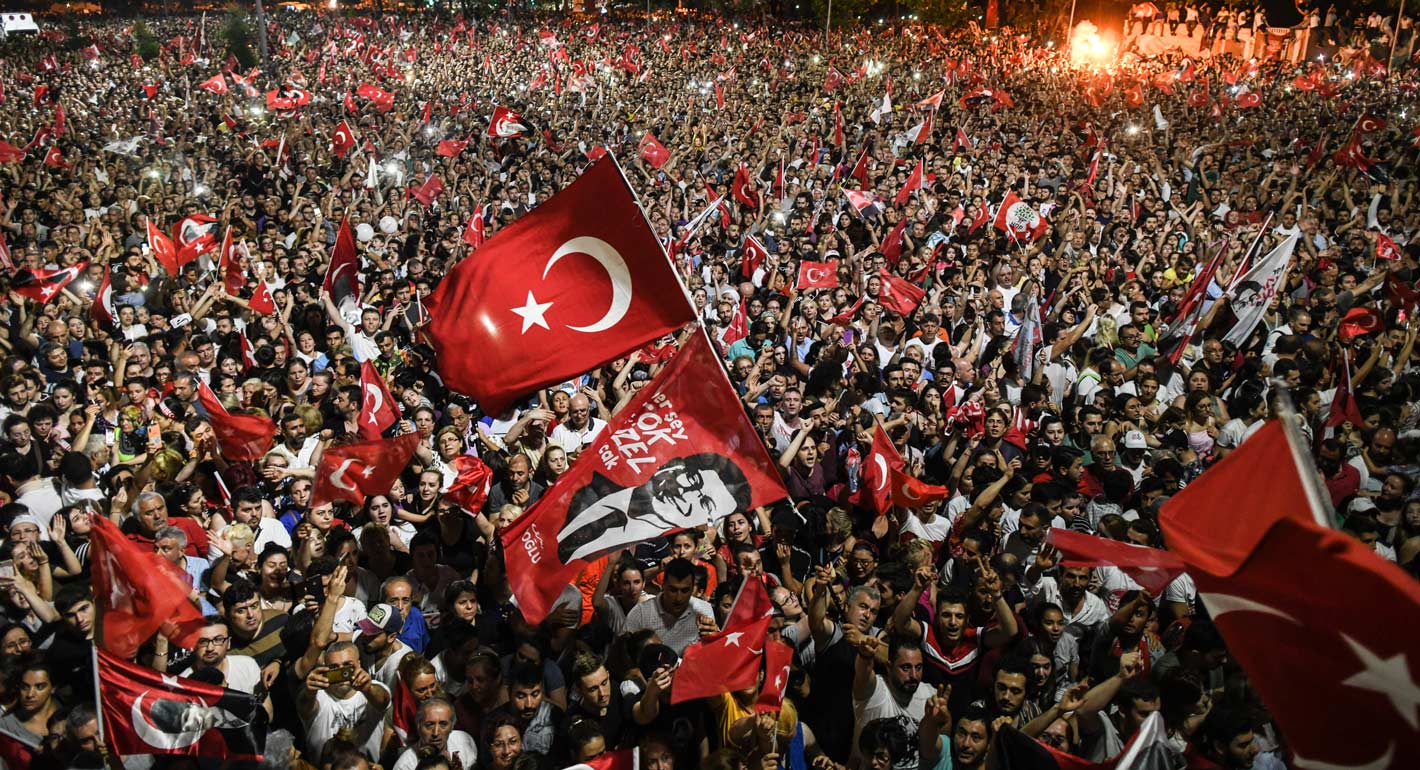
The landslide victory of Ekrem Imamoglu in the Istanbul elections constitutes a threat to Recep Tayyip Erdogan’s hegemony.
Source: Guardian
The opposition candidate Ekrem İmamoğlu’s landslide victory in the re-run mayoral elections in Istanbul will change very little in Turkish politics in the near term. But it has the potential to change everything in the long run.
After winning the Istanbul elections in March with a margin of 13,000 votes in a constituency of 10 million, İmamoğlu was denied victory on dubious legal grounds, with the High Electoral Council decreeing that new elections should be held on 23 June. On Sunday, the Istanbul electorate gave a strong mandate to İmamoğlu. He increased his majority to 800,000, almost 60-fold, and received the backing of 54% of the citizens of Turkey’s largest city. In contrast, Binali Yıldırım, the ruling Justice and Development party (AKP) candidate, received 45% of the vote.
The impressive margin is first due to people’s sense of injustice, triggered by the decision to repeat the elections. A share of the vote even shifted directly from the AKP candidate to the opposition Republican People’s party (CHP) candidate. Polling by Istanbul Economics Research suggests that the motivation for this shift was the perception that İmamoğlu’s win had been unfairly challenged.But he was also able to develop a conciliatory narrative that appealed to these voters. He provided a fresh alternative to inhabitants of Istanbul fatigued from years of acrimonious and exclusionary political rhetoric. (As a result, İmamoğlu’s campaign should be examined closely for its global implications in the fight against populism.) Last, he was particularly effective in coalescing Turkey’s fragmented opposition, which included this time the CHP, but also the secular nationalist İyi party, as well as the pro-Kurdish Peoples’ Democratic party (HDP).
The wide margin of the opposition’s win precludes a new challenge scenario. İmamoğlu will become, once more, the new mayor of Istanbul. And his victory constitutes a clear longer-term threat to Recep Tayyip Erdoğan’s hegemony.
First the established opposition parties will be emboldened by his win. The opposition is now in control of cities accounting for almost 70% of Turkey’s GDP. Nine out of the 10 biggest urban areas in the country will be ruled for the next five years by a mayor linked to the opposition, the exception being the industrial province of Bursa. The opposition will have the opportunity to dismantle and then restructure the patronage networks that have helped the AKP to establish itself so successfully at the helm of Turkish politics.
New contenders are also likely to interpret this outcome as a window of opportunity. In particular, the political movement rumoured to have been set up by the former AKP minister Ali Babacan will be encouraged by this clear sign of growing grassroots disenchantment with the ruling party.
More importantly, Sunday’s result is likely to lead to a rethink by the AKP leadership. The shock must be momentous. It is surely the most severe interruption in Erdoğan’s electoral winning electoral streak. . . .

Senior Fellow, Carnegie Europe
Sinan Ülgen is a senior fellow at Carnegie Europe in Brussels, where his research focuses on Turkish foreign policy, transatlantic relations, international trade, economic security, and digital policy.
Recent Work
Sinan Ülgen

Raluca Csernatoni, Sinan Ülgen
Carnegie does not take institutional positions on public policy issues; the views represented herein are those of the author(s) and do not necessarily reflect the views of Carnegie, its staff, or its trustees.
This will be the region’s most representative tournament, amid broad changes in its footballing landscape.
Issam Kayssi
In an interview, Marc Lynch discusses his new book decrying the post-1990 U.S.-dominated order in the Middle East.

Michael Young

Because perpetual conflict enhances control, offers economic benefits, and allows leaders to ignore popular preferences.

Angie Omar
In an interview, Jim Lamson discusses the ongoing regional conflict and sees an unclear picture when it comes to winners and losers.
Michael Young
Cairo’s efforts send a message to the United States and the region that it still has a place at the diplomatic table.
Angie Omar