

Article
Dalia Ghanem
{
  "authors": [
    "Dalia Ghanem"
  ],
  "type": "legacyinthemedia",
  "centerAffiliationAll": "dc",
  "centers": [
    "Carnegie Endowment for International Peace",
    "Malcolm H. Kerr Carnegie Middle East Center"
  ],
  "collections": [
    "Arab Spring 2.0"
  ],
  "englishNewsletterAll": "menaTransitions",
  "nonEnglishNewsletterAll": "",
  "primaryCenter": "Malcolm H. Kerr Carnegie Middle East Center",
  "programAffiliation": "MEP",
  "programs": [
    "Middle East"
  ],
  "projects": [],
  "regions": [
    "Maghreb",
    "North Africa",
    "Algeria"
  ],
  "topics": [
    "Political Reform"
  ]
}
Source: Getty
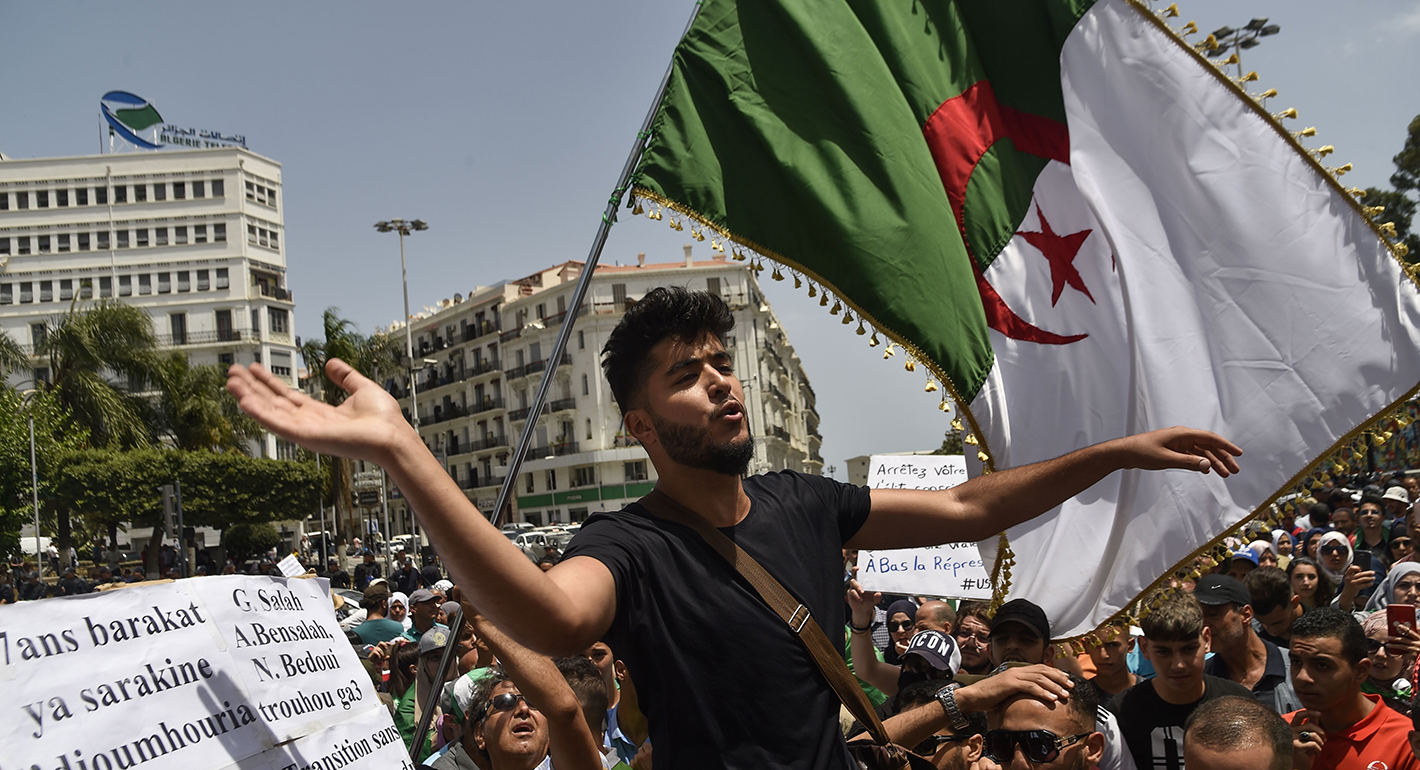
As protesters continue to call for civilian rule, the army has a number of options available, from withdrawing from politics to cracking down.
Source: Middle East Eye
On 3 July, Algeria’s interim president, Abdelkader Bensalah, called for a national dialogue without the involvement of the state or military, noting that the state would observe “the strictest neutrality” throughout the process.
Many Algerians viewed Bensalah’s speech as yet another artful deception, coming a few days before his interim mandate expires on 9 July, and after months of mass protests that culminated in the departure of former president Abdelaziz Bouteflika.
It also follows the arrests of politicians and businesspeople close to the former president and the emergence of army chief Ahmed Gaid Salah as a powerbroker.
Protesters have been calling for the implementation of a civilian state, rather than a military one. Yet, while the army stood with the people in their push to oust Bouteflika, it appears now to be withholding further support. What will Algeria’s military do next?
In making that determination, the military will need to take into consideration three important factors: its internal cohesion, institutional reputation, and corporate and individual interests.
Historically, the Algerian army has been either an arbitrator or a ruler. The level and range of its intervention has fluctuated, but one thing has remained certain: all governments in Algeria have been accountable to the military as the locus of power.
After the popular protest movement erupted on 22 February, and following Bouteflika’s initial refusal to leave, the military first arbitrated the conflict, then intervened to pressure the ailing president to step down. Since then, the military has been openly ruling.
The military’s decision to shift its loyalty and force Bouteflika to step down was based on a rational calculus of the risks and rewards. Bouteflika’s authority had been deeply undermined, and the president was too weak politically and physically to prevail. It was costly and unreasonable for the military to bet on him.
As such, the military weighed the costs and took the best decision accordingly. Staying loyal to him would have had a terrible impact on the military’s organisational cohesion and institutional reputation.
The latter is an essential factor, as the army is the most trusted institution in the country. According to the 2017 Arab Barometer, out of 1,200 respondents from all over the country, roughly 75 percent see the military as the most trustworthy institution in the country. Algerians have always been mindful of the army’s behind-the-scenes role; nonetheless, they have never blamed it for their problems, instead blaming political leaders.
Yet, since the military openly took the reins of power, Algerians are now blaming the men in uniform.
Staying at the forefront has its price: it means inheriting all socioeconomic woes and political problems, and taking responsibility for governing. For the military to leave the reins of power to an elected government is the best way forward, and one that is less risky for its reputation and internal cohesion.
Internal cohesion is another important factor. Many junior officers and enlisted men showed their support to the people because they identify with the average citizen. The Algerian army’s ranks are filled by ordinary citizens, mostly from the lower and working classes, as conscription for 12 months is mandatory for all men from the age of 19.
There are similarities and affinities between the troops and the protesters. In addition, the demonstrations are broad-based and demographically varied - men, women, young and old.
The use of coercive tactics against such a movement would likely create divisions among the ranks of mid-level and junior officers. Defections would likely threaten the military’s effectiveness, preventing it from fulfilling its central mission of preserving national security.
A third factor that the military must take into consideration is corporate and individual interests. The military has a large budget, which increased throughout the 1990s to become the highest in Africa, reaching an all-time high of more than $10bn in 2016. Last year, Algeria’s defence budget was $9.6bn, higher than any other department.
This colossal budget is classified, and there is no effective parliamentary oversight to allow for civilian scrutiny of defence spending. One of the military’s chief concerns is to protect this budget, along with the army’s corporate interests and immunity from human rights violations.
As Algeria’s civil war wound down in 1999 and the army brought Bouteflika to power, he offered a full amnesty for members of the security forces who were responsible for forced disappearances, arbitrary detentions and human rights violations during the decade-long war.
Despite some shakeups, the budget, modernisation, training and reform programmes were designed and carried out exclusively by the military. Bouteflika’s government never achieved full control over the military; today, this remains an elusive goal.
In addition, several ruling generals have personal interests to protect. With the selective and controlled liberalisation of the economy throughout the 1990s, many senior military figures infiltrated the private sector.
In deciding the next steps, the military will consider their interests - and as long as the regime is capable of delivering their high salaries, business opportunities and immunity, the army will likely remain loyal to the regime.
The Algerian military today is reluctant to surrender the supreme political power it has enjoyed since liberating the country in 1962.
It now has three options.
One would be to play down its direct involvement in politics, in order to better maintain the existing institutional structures. To do so, the ruling generals might give the illusion that the army is returning to its barracks, but maintain power by establishing a puppet civil government with people who share its political perspective. However, this would be risky, as millions of Algerians now question the legitimacy of the military’s political influence.
Second, the army could return to its barracks but keep an eye on the civil government, in order to exert pressure if need be to push certain policies.
Third, if its calculus leads to the conclusion that the costs of tolerating the popular movement would be higher than those of repression, the army could reassert its power and use repression.
The question remains whether the military is capable of assuming the burden of great repression. Knowing its modern history, the answer is complicated. To avoid taking such a risk, the military might choose not to use coercive measures directly, and marshal other security forces, such as the police, to do so. Early signs of police repression are already appearing.
Whatever option the army chooses, its priorities are to keep civilian leaders from intervening in its internal affairs, ensuring immunity and a hefty budget, and maintaining military unity.
This article was originally published in the Middle East Eye.
Former Senior Resident Scholar, Malcolm H. Kerr Carnegie Middle East Center
Dalia Ghanem was a senior resident scholar at the Malcolm H. Kerr Carnegie Middle East Center in Beirut, where her research focuses on Algeria’s political, economic, social, and security developments. Her research also examines political violence, radicalization, civil-military relationships, transborder dynamics, and gender.
Recent Work
Dalia Ghanem


Frances Z. Brown, Judy Dempsey, Dalia Ghanem, …
Carnegie does not take institutional positions on public policy issues; the views represented herein are those of the author(s) and do not necessarily reflect the views of Carnegie, its staff, or its trustees.

The armed forces champion a form of capitalism that is generating revenue, but its reliance on rent faces diminishing returns, leaving the country with massive sunk costs and deferred returns, deepening dependency on external borrowing.

Yezid Sayigh

Morocco and Algeria, each in its own way, are having to navigate the global economic fallout of the U.S.-Israeli military campaign against Iran.

Yasmine Zarhloule
This will be the region’s most representative tournament, amid broad changes in its footballing landscape.

Issam Kayssi
Understanding how farmers in the Oued Sahel-Soummam Valley grapple with climate change is essential for addressing the paradoxes through which adaptation, operating at both individual and institutional levels, deepens the region’s vulnerability and erodes the social fabric and agrarian identity that once defined life.
Ilyssa Yahmi
Unless the European Union-led energy transition provides economic development to Algeria, Morocco, and Tunisia, the process may be perceived as a new form of extraction.
Yasmine Zarhloule