

Q&A
James Schwemlein
{
  "authors": [
    "James Schwemlein"
  ],
  "type": "commentary",
  "centerAffiliationAll": "dc",
  "centers": [
    "Carnegie Endowment for International Peace"
  ],
  "collections": [],
  "englishNewsletterAll": "ctw",
  "nonEnglishNewsletterAll": "",
  "primaryCenter": "Carnegie Endowment for International Peace",
  "programAffiliation": "SAP",
  "programs": [
    "South Asia"
  ],
  "projects": [],
  "regions": [
    "South Asia",
    "Pakistan"
  ],
  "topics": [
    "Democracy",
    "Economy",
    "Security",
    "Military"
  ]
}
Source: Getty
Imran Khan’s arrest is another case of business as usual in the country’s frustrating, illiberal democratic experiment.
The arrest of former prime minister Imran Khan on May 9 is another ignominious mark on Pakistan’s democratic record. Khan, who was removed from office last year following a parliamentary vote of no confidence and survived an assassination attempt last fall, has continued to mobilize strong political support across the country.
Khan has been under scrutiny by government agencies, most notably the National Accountability Bureau, since leaving office. Khan and his party, Pakistan Tehreek-e-Insaf (PTI), allege these inquiries are politically motivated—which was the same thing that members of the parties currently sitting in government, including the Pakistan Muslim League–Nawaz (PML-N) and the Pakistan Peoples’ Party (PPP), said when the same agencies investigated them during Khan’s tenure. But, in effect, Pakistan’s judicial process follows a “guilty until proven innocent” principle, and as in other cases against senior politicians, Khan’s arrest and incarceration occurred before any trial could occur.
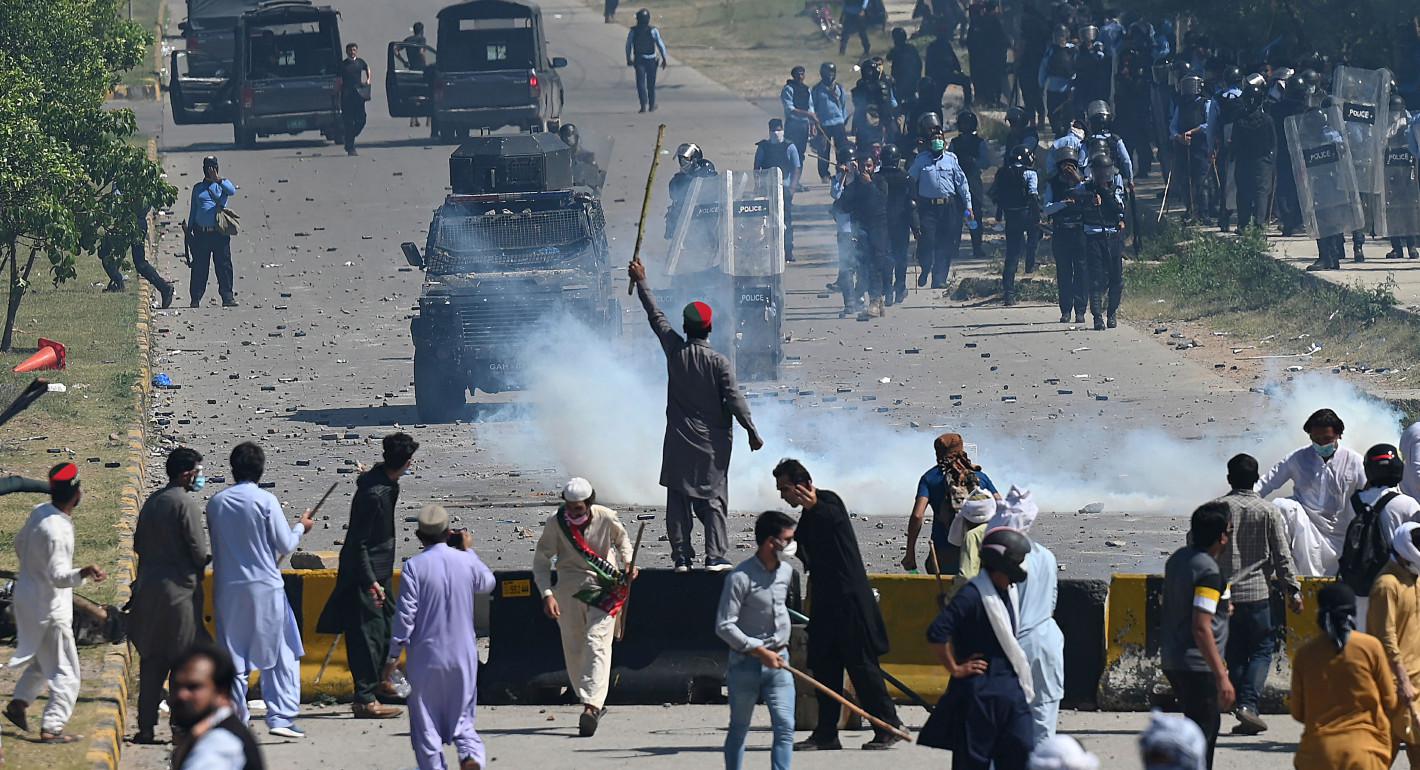
In the hours since the arrest on corruption charges, protests appear to have escalated in Lahore, Rawalpindi, and elsewhere, with a notable focus against army installations and facilities. The crowd’s focus on the Army comes after months of rising tensions between current Chief of Army Staff Asim Munir and General Qamar Bajwa, Munir’s predecessor, whom Khan blamed for his removal. The day before his arrest, Khan again argued that the Army was behind threats against his life and claimed that individual civilian and military leaders were behind ongoing plots against him.
Khan’s arrest is unfortunately business as usual for Pakistan’s democracy. Each of the past five prime ministers have been indicted or imprisoned after leaving office. Pakistan’s political scene has generally been characterized by one rule: where the Pakistan Army’s will exists, it carries, and typically persists no matter the consequences. Khan himself rose to leadership in 2018 with the countenance of the Army and was removed from office in 2022 after he lost that backing.
That Pakistan’s latest political turmoil comes at a time of significant economic challenges is also unsurprising. The economy was already in dire straits last year, before historically bad flooding destroyed a large amount of agricultural land. Today, inflation is reportedly at a fifty-year high, and food and energy shortages are becoming increasingly frequent. Investment inflows have collapsed, exports are down, and according to Moody’s, there is a rising risk that Pakistan could default on its debt service obligations as early as next month.
The current coalition government—led by Prime Minister Shehbaz Sharif of the PML-N, and including most of the other major political parties except for Khan’s PTI, under the banner of the Pakistan Democratic Movement (PDM)—continues to struggle to arrest the crisis. Negotiations with the International Monetary Fund that could draw a floor under the crisis have largely stalled until a new budget is approved by Parliament next month.
The PTI wants elections as soon as possible, while the government has pushed for elections no earlier than October—the latest permissible date based on a plain-text reading of the country’s constitution. Khan’s advocates claim that he remains the most popular and widely acceptable politician in the country. Some have floated the idea of delaying the election by a year to allow the coalition government time to deal with the economic crisis, though what a government that has struggled to deal with the economy over the last year would do differently if given another year is a mystery.
The numerous efforts undertaken by the Army and the PDM coalition government to stall an electoral test that could prove, or disprove, Khan’s popularity indicate that his adversaries also believe he would likely come out on top of an election.
The most straightforward way out of this crisis would be to agree to hold elections. Elections could create a relief valve for popular discontent, redirecting animus away from the Pakistani military establishment and back onto civilian politicians. Elections could produce a new government with the legitimacy to make necessary economic policy decisions and the runway to survive the potential political blowback against them for austerity decisions that could be painful in the near term. And elections could create the political space needed to negotiate a new compact among the politicians and the generals that could restore confidence in Pakistan’s institutions—confidence that is as desirable for Beijing and Riyadh as it is for Washington and London.
A confident Pakistan Army, secure in its authority and strategy, would believe it could achieve its desired results even with contested elections. That is not to say this current military-dominated structure would permit free and fair elections—the establishment has long record of engineering the electoral playing field to achieve its preferred result, either by manipulating the candidate pool, co-opting politicians (typically via coercion or corruption), directly interceding in the process, or through other means.
This is another decisive moment in Pakistan’s frustrating, illiberal democratic experiment. Mass protests reflect a lack of trust in the government and the Army. This trust gap did not occur overnight but accumulated over time, as the establishment reached into it toxic, antidemocratic toolbox and repeatedly undermined democratic processes and civilian institutions.
The most straightforward way to restore trust would be through timely, free, and fair elections, unfettered by the establishment’s intervention. And the simplest explanation for delaying and undermining Pakistan’s democracy is that those in charge fear the possible results.

Former Nonresident Scholar, South Asia Program
James Schwemlein was a nonresident scholar in the South Asia Program at the Carnegie Endowment for International Peace.
Recent Work
James Schwemlein

Saskia Brechenmacher, Rudra Chaudhuri, Ryan Crocker, …

The armed forces champion a form of capitalism that is generating revenue, but its reliance on rent faces diminishing returns, leaving the country with massive sunk costs and deferred returns, deepening dependency on external borrowing.

Yezid Sayigh

Just look at Iraq in 1991.

Marwan Muasher

Baku may allow radical nationalists to publicly discuss “reunification” with Azeri Iranians, but the president and key officials prefer not to comment publicly on the protests in Iran.

Bashir Kitachaev
In an interview, Ishac Diwan looks at the merits and flaws in the draft legislation distributing losses from the financial collapse.

Michael Young
Mustaqbal Misr has expanded its portfolio with remarkable speed, but a lack of transparency remains.
Yezid Sayigh