

Commentary
Konstantin Skorkin
{
  "authors": [
    "Konstantin Skorkin"
  ],
  "type": "commentary",
  "blog": "Carnegie Politika",
  "centerAffiliationAll": "",
  "centers": [
    "Carnegie Endowment for International Peace",
    "Carnegie Russia Eurasia Center"
  ],
  "collections": [],
  "englishNewsletterAll": "",
  "nonEnglishNewsletterAll": "",
  "primaryCenter": "Carnegie Russia Eurasia Center",
  "programAffiliation": "",
  "programs": [],
  "projects": [],
  "regions": [
    "Russia",
    "Eastern Europe",
    "Ukraine",
    "Caucasus"
  ],
  "topics": [
    "Foreign Policy",
    "Economy"
  ]
}
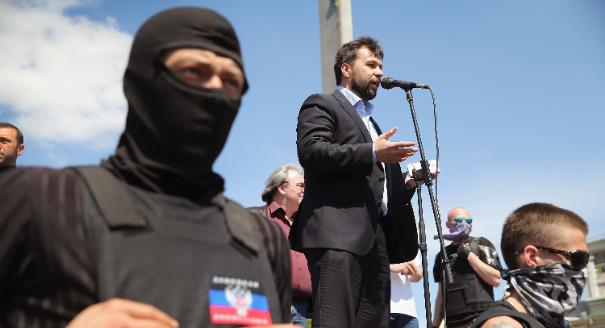
Source: Getty
Despite numerous blustering announcements that Ukraine’s separatist-held territories are set to become part of Russia, Moscow is in no hurry to hold Crimea-style referendums there, and with good reason.
The new intensity of fighting in the Donbas in recent weeks hasn’t prevented a radical reshuffle in the leadership of the self-proclaimed Donetsk and Luhansk people’s republics (DNR and LNR). Both breakaway territories have seen changes made to key government posts, with the DNR also getting a new prime minister. The defining trend in the new wave of appointments is the open presence of Russian nationals, who were previously kept in the shadows.
This trend is entirely in keeping with Russian President Vladimir Putin’s “special military operation” in Ukraine: the masks are off, there is no longer any need to pretend. The separatist republics of the Donbas don’t need to imitate nation building anymore, and the latest appointments appear to indicate that the Donbas may soon become yet another region of Russia. Yet the Kremlin is in no hurry to dismantle the DNR and LNR: apparently it is not completely confident it will win the war against Ukraine.
The war, which began with the official aim of protecting the Donbas from supposed impending Ukrainian aggression, has drastically changed the status of the “people’s republics.” The Minsk agreements aimed at ending the conflict were already hanging by a thread, and were obliterated by Moscow’s recognition of both territories as independent states on February 22, and by Russia’s full-blown invasion of Ukraine two days later.
Earlier, it was expected that the DNR and LNR would be integrated back into Ukraine to act as a Trojan horse, preventing Kyiv from getting any closer to the West, and seeding the virus of eternal civil strife within the country. Now there is no reason to reintegrate the Donbas (and some within the Russian elite, like former president Dmitry Medvedev, are still optimistic that soon there will be no Ukraine for it to be reintegrated into in any case).
Against this backdrop, openly legalizing the presence of Russian officials as ministers in the DNR and LNR comes as little surprise. After all, the first steps in this direction were taken before the war: in 2020–2021, the DNR’s deputy prime minister was Vladimir Pashkov, a former deputy governor of Russia’s Irkutsk region.
Two factors explain Moscow’s haste to shake up the separatist governments amid the ongoing hostilities. First, Moscow has a new point man on the Donbas. First Deputy Chief of Staff Sergei Kiriyenko’s grandiloquent recent visit to the region left no doubt that he has been given responsibility for the region instead of Deputy Chief of Staff Dmitry Kozak, who has become far less visible since the start of the war, and has most likely fallen out of favor in the Kremlin. The DNR’s new prime minister is Vitaly Khotsenko, a finalist in the Leaders of Russia management competition, a brainchild of Kiriyenko. Khotsenko’s appointment as head of the DNR government was followed by an influx of other Russian bureaucrats to leadership positions in both republics, and more such appointments are certain to follow.
The second factor is the final departure from office in the republics of fugitive Ukrainian oligarch Sergei Kurchenko’s protégés (he disappeared from the radar back at the start of the invasion, having been sanctioned by the EU). This process began last year, when the Russian businessman Yevgeny Yurchenko was appointed as the new boss of industry in the Donbas.
Such reshuffles may lead to more competent governance in Donbas—as far as possible under conditions of war. For all their faults, former Russian deputy governors and deputy ministers could be considered a vast improvement in terms of the managerial skills needed for civilian bureaucracy compared with the local field commanders who had clawed their way to power in the republics.
There is another reason to downgrade the local elites and replace them with people appointed directly by Russia. The Donbas may soon be awash with Russian state funding for its reconstruction, and Moscow doesn’t trust local figures with that funding. And if a considerable proportion of that money must be siphoned off, as happened in the reconstruction of Georgia’s breakaway region of South Ossetia, then it should at least land in the right pockets.
Amid this change in government, the fate of the Donbas’s most high-profile politician, DNR leader Denis Pushilin, is particularly interesting. An apparent master of political survival, he is just about the only one left from the original lineup of the leaders of the “Russian spring” to remain in power.
In Donetsk itself, where Pushilin has plenty of enemies, there are persistent rumors that he will be next to lose his post, but for now, a more realistic scenario is that he will stay on for as long as the DNR exists in its current format. After all, surrounded by Russian officials appointed to the positions of ministers and advisors, he will in any case be under close control.
Even if the Donbas does become fully integrated into Russia, Pushilin has a decent chance of holding onto power as the head of a Russian federal subject. There is a precedent for this: the unsinkable Crimean leader Sergei Aksyonov has been in his post since 2014, even though the status of the Crimean nomenklatura in the Russian hierarchy is considerably higher than that of the Donbas.
In any case, the Kremlin’s plans for the Donbas and its ruling elite are by no means set in stone, and the recent government reshuffles increase Russia’s options. On the one hand, the quasi-statehood of the DNR and LNR is becoming increasingly formalized, and they are being integrated more closely with Russian domestic structures. On the other hand, there is no rush to dismantle the self-proclaimed republics, and attempts are being made to give them some more formal legitimacy. Embassies representing the DNR and LNR have opened in Moscow, and the cases of foreign prisoners of war now being put on trial in the republics are clearly designed to force Western countries to engage in direct contact with them. Moscow has clearly yet to decide what exactly to do with the breakaway territories.
One scenario for the Kremlin would be the definitive annexation of the Donbas, along with all the territory it has seized in southern Ukraine, through another referendum. Then Moscow could try to force Kyiv to recognize that annexation as a condition of peace. For now, however, Russia’s precarious position in the Kherson and Zaporizhia regions prevents it from being able to implement that plan. The population and local elites in those areas are extremely hostile to the occupying government, and regular attacks are carried out on local collaborators. Ukraine has not given up hoping that increased arms supplies from the West will enable it to carry out a successful counterattack. This is why, despite making numerous blustering announcements that the occupied territories are set to become part of Russia, Moscow is in no hurry to hold Crimea-style referendums there, citing security concerns.
The Kremlin’s ambitious plans for Ukraine as a whole are also a factor: incorporating individual territories into Russia would mean giving up on the idea—at least temporarily—of taking control of the rest of the country.
If things don’t turn out well for the Russian troops in Ukraine, the Kremlin may well recall its idea of Novorossiya: a buffer confederation separating Russia from a now irreversibly hostile Ukraine. And then the model of the LNR and DNR may become a template for other territories that Russia has managed to occupy since the beginning of the war.

An independent journalist.
Recent Work
Konstantin Skorkin
Konstantin Skorkin
Carnegie does not take institutional positions on public policy issues; the views represented herein are those of the author(s) and do not necessarily reflect the views of Carnegie, its staff, or its trustees.

Russia spent years building a “sovereign internet,” concentrating web infrastructure exclusively within Russian territory. Ukrainian drone attacks have shown how vulnerable that approach has left the Russian internet.

Maria Kolomychenko

Putin’s conservative staffing policies and search for ever greater control have cemented parliament’s transformation into a bureaucratic appendage of the executive branch.

Andrey Pertsev

Russia’s AI-driven propaganda campaigns operate in a fragmented, chaotic, and often illogical manner. That’s not necessarily a problem for the Kremlin, though: It’s much easier to mimic genuine public debate that way.

Ilya Klishin

Without a ceasefire with Ukraine on attacking each other’s energy infrastructure—to which the Kremlin is unlikely to agree—the diesel agreement between Putin and Trump is largely for show, rather than representing a genuine increase in the volumes of Russian diesel on the global market.

Sergey Vakulenko

Russian strikes are weakening the economy sustaining Ukraine’s war effort. Closing the growing funding gap will require more European support and politically contentious reforms in Kyiv.

Balázs Jarábik