

Commentary
Nikita Smagin
{
  "authors": [
    "Nikita Smagin"
  ],
  "type": "commentary",
  "blog": "Carnegie Politika",
  "centerAffiliationAll": "dc",
  "centers": [
    "Carnegie Endowment for International Peace",
    "Carnegie Russia Eurasia Center"
  ],
  "collections": [],
  "englishNewsletterAll": "ctw",
  "nonEnglishNewsletterAll": "",
  "primaryCenter": "Carnegie Russia Eurasia Center",
  "programAffiliation": "russia",
  "programs": [
    "Russia and Eurasia"
  ],
  "projects": [],
  "regions": [
    "Middle East",
    "Iran",
    "Russia",
    "Caucasus"
  ],
  "topics": [
    "Foreign Policy",
    "Economy"
  ]
}
Source: Getty
The potential for cooperation in certain areas, like military technology, may look promising. But Iran cannot be counted upon to really help the Russian economy withstand the impact of sanctions.
Since the start of the war in Ukraine, relations between Russia and Iran have flourished. Having been hit by a new raft of tough Western sanctions over its invasion of Ukraine, Moscow set about looking for alternative partners among other traditionally anti-Western countries—including to bypass trade restrictions—and Iran looks set to be one of the most promising.
The aspect of their relationship that has attracted the most attention recently is Russia’s use of Iranian drones to terrorize Ukrainian cities. Both the Russian and Iranian governments have denied that the kamikaze drones the Russian army is using in Ukraine are Iranian, but all the evidence suggests that they are. Ukraine’s military intelligence services said at the end of October that Iran was also about to start supplying Russia with missiles. This is far from the extent of their joint projects, however.
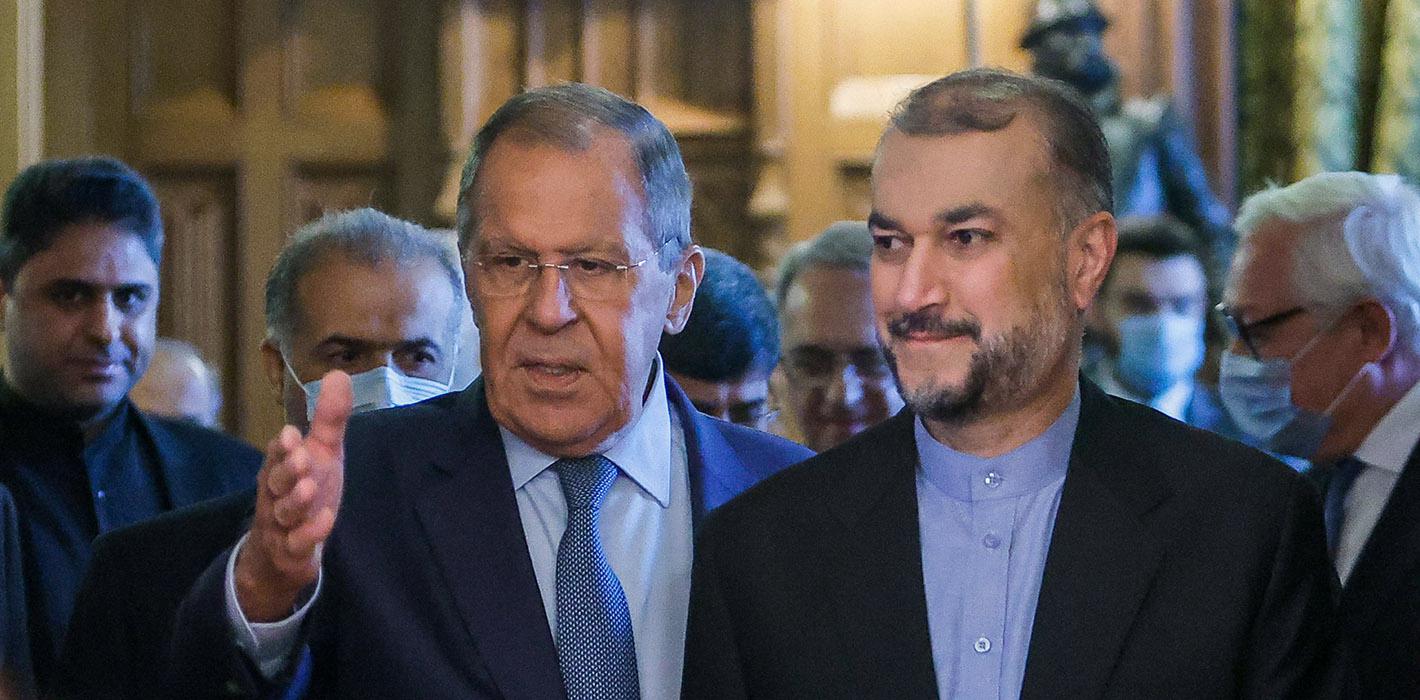
This year has seen a record number of meetings between senior Russian officials and their Iranian counterparts, including a visit to Tehran by Russian President Vladimir Putin. There was much discussion at these meetings of how to circumvent Western sanctions with Iran’s help. They were also aimed at showing Russian domestic audiences that Russia is not isolated on the international stage, despite Western efforts.
The meetings did yield concrete agreements, too. Gazprom, for example, has promised to invest $40 billion in Iran’s oil and gas sector, while Iranian spare parts for both motor vehicles and airplanes, as well as vehicles themselves, will be exported to Russia. There has also been a surge in the number of flights between the two countries, while their trade turnover, which stood at $4 billion in 2021, could reach $6 billion “in the near future,” according to Tehran.
This is not to say, however, that Iran will be able to compensate the Russian economy for the losses incurred as a result of Western sanctions. Even if those forecasts for the growth in trade turnover are accurate, that is still less than 1 percent of Russia’s total foreign trade. There is a huge gap between Iran and countries like Turkey, whose trade with Russia is worth about $30 billion a year.
Even the new agreements have raised more doubts than optimism. Iran’s civil aviation industry has been in crisis for many years (also due to Western sanctions), and certainly will not be salvaged by the sale of individual parts to Russia. The Iranian automobile industry has also seen better days. This year, the government decided to stop manufacturing a range of models due to their excessive fuel consumption, poor safety and ecological standards, and high cost compared with similar models made elsewhere. It will make up for the deficit by importing foreign cars.
There are areas in which Iran could fill a niche on the Russian market, such as pharmaceuticals, construction materials, and cosmetics. But the potential for development is hardly unlimited.
Implementing large-scale Russian state projects in Iran and making them cost-effective won’t be plain sailing either. Tehran has a deficit of hard currency and has been battling a budget deficit for years. This has created problems for Moscow in the past: Iran has still not paid off its debts to Russia for building the Bushehr nuclear plant. As of 2021, it still owed over $500 million.
The new initiatives, such as the construction of the Sirik power plant and the electrification of Iran’s railways, are due to be financed with the help of a Russian loan for $5 billion. If Moscow’s mission is to increase its political influence in Iran using these projects, then its approach can perhaps be justified. But it certainly won’t help to save the Russian economy at a time of sanctions.
Any project may be further complicated by the various and growing waves of protests Iran has been seeing for the last eighteen months. The outbursts of unrest are becoming increasingly massive, protracted, and uncompromising in their criticism of the country’s political regime.
The authorities’ harsh response—closing down public places and limiting internet access—is only making matters worse. If the government loses control of the situation in the country overall, or even in individual regions, Iran could be plunged into a severe, Venezuela-style crisis, leading to increased crime, taxation problems, and difficulties maintaining critical infrastructure. This level of instability is creating serious investment risks and getting in the way of implementing any agreements.
Another major obstacle to cooperation is that in Iran, Russia is still widely seen for historical reasons as a colonial power seeking to gain control over local resources. Polling shows that public opinion of Russia nosedived in Iran following the invasion of Ukraine. In February and March, there were even small-scale protests in Tehran against Moscow’s actions.
It will not be easy, therefore, for the Iranian authorities to present the rapprochement with Russia as an achievement to the public. Major deals with Moscow could themselves spark further protests: just last year, there were mass demonstrations in Tehran following the signing of a long-term strategic cooperation agreement with China.
Iran could teach Russia plenty about living under sanctions: this is really the area with the most potential for experience-sharing. Iran’s example shows, however, that while the negative impact of sanctions can be mitigated, it cannot be negated entirely. Iran’s GDP in absolute terms is today roughly what it was back in 2010–2011, when the main sanctions package against Tehran was introduced, while per capita it’s at the level it was back in 2004–2005. The Iranian experience is hardly an inspiring one.
With the rapprochement between Moscow and Tehran showing no sign of ending any time soon, the potential for cooperation in certain areas, like military technology, may look promising. But Iran cannot be counted upon to help the Russian economy withstand the impact of sanctions in any significant way.

Expert on Iranian foreign and domestic policies, Islamism, and Russia's policy in the Middle East
Recent Work
Nikita Smagin
Nikita Smagin
Carnegie does not take institutional positions on public policy issues; the views represented herein are those of the author(s) and do not necessarily reflect the views of Carnegie, its staff, or its trustees.

The truth of the strategic situation is that Europe and Russia are extremely unlikely to be able to “turn the page” on their confrontation within the next two decades.

Arkady Moshes
Russia spent years building a “sovereign internet,” concentrating web infrastructure exclusively within Russian territory. Ukrainian drone attacks have shown how vulnerable that approach has left the Russian internet.

Maria Kolomychenko

Putin’s conservative staffing policies and search for ever greater control have cemented parliament’s transformation into a bureaucratic appendage of the executive branch.

Andrey Pertsev

Russia’s AI-driven propaganda campaigns operate in a fragmented, chaotic, and often illogical manner. That’s not necessarily a problem for the Kremlin, though: It’s much easier to mimic genuine public debate that way.

Ilya Klishin

Without a ceasefire with Ukraine on attacking each other’s energy infrastructure—to which the Kremlin is unlikely to agree—the diesel agreement between Putin and Trump is largely for show, rather than representing a genuine increase in the volumes of Russian diesel on the global market.

Sergey Vakulenko