

Article
Understanding the climatic pain points is necessary for policymakers hoping to minimize the war’s negative environmental consequences.
Alejandro Martin Rodriguez, Joy Arkeh, Sarah Yerkes
{
  "authors": [
    "Zhao Kejin"
  ],
  "type": "legacyinthemedia",
  "centerAffiliationAll": "",
  "centers": [
    "Carnegie Endowment for International Peace",
    "Carnegie China"
  ],
  "collections": [
    "U.S.-China Relations",
    "China’s Foreign Relations"
  ],
  "englishNewsletterAll": "",
  "nonEnglishNewsletterAll": "",
  "primaryCenter": "Carnegie China",
  "programAffiliation": "",
  "programs": [],
  "projects": [],
  "regions": [
    "North America",
    "United States",
    "East Asia",
    "China"
  ],
  "topics": [
    "Foreign Policy"
  ]
}
Source: Getty
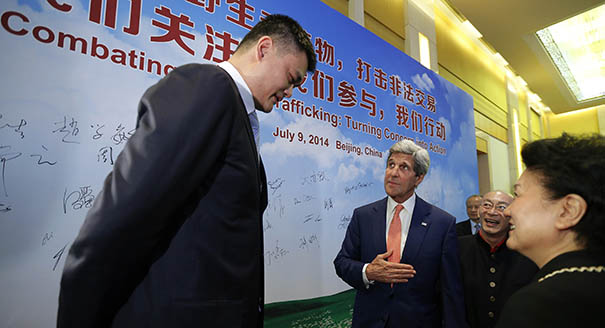
More cultural exchanges between U.S. and Chinese academics and young people can help enhance constructive relations between the two countries.
Source: China Daily
For many U.S. citizens, China is still a mysterious oriental country that sells a lot of cheap products to their country. In general, they hold little grudge against the country except for its low-quality exports flooding their supermarkets. At bottom, it is just the few China watchers, journalists, and politicians who see China as a grave threat to the United States.
Quite interestingly, Chinese people, especially the younger generations, knows a lot about what is going on in the United States, not the other way around. It thus requires them to make more efficient self-introductions to their U.S. peers. Grassroots or unofficial exchanges can be a feasible solution.
Before Xi concluded his maiden state visit to the United States, both sides agreed to support the holding of the China-U.S. Young Maker Competition annually, as well as collaboration between think-tanks in Chinese and U.S. universities, marking a promising start.Teenagers, in particular, should pursue a knowledge-driven approach in a bid to acquire a comprehensive understanding of the other country. On the other hand, think tank scholars also need to keep an open mind to their foreign counterparts and engage in more in-depth, constructive discussions, regardless of their nationalities and which government they represent.
Likewise, “state-province collaboration” between Chinese provinces and U.S. states, is expected to become another new breakthrough in the bilateral relationship, because it involves little ideological differences and focuses on economic cooperation and common interests.
A version of this article was originally published in the China Daily.

Zhao Kejin
Former Resident Scholar, Carnegie-Tsinghua Center for Global Policy
Zhao Kejin was a resident scholar at the Carnegie-Tsinghua Center until June 2020.
Carnegie does not take institutional positions on public policy issues; the views represented herein are those of the author(s) and do not necessarily reflect the views of Carnegie, its staff, or its trustees.

Understanding the climatic pain points is necessary for policymakers hoping to minimize the war’s negative environmental consequences.



Alejandro Martin Rodriguez, Joy Arkeh, Sarah Yerkes

Huawei pushed hard to enter the Egyptian data centers market, until the Americans made a better offer.

Angie Omar

Radical-right parties are expected to do well in upcoming elections in four of the EU's biggest member states. If successful, they could prevent the union from addressing key challenges ahead.

Stefan Lehne

The books, podcasts, and films that explain the world it made.

Andrew Leber
U.S. trading partners in Asia are closely watching the dispute for signs of how it may affect their own interests.

Barbara Weisel