

Commentary
Even if the Iran war stops, restarting production and transport for fertilizers and their components could take weeks—at a crucial moment for planting.
Noah Gordon, Lucy Corthell
{
  "authors": [
    "Vassily Kashin"
  ],
  "type": "commentary",
  "centerAffiliationAll": "",
  "centers": [
    "Carnegie Endowment for International Peace",
    "Carnegie Russia Eurasia Center"
  ],
  "collections": [],
  "englishNewsletterAll": "",
  "nonEnglishNewsletterAll": "",
  "primaryCenter": "Carnegie Russia Eurasia Center",
  "programAffiliation": "",
  "programs": [],
  "projects": [],
  "regions": [],
  "topics": [
    "Economy"
  ]
}
Source: Getty
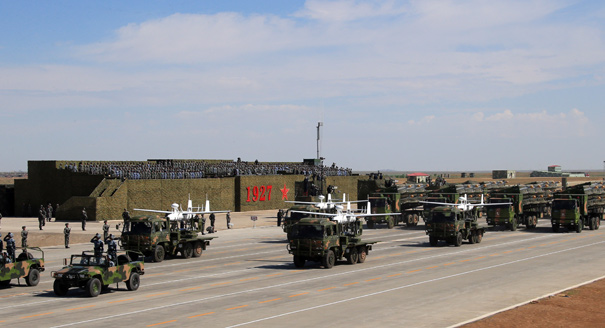
The impact of cyberweapons on strategic stability is a growing problem that extends well beyond the security of the control and communication systems of nuclear forces.
Current changes in the military sphere—in particular, the integration of artificial intelligence into weapons systems and military technology, as well as the prospects for the emergence of autonomous weapons systems—have made cyberspace a far more important arena of military operations. The strategic relationship between the United States and China, the leading rival powers of the twenty-first century, is a good illustration of this.
The major military powers, above all the United States and China, increasingly see cyberweapons as a factor that could potentially have a decisive impact on military operations.
The United States may already view cyberweapons as a key element in any “non-nuclear strategic attack” that could trigger an American nuclear response. This principle is enshrined in the 2018 Nuclear Posture Review.
Operations in cyberspace also play an important role in the concept of the U.S. AirSea Battle doctrine formalized in 2010 and later renamed the Joint Concept for Access and Maneuver in the Global Commons.
The Chinese, for their part, have largely followed the American concepts in this field (for example, fifth dimension operations, a key aspect of which is cyberwarfare), while processing and adapting them to their own needs.
Back in the late 1990s, China formulated the concept of Integrated Network Electronic Warfare, which envisaged the integrated use of cyberattacks, radio-electronic warfare, and fire strikes to destroy the enemy’s information infrastructure, thereby gaining a decisive advantage.
Chinese specialists view the widespread use of information technology in the U.S. armed forces as both its key strength and its weak spot. The key role that the Chinese political and military leadership assigns to information technology and an information confrontation in a future war is evidenced by the fact that the military strategy directives issued by China’s Central Military Council in 2004 defined the most likely scenario of a future war as “a local war with the use of information technology,” redefined in 2015 as a “computerized local war.”
The role of the information space and cyberweapons in the Chinese military buildup was further enhanced by the creation of the People’s Liberation Army Strategic Support Force in December 2015. These troops, which are specifically focused on conducting military operations in cyberspace, as well as other forms of information warfare, are effectively granted the status of a separate service of the armed forces.
The U.S. command perceives the People’s Liberation Army’s ability to conduct military operations in cyberspace as an important element of Anti-Access/Area Denial strategy aimed at limiting an enemy’s access to certain areas. The United States believes that the increased capabilities of the Chinese armed forces in this field could become a crucial element of a devastating strategic non-nuclear strike by China against U.S. forces and U.S. allies in the Western Pacific, which in turn could prompt the United States to use nuclear weapons.
The United States views China as its main opponent in cyberspace, though not its only one: Russia is considered another serious adversary. However, unlike Russia, China has a proven track record of carrying out extremely large-scale and successful intelligence operations in cyberspace. It was involved in stealing significant amounts of information about fifth-generation jet fighters in 2009–2011 (China’s J31 jet fighter was developed with the help of data obtained through cyberespionage), in stealing the personal data of about 21 million U.S. federal employees in 2015, and in the alleged hacking of the covert system the CIA used to communicate with its agents in China in 2010.
China’s strength lies in major state investments in artificial intelligence development programs, as well as huge data sets that can be used to develop machine-learning technology.
The threat that one of the sides in the ongoing arms race in the Western Pacific will gain a significant competitive advantage in creating cyberweapons may induce the opponent left trailing behind to resort to the threat of nuclear escalation as the last possible deterrent.
The three leading nuclear powers—the United States, Russia, and China—are paying considerable attention to developing unmanned and autonomous weapons systems. Such autonomous platforms offer opportunities for creating fundamentally new means of delivering nuclear weapons, for example, Russia’s Poseidon system, an unmanned underwater vehicle. Its main goal is to deliver a nuclear payload to the enemy’s coastline to destroy crucial elements of coastal economic infrastructure and inflict unacceptable harm on a country’s territory through vast radioactive contamination zones, tsunamis, and other devastating effects of a nuclear explosion.
The development of multipurpose unmanned underwater vehicles, including military ones, is a priority area of military innovation for the leading powers. Such systems are going to play a growing role in naval combat, particularly in counteracting a potential enemy’s nuclear missile submarines.
In turn, these autonomous weapons systems may become prime targets for the opponent’s cyberweapons. Due to their scale, they will be more vulnerable than the strategic nuclear forces’ communication and control systems, and potentially as valuable.
The threat of deploying cyberweapons will increase with the introduction of artificial intelligence into strategic nuclear forces’ control systems, as the consequence of having less time to make a decision to launch a strike, due to the greater vulnerability of strategic nuclear forces and the emergence of new offensive systems such as hypersonic weapons.
Given the extreme vulnerability of all essential control systems—of the government, the armed forces, and nuclear forces—to cyberweapons, their initial successful use may cause panic on the receiving end, provoking the attacked party to launch a counterstrike amid fears of the possible paralysis of its control system.
The development of cyberweapons also raises the question of the evolving role of human intelligence as a factor in strategic stability. In these circumstances, intelligence service agents become a kind of cyberweapon delivery system themselves, providing malware access to information systems that are isolated from the global network and that control sensitive processes. The infamous Stuxnet malicious computer worm attack on Iran’s Natanz uranium enrichment plant in 2009 and 2010 illustrates the important role played by intelligence agents: the virus was reportedly planted in the computer system by an agent inside the facility.
Accordingly, if one of the sides acquires agents in structures that have access to sensitive information systems, this could seriously impact the strategic stability between the nuclear powers. Reorienting intelligence toward gaining access to critically important information systems is likely to become more widespread, triggering regular bouts of excessive suspicion among all major players.
The development of cyberweapons is inextricably linked to the growing role of intelligence in cyberspace as a factor affecting strategic stability. This role will continue to grow with the creation of new technical intelligence data processing systems that use machine learning. These systems could potentially jeopardize existing means of carrying out a retaliatory strike, such as mobile ground rocket launchers and, potentially, nuclear missile submarines. As a result, another priority taking shape is countering the development of enemy intelligence capabilities that require the processing of large amounts of data needed by machine-learning systems.

Vassily Kashin
a senior fellow at the Institute of Far Eastern Studies of the Russian Academy of Sciences and an expert on China's military-industrial complex
Carnegie does not take institutional positions on public policy issues; the views represented herein are those of the author(s) and do not necessarily reflect the views of Carnegie, its staff, or its trustees.

Even if the Iran war stops, restarting production and transport for fertilizers and their components could take weeks—at a crucial moment for planting.

Noah Gordon, Lucy Corthell
Tehran’s attacks are reshaping the security situation in the Middle East—and forcing the region’s clock to tick backward once again.

Amr Hamzawy

Only collective security can protect fragile economic models.

Andrew Leber

In a volatile Middle East, the Omani port of Duqm offers stability, neutrality, and opportunity. Could this hidden port become the ultimate safe harbor for global trade?
Giorgio Cafiero, Samuel Ramani

Arguing that Chinese policy is hung on alliances—with imputations of obligation—misses the point.

Evan A. Feigenbaum