

Commentary
Depleted financial reserves and a shrinking tax base mean it is no longer possible to simultaneously deliver high defense spending, price stability, and economic growth.
Alexandra Prokopenko
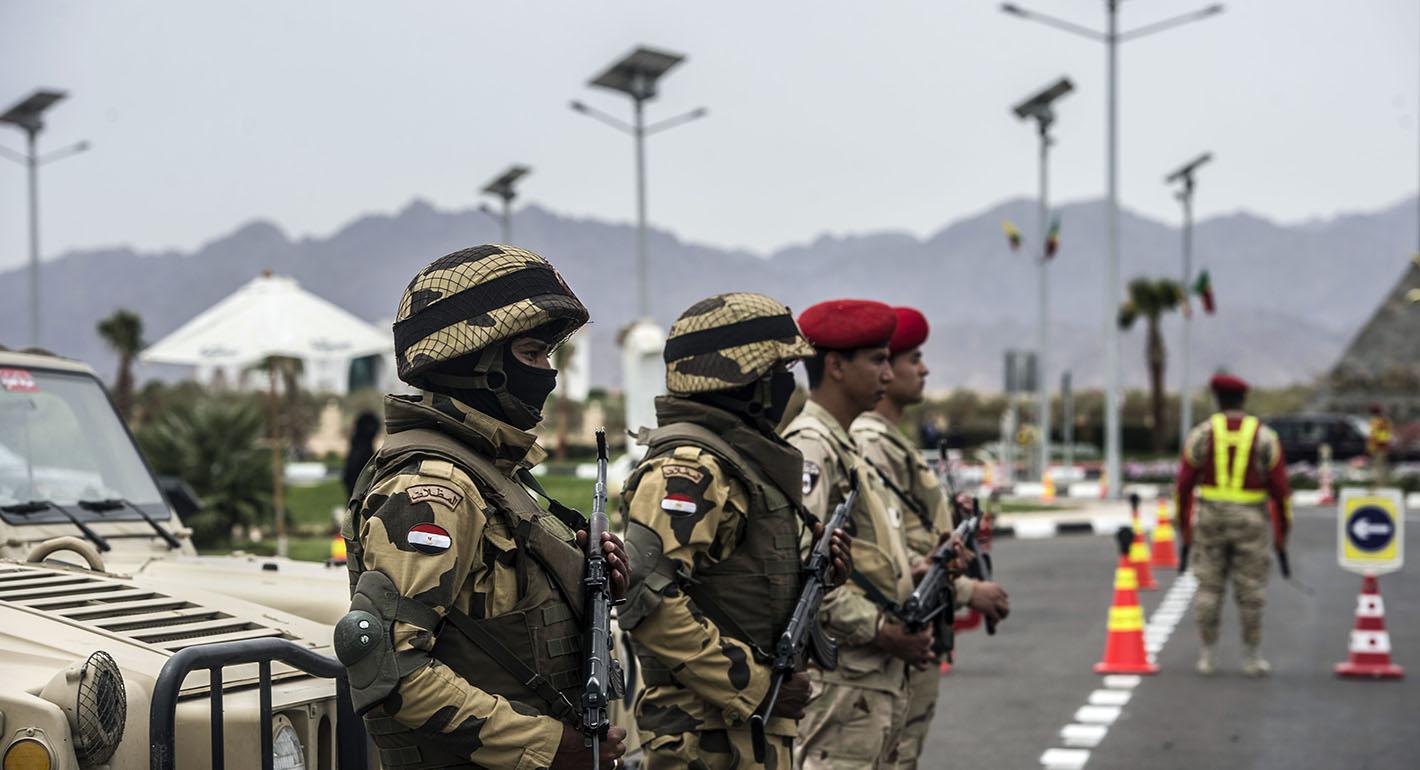
Source: Getty
The Egyptian military’s involvement in the economy has come at a high cost, contributing to underperformance in development.
The historical pattern of Egypt’s development model puts the military at the center as economic savior. Egyptian President Abdel Fattah el-Sisi did not invent the military’s fixation on controlling the economy for political ends, but after decades of military involvement in the economy, Egypt continues to slide lower on all major socioeconomic indicators compared to its peer group. As a result of this military involvement in the economy, Egypt misallocates public investments in large infrastructure projects, unproductive sectors, and an inefficient defense industry, at a great cost to the welfare of ordinary Egyptians.
The role of the military in Egypt’s economy is becoming larger and more opaque, with seemingly negative implications, particularly when considering the declining position of Egypt in the global economy from the 1950s to today. With a rapidly growing, predominantly young population of over 100 million, the political implications of such a decline are potentially severe. A lack of jobs, coupled with the military establishment’s desire to control the political and economic space, is a recipe for political stalemate or, worse, revolt.
The most obvious manifestation of this economic underperformance is the fascination with large infrastructure projects. In “Owners of the Republic,” Yezid Sayigh describes the military’s fascination with projecting its influence and might, appeasing a small political constituency, and cultivating a sense of entitlement. His comprehensive account details how and why Egyptian military leaders have gradually intervened in the formal economy. At long last dispensing with the often inflated, inaccurate figures of the military’s control over the economy, Sayigh provides a clear picture of what the military controls, owns, and manages.
While Egypt certainly needs to update its dilapidated public infrastructure, its economic policies increasingly look like vanity projects, ends in themselves and not means to economic or social development. The military invests in impressive roads and bridges, construction projects that cater to a small group of wealthy Egyptians but leave many of the poorest segments of society without basic utilities and services. The Arab Spring protests upended Egypt in part because of the extreme polarization of wealth between haves and have-nots.
While economists measure Egyptian GDP growth at approximately 5 percent per year, the reality is that Egypt’s trickle-down rate to the poorest segment of society is near negligible and arguably negative. This is because GDP growth captures exports and investments but not employment rates, distribution of wealth, or people’s overall well being. The military’s fascination with the built environment compounds this, as it does not emphasize productivity, employment, or profit.
Marveling at the output of the military’s achievements, without considering the socioeconomic impact or lack thereof, is a blind spot for the military establishment, as demonstrated by the building of the new administrative capital. The new capital is billed as a smart city with modern technological innovations, but it is unlikely to rid the country of endemic corruption or modernize the bloated public sector. Rather it is more likely built to keep the president insulated from potential protests.
Egypt’s socioeconomic underperformance has also resulted from the military’s focus on investment into unproductive sectors. The military’s investment in public housing could be positive, as there is an enormous shortage of affordable public housing in Egypt. But beyond affordable housing, much of the military’s investment fails to benefit the masses or the average Egyptian, while socioeconomic indicators are worsening or stagnating.
The World Bank notes that declining per capita income since 2016 and rising poverty, inflation, and population will only compound Egypt’s socioeconomic challenges. Moreover, Egypt’s public debt is rising and, as recent rounds of IMF and World Bank debt rescheduling terms demonstrate, the public often pays the price through increased prices on basic goods and services and regressive taxation policies. In other words, average Egyptians pay for the debt being accrued, adding to their declining socioeconomic standards.
Another area of potential investment and yet continued neglect is the railway system. Railways evoke less political symbolism and are used by the predominantly poor sectors of Egyptian society, so they do not figure prominently in economic planning. Instead, the military’s focus is on flashier and more expensive monorail projects that will likely not cater to the poor or extend into southern Egypt’s neglected communities.
Investment in an inefficient defense industry is a final source of socioeconomic underperformance for Egypt. The production of defence products is a cornerstone of the military’s economic development plans. Although the defense industry's accounts are opaque, enough is known about its operation to conclude that its conversion for civilian purposes has proven ineffective. The welfare of ordinary Egyptians would be better served by improvements in services like healthcare and education, not in sinking more public resources into an inefficient defense industry.
As the most populous Arab state, Egypt’s success or failure in economic development has regional, if not global, implications. While Egypt may have been a role model for developing countries in previous decades, it is now more likely to be seen in a less flattering light, as too big to fail. While in past years, Arab Gulf states have shored up Egypt with billions in loans and grants, the severe decline in oil prices means they will be less willing and able to prop up the Egyptian government. Moreover, worker remittances to Egypt are likely to decline as oil prices decline and the regional economic outlook cools. MENA countries would rather not face the challenge of hundreds of thousands of Egyptians with even less incentive to return home because of a declining Egyptian economy.
The military is unlikely to succeed as the economic savior of Egypt. The military faces weighty expectations in responding to the increasing needs of the people, but it does not have the nimbleness, creativity, and capacity to do so. The coronavirus pandemic has further exposed the need for public trust, leadership, and investment in social welfare and well being, but the Sisi administration has insisted on maintaining the pace of construction of vanity projects such as the new administrative capital. Egypt’s failure would be colossal for the entire MENA region and is worthy of policy attention, but the international community’s willingness to accept Sisi as a stabilizing force and ignore the looming socioeconomic—and potentially political—crisis facing Egypt is present yet shortsighted.
Bessma Momani is professor of political science at the University of Waterloo, Canada.

Bessma Momani
Bessma Momani is a full professor in the Department of Political Science and the assistant vice president of research and international at the University of Waterloo in Canada.
Carnegie does not take institutional positions on public policy issues; the views represented herein are those of the author(s) and do not necessarily reflect the views of Carnegie, its staff, or its trustees.

Depleted financial reserves and a shrinking tax base mean it is no longer possible to simultaneously deliver high defense spending, price stability, and economic growth.

Alexandra Prokopenko

Understanding the climatic pain points is necessary for policymakers hoping to minimize the war’s negative environmental consequences.



Alejandro Martin Rodriguez, Joy Arkeh, Sarah Yerkes

Huawei pushed hard to enter the Egyptian data centers market, until the Americans made a better offer.

Angie Omar

The books, podcasts, and films that explain the world it made.

Andrew Leber

U.S. trading partners in Asia are closely watching the dispute for signs of how it may affect their own interests.

Barbara Weisel