

Commentary
Japan’s long-term security policy is driven by concerns about China, and there is little appetite for (or interest in) pursuing a confrontation with Moscow.
James D.J. Brown
{
  "authors": [
    "Asel Doolotkeldieva"
  ],
  "type": "commentary",
  "blog": "Carnegie Politika",
  "centerAffiliationAll": "dc",
  "centers": [
    "Carnegie Endowment for International Peace",
    "Carnegie Russia Eurasia Center"
  ],
  "collections": [
    "Aso Tavitian Initiative"
  ],
  "englishNewsletterAll": "ctw",
  "nonEnglishNewsletterAll": "",
  "primaryCenter": "Carnegie Russia Eurasia Center",
  "programAffiliation": "russia",
  "programs": [
    "Russia and Eurasia"
  ],
  "projects": [],
  "regions": [
    "Central Asia",
    "Kazakhstan",
    "Kyrgyz Republic",
    "Russia"
  ],
  "topics": [
    "Economy"
  ]
}
Source: Getty
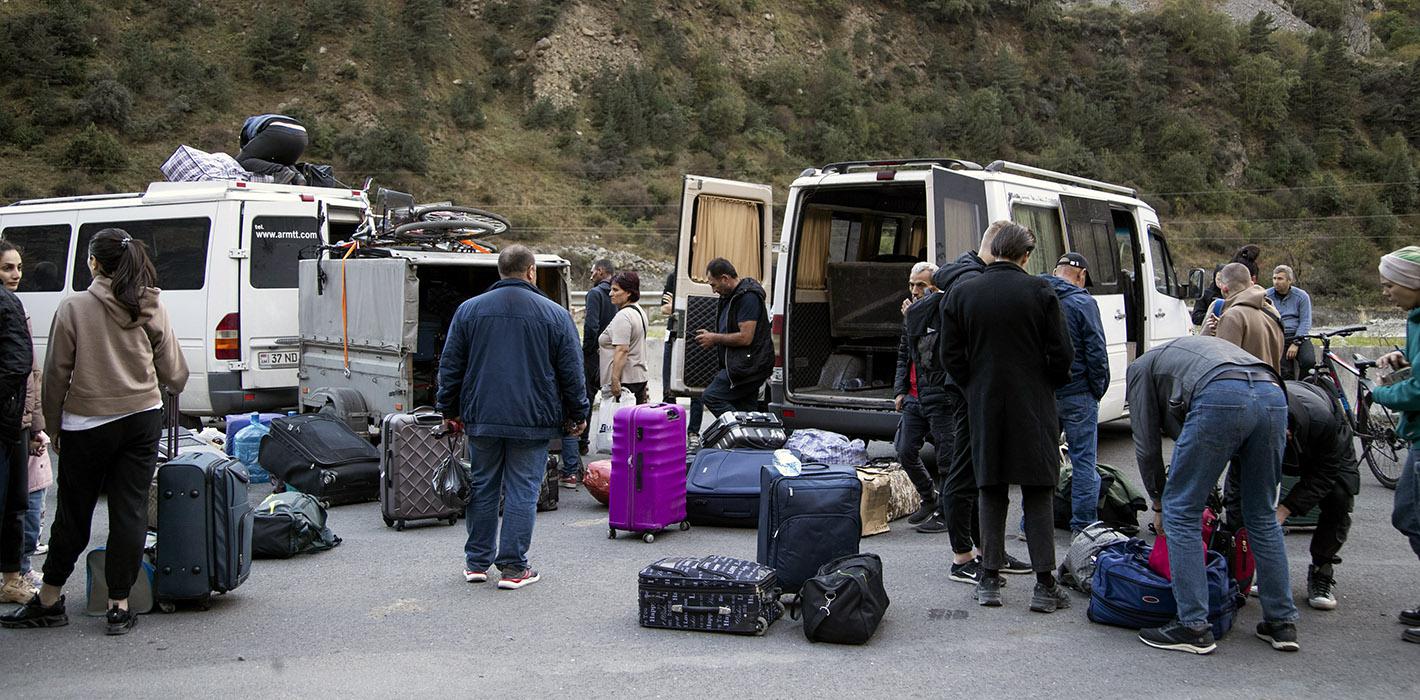
Concerns and public resentment over the influx of Russians cannot be seen any other way than through the prism of the long colonial history between the Central Asian states and the Russian (and later Soviet) empire.
As Russia’s European neighbors restrict entry for Russians in response to the war in Ukraine, the right to free movement across the Eurasian Economic Union’s borders is truly beginning to be appreciated for the first time, with tens of thousands of Russian men fleeing the mobilization order heading to former Soviet states, including the countries of Central Asia.
Previously, the open borders had always been considered a one-way street benefitting so-called “low skilled” workers from Central Asia heading to Russia for better wages and careers, while Russians typically tended to look more toward Europe. Now, in a bid to avoid being sent to fight in Ukraine, Russians are looking east and south, however temporarily.
The Kazakh Interior Ministry reported that about 200,000 Russians entered the country in the two weeks following September 21, when the mobilization was announced, with many subsequently going elsewhere: 147,000 left the country during the same period.
This massive movement has already created chaos on the borders and flooded Kazakh cities with Russian men, disrupting daily life there for residents. These countries had already seen an earlier wave of relokanty (those who relocate) in the days following the outbreak of war, when Kyrgyzstan alone was estimated to have been inundated by thousands of Russian nationals.
This time, the costs of accommodation and other services in some capitals have doubled and tripled. In unregulated markets, landlords are evicting local families so that they can charge more to affluent Russian tenants. Students and vulnerable groups have become the primary victims. The Kazakh authorities have warned against replacing local workers with new Russian arrivals, although anecdotal evidence suggests that is already happening. Since March, the influx of arrivals from Russia has sparked a deficit of dollars, causing major problems on local financial markets.
The current mass movement has polarized local societies. Various groups of ordinary people have sprung up to help the draft dodgers with medical assistance, food, shelter, and information. Others are less enthusiastic, accusing their more welcoming compatriots of having a colonial mentality for being willing to help the Russians, since in Russia racial slurs are frequently used to describe Central Asians, and the phrase “for Slavs only” is commonplace on Russian real estate websites. There are also references to the widespread racism and discrimination faced by Central Asians when working in Russia, as well as concerns about Russians taking jobs from local people, and about the economic impact of the new wave of arrivals.
The official positions of Central Asian governments are more restrained, but tension and unease can still be detected. Kazakh President Kassym-Jomart Tokayev has said that Kazakhstan “should look after and protect” Russians arriving there. Kyrgyz President Sadyr Japarov has stated outright that draft dodgers should not fear extradition.
On the other hand, being dependent on Russia for trade and military security, among other things, regional leaders are being careful not to burn bridges with their strategic partners in Moscow. At the beginning of the war in Ukraine, Central Asian governments adopted a neutral position, balancing between the threat of international sanctions for backing Russia, and the Kremlin’s possible retaliation for condemning it.
The region has enough internal problems to deal with, beginning with interstate conflicts (like the recent clashes between Tajikistan and Kyrgyzstan), the lack of cooperation among the states, and risky domestic transitions of power, in which Russia could choose to play a disruptive role. Their current silence on Russia announcing the annexation of Ukrainian territory speaks volumes about these internal dilemmas. Only Kazakhstan has taken a bold position, refusing to recognize the sham referenda organized in occupied Ukrainian territory.
Despite the neutrality at the official level, a significant number of people in the Central Asian nations support Ukraine. Focus groups carried out by this author in all provinces of Kyrgyzstan in spring 2022 showed that people supported the government’s neutral position mainly out of concern for labor migrants working in Russia, and for fear of upsetting the regional security status quo. The mass influx of Russian draft dodgers cannot help but fuel fears over security and sovereignty.
In recent weeks, concerns that Russia could use labor migrants as leverage over Central Asian governments have only grown amid reports that Central Asian labor communities in Russia are being targeted for mobilization. Recruitment leaflets have allegedly been distributed at Moscow’s Sakharovo migration center in the Uzbek and Kyrgyz languages, offering attractive salaries and “fast track” citizenship in exchange for signing up. Although the Kyrgyz Embassy in Russia has refuted information that migrants are being mobilized, migrants themselves have reported being singled out and pressured by Russian police and border services.
The prospect of Central Asians being mobilized has stirred painful collective memories of the 1916 Uprising (Urkun), when czarist troops killed 270,000 Kyrgyz, Kazakhs, and other Central Asians who refused conscription during World War I.
Indeed, the concerns and public resentment over the influx of Russians cannot be seen any other way than through the prism of the long colonial history between the Central Asian states and the Russian (and later Soviet) empire. These colonial relations are perpetuated by contemporary Russian imperialism, which neither the Russian establishment nor opposition elites hesitate to practice toward what they see as the empire’s “southern borderlands.”
Kazakhstan, which shares the second longest land border in the world with Russia, has been a target, following Ukraine and Georgia, of Russian populist imperialist claims. Putin himself has publicly said that the Kazakhs never had statehood before the collapse of the Soviet Union, something recently repeated by former president Dmitry Medvedev, while members of the State Duma have claimed that parts of Kazakh territory were Russian “gifts.” Russian pro-governmental media target local intellectuals and historians and call them nationalists and Russophobes. The current worries of Kazakh nationals and government officials about the newly arrived Russians becoming a “fifth column” should be seen against this backdrop.
While Western partners observe the region from afar, China is the least interested in seeing Russia retaliate against the Central Asian states, having invested billions of dollars in regional infrastructure projects. In September 2022, on the way to Samarkand to attend a summit of the China-led Shanghai Cooperation Organization, the Chinese leader Xi Jinping visited Astana, where he said that China supported Kazakhstan’s sovereignty and territorial integrity.
It remains to be seen, therefore, whether this impromptu parachuting of Russians into Central Asia will create an opportunity for the reconsidering of mutual relations—if not at an official level, then at least at a societal level.
Asel Doolotkeldieva
Dr. Asel Doolotkeldieva is a senior lecturer at the OSCE Academy in Bishkek, Kyrgyzstan.
Carnegie does not take institutional positions on public policy issues; the views represented herein are those of the author(s) and do not necessarily reflect the views of Carnegie, its staff, or its trustees.

Japan’s long-term security policy is driven by concerns about China, and there is little appetite for (or interest in) pursuing a confrontation with Moscow.

James D.J. Brown
The truth of the strategic situation is that Europe and Russia are extremely unlikely to be able to “turn the page” on their confrontation within the next two decades.
Arkady Moshes

Russia spent years building a “sovereign internet,” concentrating web infrastructure exclusively within Russian territory. Ukrainian drone attacks have shown how vulnerable that approach has left the Russian internet.

Maria Kolomychenko

Putin’s conservative staffing policies and search for ever greater control have cemented parliament’s transformation into a bureaucratic appendage of the executive branch.

Andrey Pertsev

Russia’s AI-driven propaganda campaigns operate in a fragmented, chaotic, and often illogical manner. That’s not necessarily a problem for the Kremlin, though: It’s much easier to mimic genuine public debate that way.

Ilya Klishin