

Commentary
Alexander Gabuev
{
  "authors": [
    "Alexander Gabuev"
  ],
  "type": "commentary",
  "blog": "Carnegie Politika",
  "centerAffiliationAll": "",
  "centers": [
    "Carnegie Endowment for International Peace",
    "Carnegie Russia Eurasia Center"
  ],
  "collections": [],
  "englishNewsletterAll": "",
  "nonEnglishNewsletterAll": "",
  "primaryCenter": "Carnegie Russia Eurasia Center",
  "programAffiliation": "",
  "programs": [],
  "projects": [],
  "regions": [
    "China",
    "Ukraine",
    "Caucasus",
    "Russia",
    "Eastern Europe"
  ],
  "topics": [
    "Economy",
    "Foreign Policy",
    "Military",
    "Global Governance"
  ]
}
Source: Getty
China’s vague plan is aimed not at actually ending the war, but at impressing the developing world and rebutting accusations that Beijing has become a silent accomplice to Moscow.
A year into the war in Ukraine, China has finally elaborated its stance on the conflict, releasing a twelve-point document proposing a framework for a political settlement. The document is a laundry list of familiar Chinese talking points about the war. It repeats Beijing’s support for the UN Charter and the territorial integrity of states, but at the same time condemns unilateral sanctions, and criticizes the expansion of U.S.-led military alliances.
Those who expected a roadmap to peace in Ukraine will surely be disappointed. Yet the authors of the Chinese position paper have no such ambition, and certainly do not intend for Beijing to become deeply embroiled in the conflict. The document is sooner a rebuttal to Western allegations that China has been a silent accomplice to Russia, and an attempt to bolster its image as a responsible world power in the eyes of developing countries.
Expectations around the paper were raised by Wang Yi, until recently China’s foreign minister and now the Politburo’s point man on foreign policy, who had announced the proposal at the Munich Security Conference. But the released document predictably lacked specifics about burning issues such as resolving the territorial dispute between Kyiv and Moscow or security guarantees for Ukraine. Moreover, the language of the document does not bind anyone to anything, Beijing included. This is a feature, not a bug, of the Chinese position on the war in Ukraine.
The Russian invasion of Ukraine took China by surprise. As in 2014, when the conflict in Ukraine began (and in 2008 during Russia’s war against Georgia), China staked out a position so careful as to be ambiguous. On the one hand, Beijing immediately came out in support of Ukraine’s sovereignty and territorial integrity and the war’s swift resolution. On the other, Chinese diplomats echoed the joint declaration signed by Russian President Vladimir Putin and his Chinese counterpart Xi Jinping on February 4, 2022, in which the Ukraine crisis was blamed on NATO expansion and the West’s disregard for Russia’s demands on European security. At the same time, as before, China condemned Western sanctions against Russia while strictly observing them.
This vagueness reflects China’s varied and complex interests. Beijing considers itself a champion of the principle of territorial integrity and its primacy over the right to self-determination, being sensitive to not only the issue of Taiwan, but also that of separatist movements within its own borders.
Still, its strategic relations with Russia are also of great significance given the two countries’ long and now undisputed border, their complementary economies, and Russia’s role as a source of commodities and some advanced weapons (like Su-35 fighter jets and S-400 surface-to-air missiles) for China. For Beijing, a scenario in which Russia’s comprehensive defeat in Ukraine precipitates Putin’s ouster and the installation of a pro-Western government in Russia is a strategic nightmare that China is prepared to help the Kremlin avoid.
At the same time, relations with the West are crucial for China’s economic prosperity and technological advancement. Beijing is under no illusion that they will improve in the foreseeable future amid intensifying competition with the United States. But nor is it keen to accelerate its inevitable break with the United States and its allies and thereby lose access to Western technology, markets, and finance. All of this means China cannot unconditionally support Russia in its war with Ukraine.
This posture has enabled China to become one of the war’s principal beneficiaries, even if unintentionally. The conflict has diverted some U.S. resources away from the Indo-Pacific and consumed much of the bandwidth of the Biden administration that would otherwise have been focused on containing China.
It is also to China’s advantage that Russia has been weakened, isolated, and conclusively reduced to the status of Beijing’s junior partner: a trend that existed before 2014, but was massively accelerated by Putin’s invasion of Ukraine. For now, Russia is selling China natural resources at a discounted rate and encouraging Chinese companies to fill the vacuum created by Western firms’ exit from Russia. Yet in the future, Beijing hopes, Russia might gradually agree to Chinese terms in any and all areas of cooperation.
Still, remaining on the fence—even one as wide as the Great Wall—is becoming increasingly difficult for Beijing. China has come under intensifying criticism in relation to the war, including from Europe, whose growing alignment with the U.S.-led transatlantic coalition is extremely worrying for Beijing. It has thus set out in search of a convincing rebuttal to the West’s criticism, as well as of a narrative with which to explain its position to the developing countries it has worked so hard to court.
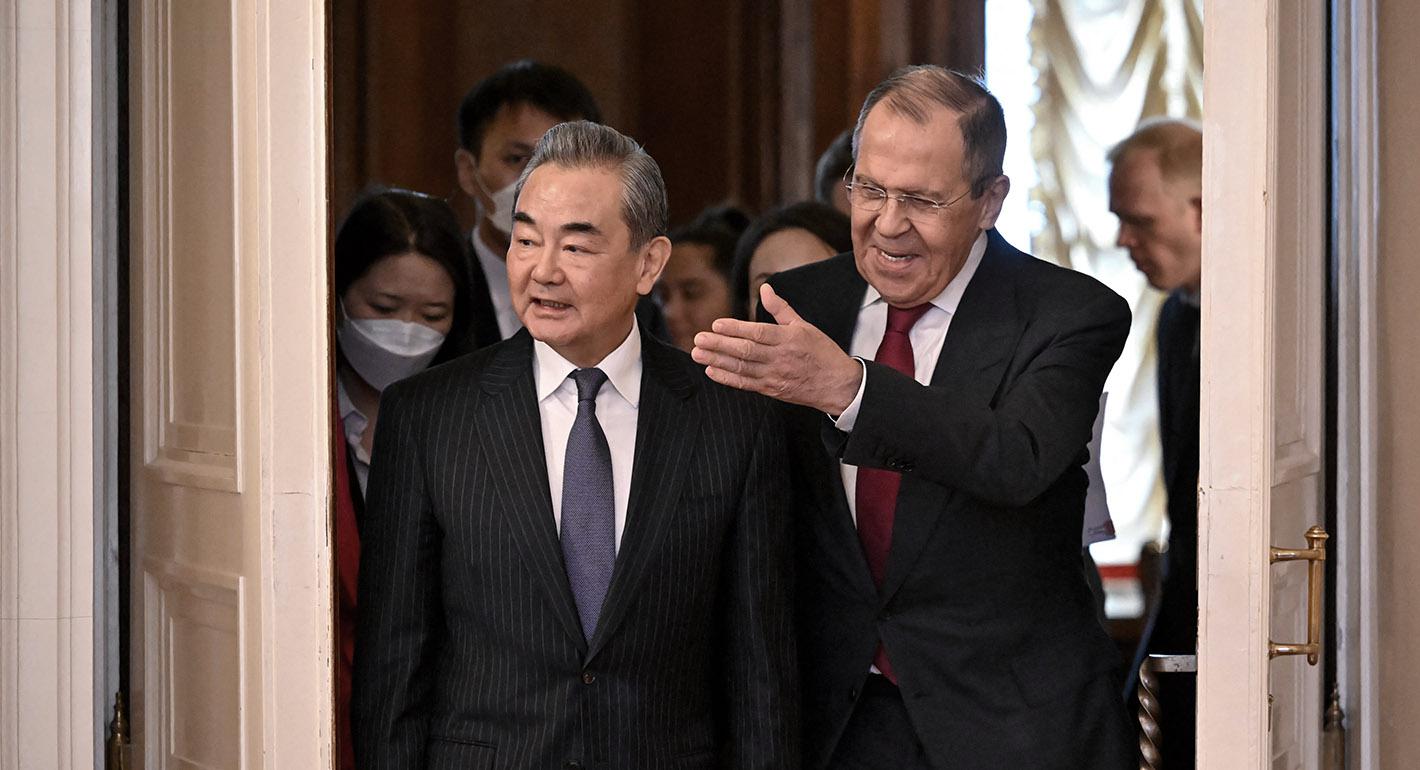
Hence the development of its position paper on Ukraine, the release of which was accompanied by a diplomatic offensive. In February 2023, Wang visited France and Italy and appeared at the Munich Security Conference, where he met with U.S. Secretary of State Antony Blinken and Ukrainian Foreign Minister Dmytro Kuleba. He then visited Hungary and finally Russia, where he was received by Security Council Secretary Nikolai Patrushev, Foreign Minister Sergey Lavrov, and Putin himself. Only after this whirlwind tour of Europe, the itinerary of which was designed to give the impression of shuttle diplomacy, did Beijing publish the document.
Yet Wang’s travels were about much more than discussing the position paper: the release of a compilation of Beijing’s talking points didn’t require an expensive voyage by China’s top diplomat. He sought to persuade Europe that it should not blindly pursue Washington’s anti-China policy. And in Moscow, Wang engaged key figures on major questions such as military cooperation, gas pipeline deals, the yuanization of the Russian economy, Russia’s access to technology imports from China, and Xi’s planned visit to Moscow.
Beijing understands that there is no serious demand in Moscow, Kyiv, or Washington for a peace plan or other compromise that would put an end to the fighting—at least at this point in time, when all sides are ready to give war a chance. Chinese leaders expect that the war will go on for some time. Their proposal, then, has less to do with actually ending the war and more to do with maintaining China’s international reputation and undermining that of the West.
With its ambiguity and, indeed, uselessness, the risk of anyone seizing on the paper and demanding that China act to make it reality is negligible. The international reaction to the plan met China’s expectations (and, most likely, was part of the initial design).
Moscow issued cautious praise for the document. "Any attempt to produce a plan that would put the conflict on a peace track deserves attention. We are carefully considering the plan of our Chinese friends," said Putin’s spokesman, Dmitry Peskov.
For their part, Kyiv and the West rejected the Chinese proposal outright. "I've seen nothing in the plan that would indicate that there is something that would be beneficial to anyone other than Russia if the Chinese plan were followed,” U.S. President Joe Biden told ABC News.
These reactions suit Beijing entirely, giving it ammunition for the next time it is accused of quietly abetting Putin’s aggression. With respect to the developing world, it allows China to present itself as the only permanent member of the UN Security Council working toward peace: Russia has invaded Ukraine, the U.S., UK and France are providing weapons to a party of war, and Beijing alone has not only developed a peace proposal, but almost convinced the Kremlin to start talks. If the diplomatic effort has collapsed before it even started, the world has only the West to blame. When urged to force Putin to the table in future, Beijing may demand that the West instead press Ukrainian President Volodymyr Zelensky to accept its plan.
Certainly, it will not be easy for Beijing to claim the mantle of peacemaker. Already, the United States and its allies have publicly accused the Chinese leadership of discussing potential weapons deliveries to Russia. Recent disclosures in Western media show that not only has China bought oil and gas from Russia, thereby filling Putin’s war chest, it has also continued to supply it with arms components and even contemplated providing it with armed drones and other weapons. Such calculated disclosures suggest that for Beijing, the title of peacemaker will not come without a fight, even as its leaders do their best to stay out of a bigger, bloodier one in Ukraine.

Director, Carnegie Russia Eurasia Center
Alexander Gabuev is director of the Carnegie Russia Eurasia Center. Gabuev’s research is focused on Russian foreign policy with particular focus on the impact of the war in Ukraine and the Sino-Russia relationship. Since joining Carnegie in 2015, Gabuev has contributed commentary and analysis to a wide range of publications, including the Financial Times, the New York Times, the Wall Street Journal, and the Economist.
Recent Work
Alexander Gabuev
Alexander Gabuev
Carnegie does not take institutional positions on public policy issues; the views represented herein are those of the author(s) and do not necessarily reflect the views of Carnegie, its staff, or its trustees.

Russian strikes are weakening the economy sustaining Ukraine’s war effort. Closing the growing funding gap will require more European support and politically contentious reforms in Kyiv.

Balázs Jarábik

Despite a new textbook, an influx of Russian teachers and managers, and an end to the teaching of Ukrainian, the Kremlin is unlikely to have “reprogrammed” locals.

Konstantin Skorkin

For every ruble allocated to social policy, health, and education in 2027, double that amount is earmarked for the army, the police, and the security services.

Alexandra Prokopenko

Cargo traffic through Russia’s Northern Sea Route has increased because of the disruption caused by the conflict in the Middle East, the Ukraine war, and U.S.-China tensions.

Mikhail Korostikov
An analysis of traffic accident data suggests that Ukrainian drone attacks caused a material but not disastrous fall in Russian gasoline consumption over the summer.

Sergey Vakulenko