

Commentary
Maxim Starchak
{
  "authors": [
    "Maxim Starchak"
  ],
  "type": "commentary",
  "blog": "Carnegie Politika",
  "centerAffiliationAll": "dc",
  "centers": [
    "Carnegie Endowment for International Peace",
    "Carnegie Russia Eurasia Center"
  ],
  "collections": [],
  "englishNewsletterAll": "ctw",
  "nonEnglishNewsletterAll": "",
  "primaryCenter": "Carnegie Russia Eurasia Center",
  "programAffiliation": "russia",
  "programs": [
    "Russia and Eurasia"
  ],
  "projects": [],
  "regions": [
    "Russia",
    "Caucasus"
  ],
  "topics": [
    "Foreign Policy",
    "Economy",
    "Political Reform",
    "Domestic Politics"
  ]
}
Source: Getty
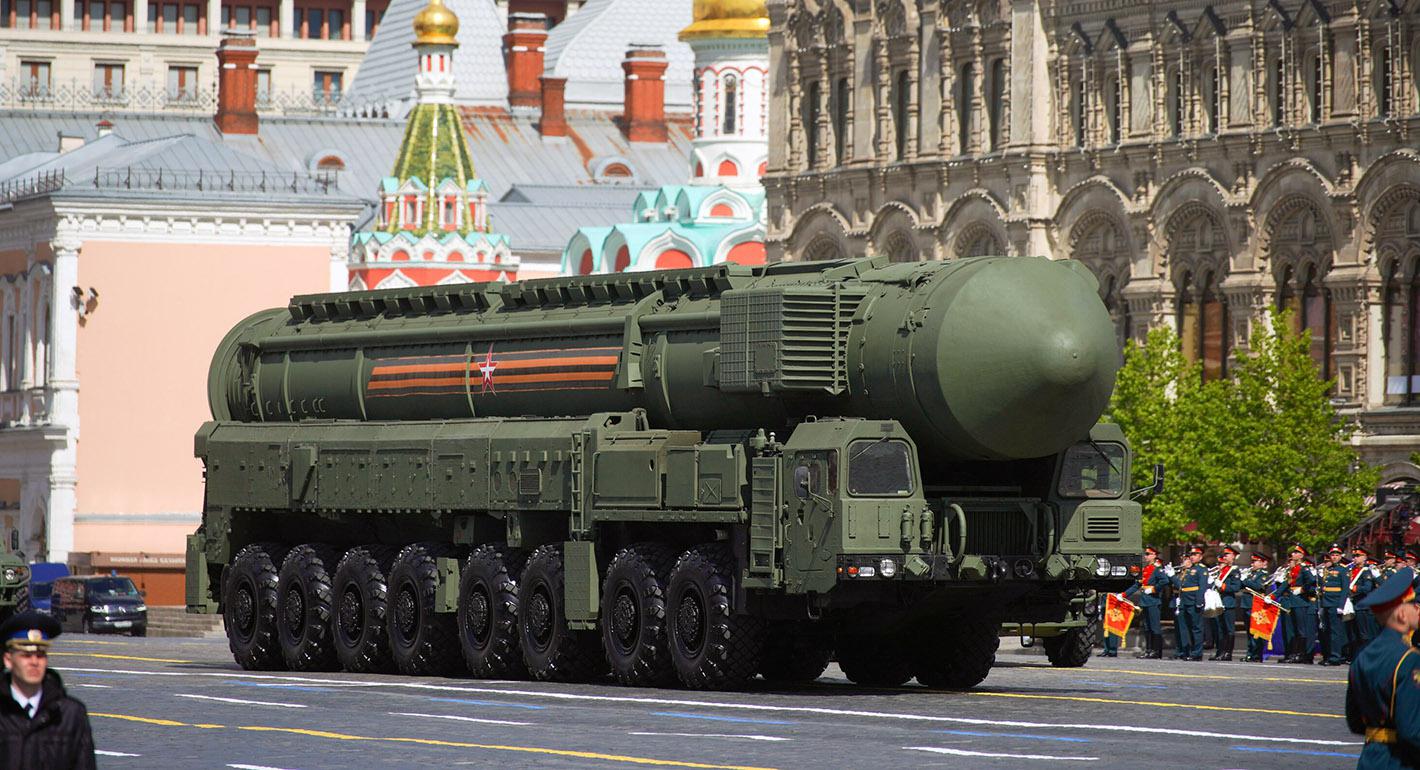
The Sarmat has been hailed as a game changer, but its development has been so rushed and plagued by delays that Moscow likely doesn’t know its exact capabilities.
Russia has completed work on the Sarmat, its new super-heavy intercontinental ballistic missile (ICBM). According to President Vladimir Putin, the country now just needs to “begin mass production” and put the missiles into service.
Pro-Kremlin analysts have been gushing in their praise, predicting that the Sarmat—an underground silo-based missile capable of carrying ten-plus nuclear warheads—will change the global strategic deterrence landscape. What’s being spun as a triumph of the domestic defense sector, however, is actually yet more evidence of a crisis that has engulfed the state space agency Roscosmos and Russia’s missile production sector as a whole.
Russia has long needed a new ICBM. The Voevoda ICBM (NATO reporting name: Satan) that the Sarmat is due to replace was first brought into service in the 1970s, and was subsequently used by both the Soviet military and then Russia’s Strategic Missile Forces. The Voevoda was a significant achievement for the Soviet Union at the time, breaking all existing records for size and power. The only problem was that it was manufactured in Ukraine.
After the collapse of the Soviet Union, there were discussions in Moscow about replacing the Voevoda so as not to be dependent on unpredictable political relations with Kyiv. Each missile had a guaranteed shelf life of fifteen years, meaning the Soviet stockpile should in any case have been taken out of service by 2007. Another option, however, was to extend their shelf lives and, in 2008, Moscow signed an agreement with Kyiv to do exactly that. The work was to be carried out by Ukraine’s Yuzhnoye State Design Bureau.
Russia launched its last Voevoda in 2013, confirming they could be used for another five or six years. Russian Defense Minister Sergei Shoigu and other generals said repeatedly that the Voevoda would be fully withdrawn from service in 2022.
The collapse in ties between Kyiv and Moscow in 2014, after Russia’s annexation of Crimea and support for rebels in eastern Ukraine, accelerated that process. All cooperation with Ukrainian contractors ceased, and responsibility for the Voevoda’s maintenance passed to Russia’s Makeyev Rocket Design Bureau. But this was a stopgap solution. Launches ceased, with missiles and warheads simply undergoing annual checks.
The Sarmat was supposed to finally solve this problem. Work on it began in 2013 (also by the Makeyev Rocket Design Bureau). Creating a modern missile from scratch required brand new production lines and cooperation among various enterprises.
Last month, Roscosmos head Yury Borisov announced that the Sarmat was already in service. But on October 5, Putin said that while the missile had passed all the relevant checks, several “administrative procedures” remained to be completed before it could be put into mass production and handed to the military. He promised this would be done “in the near future.”
It might seem as though the appearance of the Sarmat should be a cause for celebration in the Kremlin, which has succeeded in expanding its nuclear arsenal and showing off a new missile to the world. Upon closer examination, however, the Sarmat saga is a stark example of the profound crisis gripping Russia’s missile production sector.
The Sarmat’s development was plagued by repeated delays. Initial tests were supposed to have taken place in 2015, but only happened in 2017. The missile was supposed to enter into service in 2018, but that deadline was also repeatedly pushed back. The political pressure for the Sarmat to enter service intensified dramatically in 2021, but that did little to expedite the process.
Russia initially planned three Sarmat test launches in 2021, but that plan was amended down to one—and then delayed until 2022. Test launches finally took place in April 2022, but there have been none since.
Then head of Roscosmos Dmitry Rogozin promised the Sarmat would be fine-tuned in a second round of flight tests and, following the successful April launches, he announced a minimum of three more tests that year. They never happened. In February 2023, there was likely a Sarmat test launch that ended in failure.
At that point, it seems, the Kremlin decided it could wait no longer, and the missile was put into service despite having been tested successfully only once. Even now, much remains unknown about the missile. Can Sarmat carry a hypersonic glide vehicle or multiple warheads able to separate? Can it evade missile defenses and hit its target at a distance of 18,000 kilometers? There are no answers to these questions: Russia appears to have put a missile into service without knowing its full capabilities.
That step is unique in missile production history. The Voevoda R-36M, for example, underwent thirty-six successful tests before being put into service, while the Voevoda R-36M2 was successfully tested twenty times.
The Sarmat’s problems are the result of the financial losses and rising debts of Roscosmos and its contractors. Some Roscosmos contractors have been under U.S. sanctions since 2014, and almost all their international contracts were cancelled after Russia’s full-scale invasion of Ukraine in 2022. Being cut off from Western technology and equipment means Roscosmos and its contractors face bigger losses and longer production delays.
A good example is Proton-PM, which manufactures propulsion systems for the Sarmat. The firm has a long backlog of orders, but it can’t meet them. Part of its production system is old and badly outdated, while modern parts cannot operate now that Western manufacturers are no longer servicing equipment or supplying parts. Instead, Proton-PM is forced to buy Russian or Chinese technology. There’s also a shortage of qualified staff.
Roscosmos itself is in desperate need of money. As a result, it has made redundancies, been forced to seek new markets in developing countries (such as Algeria and Egypt), and—for the first time in history—issued publicly traded bonds. It’s planning to raise 10 billion rubles ($102.7 million) in 2023, and as much as 50 billion rubles over the course of the whole program.
One often-used way of measuring how successful nations are in space is by counting the number of objects they send into orbit. In the last eight years, Russia has carried out between fifteen and twenty-six launches every year: far behind both the United States and China. When the same methodology is applied to missile launches, the picture looks far from rosy for Russia. The number of ground launches of ICBMs has plummeted from between six and ten in 2013–2017 to between two and five in 2018–2022. In these desperate times, it appears that the Kremlin has decided to prioritize its nuclear deterrent over the need to establish the Sarmat’s exact in-flight capabilities.
Expert on Russian nuclear policy
Recent Work
Maxim Starchak
Maxim Starchak
Carnegie does not take institutional positions on public policy issues; the views represented herein are those of the author(s) and do not necessarily reflect the views of Carnegie, its staff, or its trustees.

If the Russian-speaking community in Latvia cannot articulate their interests without being seen as disloyal, they could end up embracing a pro-Kremlin agenda.

Sergejs Potapkins

Russia’s ruling party would have benefited from Putin appearing as its distant patron, but as an active frontman imposing his views on the public, he has done nothing but harm both the party’s election campaign and the ruling system overall.

Andrey Pertsev

Depleted financial reserves and a shrinking tax base mean it is no longer possible to simultaneously deliver high defense spending, price stability, and economic growth.

Alexandra Prokopenko
Blurring the line between humans and animals is a long-standing tradition in social utopian prose. In his latest novel, Leonid Bershidsky reminds us that in social experiments, people are often treated no differently than animals.

Alexander Baunov

In the tenth year of his presidency, President Mirziyoyev’s system is becoming even more personalized than that of his predecessor Karimov.

Galiya Ibragimova