

Commentary
Putin’s conservative staffing policies and search for ever greater control have cemented parliament’s transformation into a bureaucratic appendage of the executive branch.
Andrey Pertsev
{
  "authors": [
    "Emil Avdaliani"
  ],
  "type": "commentary",
  "blog": "Carnegie Politika",
  "centerAffiliationAll": "dc",
  "centers": [
    "Carnegie Endowment for International Peace",
    "Carnegie Russia Eurasia Center"
  ],
  "collections": [
    "Aso Tavitian Initiative"
  ],
  "englishNewsletterAll": "ctw",
  "nonEnglishNewsletterAll": "",
  "primaryCenter": "Carnegie Russia Eurasia Center",
  "programAffiliation": "russia",
  "programs": [
    "Russia and Eurasia"
  ],
  "projects": [],
  "regions": [
    "Caucasus",
    "Russia",
    "Georgia",
    "Western Europe"
  ],
  "topics": [
    "Economy",
    "Foreign Policy"
  ]
}
Source: Getty
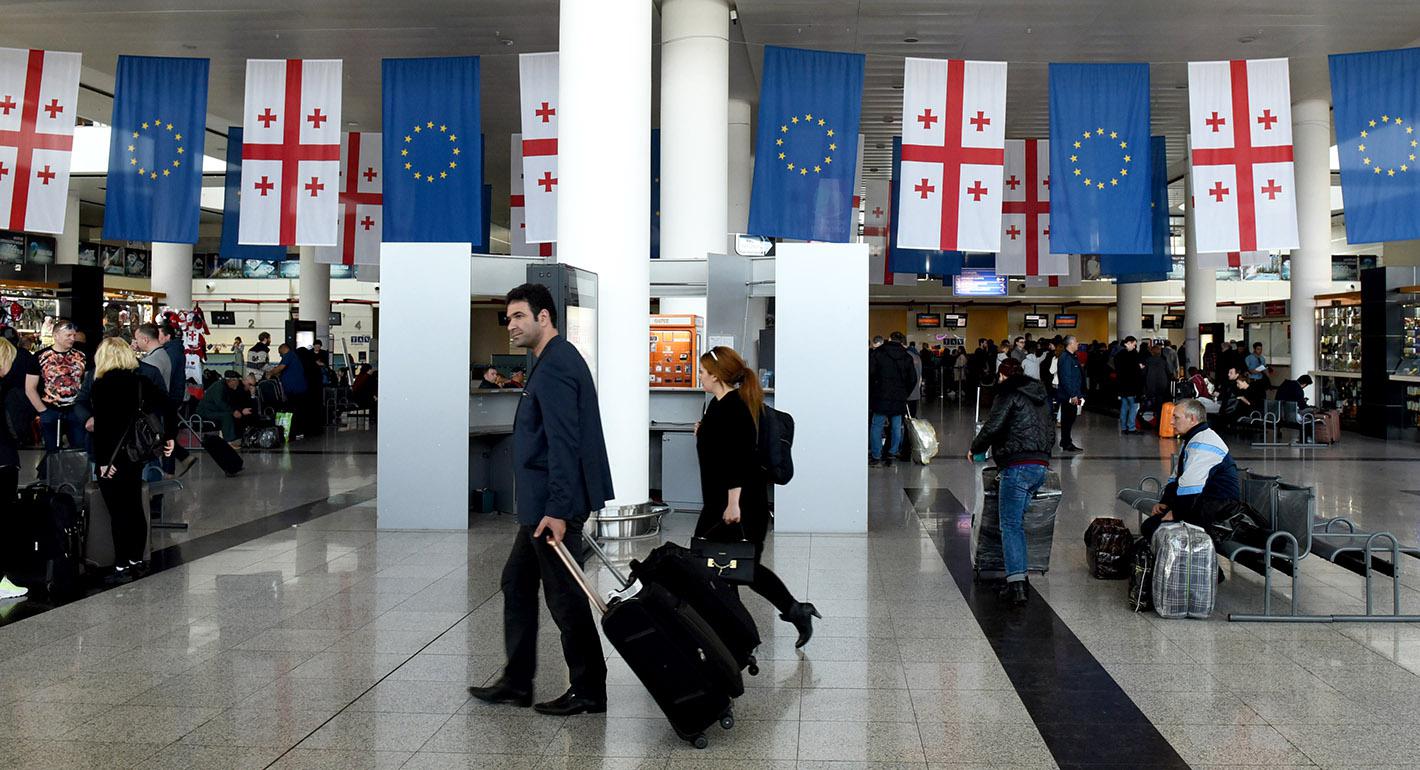
The announcement of EU candidate status is both a boon for Georgia and a geopolitical challenge, given possible retaliation from Russia.
The European Union recommended on November 8 that Georgia be granted its long-awaited candidate status, an essential step to future membership of the bloc. The recommendation is, however, contingent on Tbilisi meeting nine conditions: a reminder that Georgia still has a long way to go before accession talks can begin. For now, the main sticking point is that carrying out the reforms the EU wants may damage the country’s ruling party, Georgian Dream.
Candidate status is not a panacea, nor is it an iron-clad guarantee that a country will become an EU member state. Still, the announcement will likely calm political tensions in Georgia, and soothe relations between Tbilisi and Brussels that have been marred by disagreements on how the country is progressing toward meeting EU recommendations.
Georgian political life has become increasingly polarized in the last year. The opposition lacks financial resources, a viable political agenda, and charismatic leaders. The ruling party is more popular, but it too is facing significant challenges, including growing political apathy.
Candidate status will not solve these problems, which will persist in the run-up to the 2024 parliamentary elections. While Georgian Dream is likely to do well in the vote, it will be a challenge to balance Brussels’ expectations and Georgians’ desire for democratic and economic progress against the party’s own political ambitions. Georgian Dream will, however, benefit from the fact that real progress on Georgia’s path to the EU was achieved on its watch.
One pressing issue will be addressing problems in Georgia’s judiciary, which has been notoriously susceptible to political influence since the country regained independence in the early 1990s. Cleaning up the legal system is one of the EU’s conditions for Georgia, and it will be extremely difficult for the ruling party to deliver. Government critics argue that an impartial judiciary would undermine Georgian Dream’s ability to dominate political life.
Equally important is the requirement for Georgia to align its foreign and security policies with the EU. It’s true that Tbilisi has long pursued a pro-Western foreign policy, and awarding candidate status goes some way to refuting allegations often heard in the West that the Georgian government is pro-Russian. At the same time, Tbilisi has explored a multi-vector foreign policy over the last year, building closer economic ties with the EU’s systemic rivals. Expecting Tbilisi to abandon its close links with China, for example, would be futile. A major test will be to see whether the tender to construct a deep seaport at Anaklia—a critical infrastructure project for Georgia as it seeks to become a Eurasian transit hub—is awarded to a Western or Chinese company.
But it is relations with Russia that will likely pose the greatest challenge to Georgia’s EU aspirations. Tbilisi has trodden a difficult path since Russia’s full-scale invasion of Ukraine in February 2022, navigating between its support for Kyiv and a revanchist, aggressive Moscow. This has not always been successful, and there has been some tension with Western partners. After all, Georgia’s economic ties with Russia have strengthened, despite the war in Ukraine, the longstanding Russian occupation of 20 percent of Georgian territory, Moscow’s apparent decision to open a naval base in some of that territory—Abkhazia—and the recent abduction and killing of Georgian nationals (on November 6, for example, a Georgian national was murdered by Russian troops while trying to visit a church in occupied South Ossetia).
So far, it is not clear how the Georgian government will be able to balance EU integration against relations with Russia. Moscow might downplay the significance of EU enlargement near its borders by outwardly focusing its ire on NATO expansion, but that is only half the story. Russia invaded Ukraine in 2014 because Kyiv was re-orientating toward the EU. In other words, EU expansion is of no less concern for Moscow than NATO enlargement. Notably, Georgia appeared alongside Ukraine in the infamous ultimatum that Moscow handed to the West in the months before the full-scale invasion of Ukraine. Among other demands, the Kremlin wanted Georgia to reverse its pro-Western trajectory.
On paper, Russia could seek a military solution in Georgia. But Russia is already bogged down in Ukraine and suffering from Western sanctions. Opening a second front in the South Caucasus would only lead to further isolation, and perhaps reduce the chances of success in Ukraine.
A more realistic strategy would be for Moscow to pressure Tbilisi via sanctions that could hurt the Georgian economy. But even that would not be enough to force Tbilisi into a foreign policy U-turn. While Russia’s share of Georgia’s trade rose to 12.4 percent in the first six months of 2023—the highest figure for sixteen years—it remains relatively modest. In comparison, the EU is Georgia’s main economic partner, accounting for 20.5 percent of overall trade.
Whatever path Russia chooses, the announcement of EU candidate status for Georgia has broader implications for Europe and Russia in the South Caucasus. Going forward, the EU looks set to increase its engagement with the South Caucasus, an area of increasing geopolitical importance when it comes to energy diversification (as evidenced by the expanded gas deal signed with Azerbaijan in 2022); trans-Eurasian trade routes such as the expanding “Middle Corridor;” and broader Black Sea security. Georgia could even end up serving as an example for neighboring countries, especially Armenia, which is increasingly frustrated by Russia’s unwillingness to honor its security commitments.
EU expansion in the South Caucasus fits into a broader trend of what could be termed Russia’s managed decline in the region. Signs of Moscow’s dwindling prestige were on show well before 2022, but the war in Ukraine has accelerated this process. Events leading up to Azerbaijan’s seizure of the disputed Nagorno-Karabakh region this year were a particularly vivid illustration of the shift in Russia’s position. In the congested geopolitical space of the South Caucasus, Moscow is increasingly only one of several major powers vying for influence.

Emil Avdaliani
Professor of international relations at European University in Tbilisi, Georgia
Carnegie does not take institutional positions on public policy issues; the views represented herein are those of the author(s) and do not necessarily reflect the views of Carnegie, its staff, or its trustees.

Putin’s conservative staffing policies and search for ever greater control have cemented parliament’s transformation into a bureaucratic appendage of the executive branch.

Andrey Pertsev

Russia’s AI-driven propaganda campaigns operate in a fragmented, chaotic, and often illogical manner. That’s not necessarily a problem for the Kremlin, though: It’s much easier to mimic genuine public debate that way.

Ilya Klishin

Without a ceasefire with Ukraine on attacking each other’s energy infrastructure—to which the Kremlin is unlikely to agree—the diesel agreement between Putin and Trump is largely for show, rather than representing a genuine increase in the volumes of Russian diesel on the global market.

Sergey Vakulenko

Russian strikes are weakening the economy sustaining Ukraine’s war effort. Closing the growing funding gap will require more European support and politically contentious reforms in Kyiv.

Balázs Jarábik

Despite a new textbook, an influx of Russian teachers and managers, and an end to the teaching of Ukrainian, the Kremlin is unlikely to have “reprogrammed” locals.

Konstantin Skorkin