

Commentary
Japan’s long-term security policy is driven by concerns about China, and there is little appetite for (or interest in) pursuing a confrontation with Moscow.
James D.J. Brown
{
  "authors": [
    "Milàn Czerny"
  ],
  "type": "commentary",
  "blog": "Carnegie Politika",
  "centerAffiliationAll": "dc",
  "centers": [
    "Carnegie Endowment for International Peace",
    "Carnegie Russia Eurasia Center"
  ],
  "collections": [],
  "englishNewsletterAll": "ctw",
  "nonEnglishNewsletterAll": "",
  "primaryCenter": "Carnegie Russia Eurasia Center",
  "programAffiliation": "russia",
  "programs": [
    "Russia and Eurasia"
  ],
  "projects": [],
  "regions": [
    "Middle East",
    "Israel",
    "Palestine",
    "Russia",
    "Caucasus"
  ],
  "topics": [
    "Foreign Policy",
    "Economy"
  ]
}
Source: Getty
Moscow’s rapprochement with Hamas and the subsequent deterioration in ties with Israel signals the failure of Russia’s long-standing goal of appearing as a great power by acting as a mediator in the Middle East.
Israel is an important partner for Russia in the Middle East, but amid the war in Gaza and Moscow’s rapprochement with Hamas, ties between the two countries are at their lowest in recent history. These tensions mark a break in Moscow’s long-standing efforts to present itself as a neutral mediator in the Middle East. Russia is increasingly aligning itself with Iran and its allies, and accordingly risks only being able to influence the region from its margins.
While Israel and the Soviet Union had no diplomatic relations for decades after the 1967 Arab-Israeli war, in which the Soviet Union had backed the Arab nations involved, ties between Russia and Israel largely improved at the turn of the century. The two countries became even closer in the last decade under Israeli Prime Minister Benjamin Netanyahu, who personified Israel’s relations with Russia by presenting himself as a friend of Russian President Vladimir Putin.
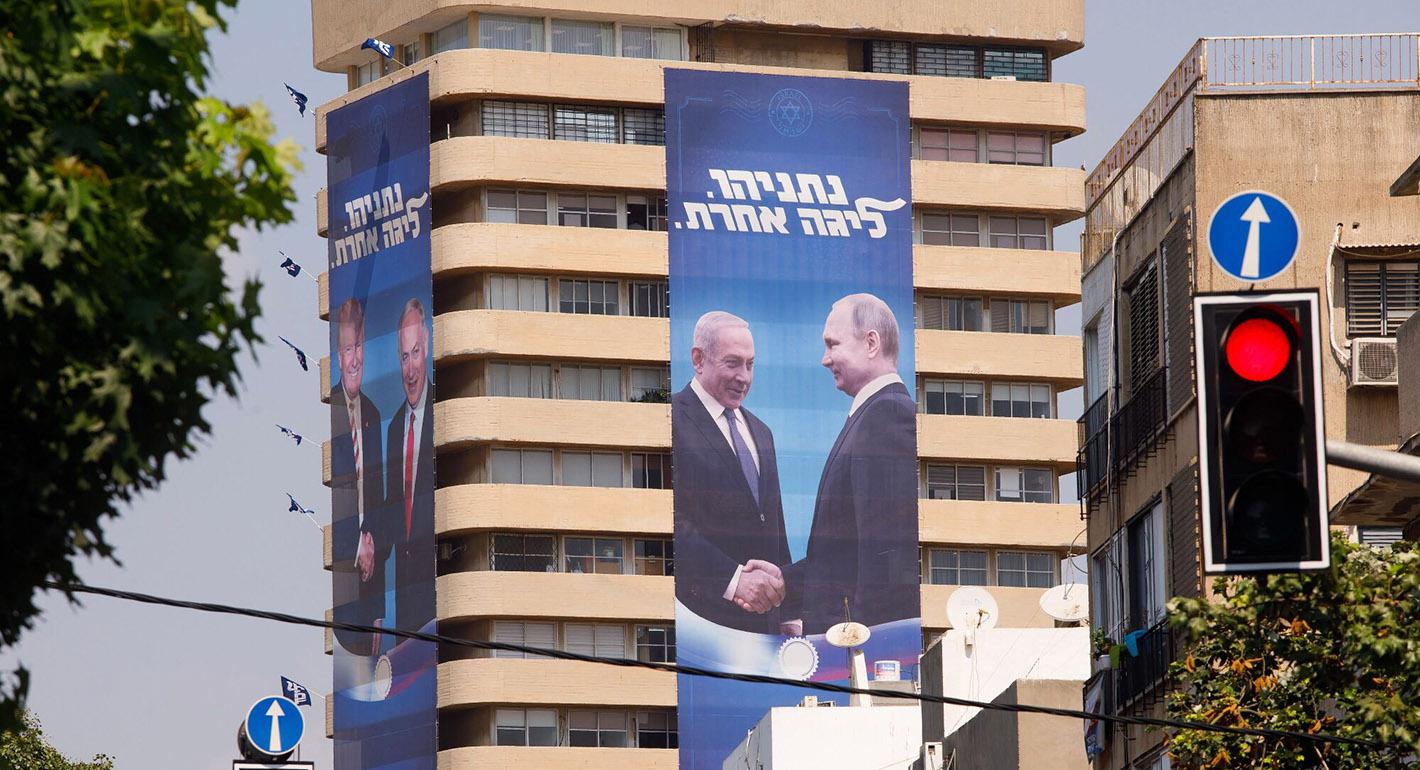
In 2019, Netanyahu even launched his election campaign with large posters of himself shaking hands with the Russian president. Netanyahu sought to portray himself as a leader of the same standing as Putin—perceived in Israel as the head of a great power—and to convey the message that his close ties with Putin would help ensure Israel’s security following Russia’s 2015 military intervention in Syria. The Israeli leader had long boasted that his alleged “personal friendship” with Putin was key to ensuring limited Russian support for Iran and getting Moscow to turn a blind eye to Israeli strikes against Iranian targets in Syria.
Unlike other Western states, Israel did not fundamentally change its approach to Russia following the Kremlin’s invasion of Ukraine. Israel did not impose any financial sanctions on Russia, declined to send weapons to Kyiv despite repeated requests from Ukrainian President Volodymyr Zelensky, and failed to name Russia when addressing attacks against Ukraine. Israel was unwilling to sever ties with Russia, and even started to adopt a cooperative approach in the second half of 2023 by signing new bilateral agreements in nonsensitive sectors, such as the cultural field.
Israel became one of few U.S. allies willing to engage diplomatically and economically with Russia, which helped limit Moscow’s international isolation. Israel became the largest importer of Russian vodka following the imposition of Western sanctions; Russian firms such as Yandex expanded their operations in Tel Aviv; and sanctioned Russian individuals benefited from newly acquired Israeli documents to travel visa-free to Europe.
Russia also valued its rapprochement with Israel as it sought to cultivate ties with all actors in the Middle East following its Syrian intervention in 2015. Despite occasional sources of tension, such as the 2018 downing of a Russian plane by Syrian forces during Israeli strikes, Moscow was careful to maintain dialogue with both Israel and its foes: Iran, Hamas, Hezbollah, and Syria. This balancing act enabled Russia to gain status recognition and to present itself as a great power and an essential intermediary in the Middle East.
Israel had tolerated Russia’s preexisting ties with its enemy and Hamas-backer Iran, but Moscow’s vocal support for Hamas following the bloodiest attack in Israel’s history on October 7 is seen as a step too far. Following Hamas’s visit to Moscow, Israeli security officials now mention Russia in the same breath as Israel’s existential foes Iran and Hezbollah. While Russia’s support for Hamas is for now rhetorical and symbolic rather than material, this is perceived by Israel as akin to allyship with Hamas.
Indeed, Russia is leading UN condemnation of Israel’s military actions in Gaza, with its representative Vasily Nebenzya questioning Israel’s right to defend itself as an “occupier.” In turn, Israel’s ambassador to the UN, Gilad Erdan, denounced Russia for using the Hamas attack “to distract the world’s attention from the invasion of Ukraine,” and called Russia “the last country” that could teach Israel about morality.
At the same time, Israel is aligning itself as closely as possible with the United States and the West in general, and hence further away from Russia. In recent years, Netanyahu sought to portray Israel as an independent actor, and presented himself as a leader capable of maintaining simultaneous communication with the American, Chinese, Indian, and Russian leaders. But the support provided by U.S. President Joe Biden and European leaders to Israel since the start of the war in Gaza is strengthening the view in Israel that when push comes to shove, only the West can really be relied upon to have its back.
Israel will seek to avoid disagreements with the United States and the West on the international arena to maintain this support throughout what it expects to be a lengthy military campaign in Gaza. On November 16, for example, Israeli banks introduced restrictions on accounts belonging to Russian nationals in line with EU instructions.
Still, Israel has said nothing about reassessing its policy toward Ukraine to provide weapons or impose sanctions. Nor is it likely there will be much appetite in Israel to provide military support for others once its own war comes to an end. Israel is unwilling to end dialogue completely, and risk Moscow providing additional military support to Israel’s enemies.
For its part, Russia still appears unwilling to provide offensive weapons to Israel’s foes. Quite apart from doubts over Moscow’s capacity to do so, Russia is well aware that it would be a point of no return in its ties with Israel, and is cautious of taking such a leap.
While bilateral ties therefore remain unsevered, the abrupt cooling in relations between Russia and Israel could quickly have unintended consequences. Israel has already stopped giving advance warning to Moscow ahead of airstrikes it carries out in Syria, raising the risk of an inadvertent confrontation between the two powers.
Moscow’s rapprochement with Hamas and the subsequent deterioration in ties with Israel also signals the failure of Russia’s long-standing goal of appearing as a great power by acting as a mediator in the Middle East. Since the start of the war in Gaza, Netanyahu has held just one phone call with Putin, which is testament to the fact that Moscow is not seen as a significant actor in the conflict.
Indeed, having already limited its military presence in the region, Moscow has not increased the number of its troops in Syria since the outbreak of the latest hostilities. The United States, meanwhile, has dispatched two aircraft carriers to the Mediterranean coastline.
The war in Ukraine has also pushed Russia closer to Iran. That rapprochement is driven by Moscow’s broader confrontation with the West and its need to ensure weapons supplies for its own war, such as Iranian drones. These ties strengthen Israel’s perception of Moscow’s proximity to Tehran and its allies.
Of course, Russia’s influence in the region isn’t limited to its ties with Israel, but the tensions in that relationship underline the fact that Moscow, busy fighting its own war in Ukraine and having lost its leverage by abandoning its former neutrality, is increasingly being marginalized in the Middle East.
Milàn Czerny
Carnegie does not take institutional positions on public policy issues; the views represented herein are those of the author(s) and do not necessarily reflect the views of Carnegie, its staff, or its trustees.

Japan’s long-term security policy is driven by concerns about China, and there is little appetite for (or interest in) pursuing a confrontation with Moscow.

James D.J. Brown

The truth of the strategic situation is that Europe and Russia are extremely unlikely to be able to “turn the page” on their confrontation within the next two decades.

Arkady Moshes

Russia spent years building a “sovereign internet,” concentrating web infrastructure exclusively within Russian territory. Ukrainian drone attacks have shown how vulnerable that approach has left the Russian internet.

Maria Kolomychenko

Putin’s conservative staffing policies and search for ever greater control have cemented parliament’s transformation into a bureaucratic appendage of the executive branch.

Andrey Pertsev

Russia’s AI-driven propaganda campaigns operate in a fragmented, chaotic, and often illogical manner. That’s not necessarily a problem for the Kremlin, though: It’s much easier to mimic genuine public debate that way.

Ilya Klishin