

Commentary
Andrey Pertsev
{
  "authors": [
    "Andrey Pertsev"
  ],
  "type": "commentary",
  "blog": "Carnegie Politika",
  "centerAffiliationAll": "dc",
  "centers": [
    "Carnegie Endowment for International Peace",
    "Carnegie Russia Eurasia Center"
  ],
  "collections": [],
  "englishNewsletterAll": "ctw",
  "nonEnglishNewsletterAll": "",
  "primaryCenter": "Carnegie Russia Eurasia Center",
  "programAffiliation": "russia",
  "programs": [
    "Russia and Eurasia"
  ],
  "projects": [],
  "regions": [
    "Russia",
    "Caucasus"
  ],
  "topics": [
    "Political Reform",
    "Domestic Politics"
  ]
}
Source: Getty
Creating a new political post to oversee major social spending plans will cause a shift in the balance of power within Russia’s bureaucracy.
The social spending commitments made by Russian President Vladimir Putin in his February state of the nation address indicate that at least one Russian official will get an influential new job. The lucky person will likely be either a deputy prime minister with expanded powers, or a special coordinator. Either way, they’ll get regular access to the president, the opportunity to disburse large sums, and the tools to shape their public image. That will automatically create an alternative center of power within the government.
Putin has not made any campaign pledges ahead of Russia’s presidential elections in March. Instead, he chose to use his state of the nation address to announce five new “national projects,” titled “Personnel,” “Youth of Russia,” “Family,” “Long and Active Life,” and “Data Economy.” Four of them are obviously socially orientated, and will involve subsidized mortgages, social handouts to families, and higher salaries for state employees, as well as building and modernizing schools, universities, and hospitals.
The reasoning is clear: the Kremlin reaps the biggest political dividends from social spending. People always notice when a local school or hospital is renovated. Of course, governors and the ruling United Russia party benefit from these projects, but the main beneficiary is Putin.
The new national projects will also be a boon for all those involved in executing them: above all, the deputy prime minister in charge of social affairs. Currently, this post is held by Tatiana Golikova, but after this month’s presidential election, the government will be required to resign, and there will likely be a reshuffle. To a lesser extent, the deputy prime ministers in charge of industry and construction will also be involved.
There are several possible benefits for these managers. Firstly, by manipulating the tender process, they can choose to award contracts to “friendly” companies with which it suits them to work. Secondly, they will get access to Putin, who will likely be hosting regular meetings on the national projects’ implementation: both in public and behind closed doors. That’s what happened with Russia’s first four national projects when they were launched in 2005.
Close contact with Putin is an extremely valuable resource in the Russian power vertical, bestowing financial and political rewards and often outweighing formal status. The best example is Dmitry Medvedev, who was the first person appointed to oversee the national projects in 2005. Then a deputy prime minister, Medvedev was selected by Putin three years later to succeed him as president.
It will be easy for the person in charge of the national projects to generate good PR for themselves. Indeed, they will be able to position themselves as something of an avuncular figure, doling out cash from a magic money tree. Any problems can be blamed on those in government who are directly responsible for the economy. The post will be an ideal opportunity to promote a personal brand.
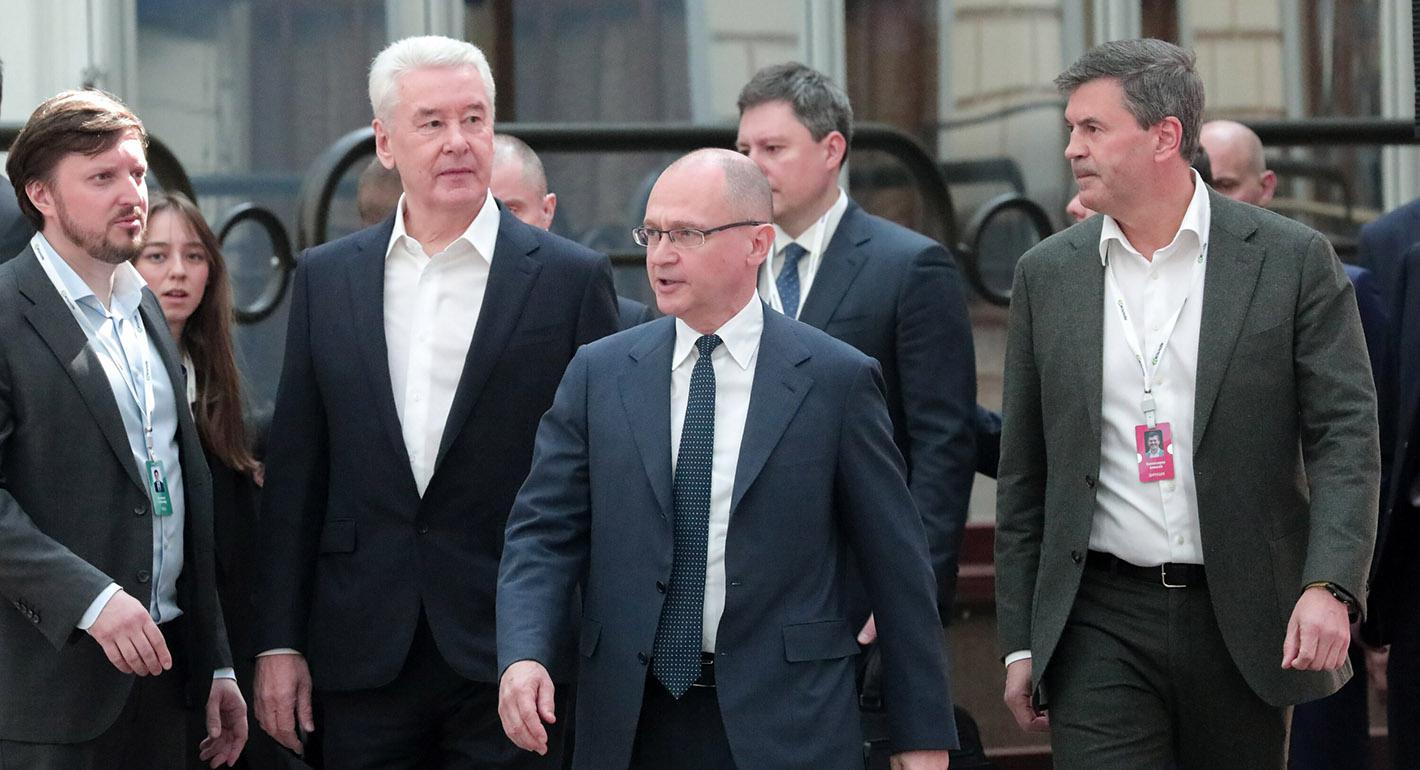
Of course, whoever gets the job will have to be careful not to be seen to be dishing out more cash than Putin. But it’s clearly possible to have your own personal brand in Russian politics. Prime Minister Mikhail Mishustin, for example, has fashioned an image for himself of both a professional operator and the sort of guy who can pat a minister on the back while dropping slang into conversation with them. The profile of Sergei Kiriyenko, the Kremlin deputy chief of staff in charge of domestic politics, is something along the lines of “Lord of the Donbas,” inspecting social infrastructure in Russian-occupied eastern Ukraine and handing out largesse in the form of pensions and salaries.
Indeed, Kiriyenko is undoubtedly the frontrunner for the post of deputy prime minister overseeing the socially focused national projects. Apart from his close involvement in social issues in occupied Ukraine, he also previously headed the state nuclear corporation Rosatom, which ran a lot of social projects, and had a short stint as prime minister in the 1990s. He also works closely with the government’s social ministries, helped develop the ideological component of Russia’s school curriculum and new “Fundamentals of Russian Statehood” university course, and has organized major conferences and forums.
Of course, there are other possible candidates. Deputy Prime Minister Yury Trutnev, who is also the presidential envoy to the Far East, has long overseen social and infrastructure projects in that part of the country. Marat Khusnullin, one of Putin’s favorites, regularly reports to the president on the success of ambitious infrastructure ventures. There’s also Deputy Prime Minister Dmitry Chernyshenko, who oversees digitization and sport, and enjoys Putin’s favor. However, none of them are as well suited as Kiriyenko.
Either way, the creation of a new deputy prime minister post will cause a major shift in the balance of power within Russia’s bureaucracy. Considering Medevdev’s rise from national projects to the presidency, the appointment will mean the elite starts thinking about a possible successor to Putin. The person who gets the job will inevitably be seen in a new light. In addition, the emergence of a new center of influence in the government will likely generate conflicts with the prime minister, who will be required to find the money.
For many years now, Putin has avoided a major reshuffle among Russia’s top officials in order to head off any speculation about power transitions or successors. Now, however, he has little choice but to empower a major new political player.

Andrey Pertsev is a journalist with Meduza website.
Recent Work
Andrey Pertsev
Andrey Pertsev
Carnegie does not take institutional positions on public policy issues; the views represented herein are those of the author(s) and do not necessarily reflect the views of Carnegie, its staff, or its trustees.

If the Russian-speaking community in Latvia cannot articulate their interests without being seen as disloyal, they could end up embracing a pro-Kremlin agenda.

Sergejs Potapkins

Russia’s ruling party would have benefited from Putin appearing as its distant patron, but as an active frontman imposing his views on the public, he has done nothing but harm both the party’s election campaign and the ruling system overall.
Andrey Pertsev

Depleted financial reserves and a shrinking tax base mean it is no longer possible to simultaneously deliver high defense spending, price stability, and economic growth.

Alexandra Prokopenko
Blurring the line between humans and animals is a long-standing tradition in social utopian prose. In his latest novel, Leonid Bershidsky reminds us that in social experiments, people are often treated no differently than animals.

Alexander Baunov

In the tenth year of his presidency, President Mirziyoyev’s system is becoming even more personalized than that of his predecessor Karimov.

Galiya Ibragimova