

Commentary
Temur Umarov
{
  "authors": [
    "Temur Umarov"
  ],
  "type": "commentary",
  "blog": "Carnegie Politika",
  "centerAffiliationAll": "",
  "centers": [
    "Carnegie Endowment for International Peace",
    "Carnegie Russia Eurasia Center"
  ],
  "collections": [
    "Aso Tavitian Initiative",
    "Politika: The Best of 2025"
  ],
  "englishNewsletterAll": "",
  "nonEnglishNewsletterAll": "",
  "primaryCenter": "Carnegie Russia Eurasia Center",
  "programAffiliation": "",
  "programs": [],
  "projects": [],
  "regions": [
    "Central Asia",
    "United States"
  ],
  "topics": [
    "Foreign Policy",
    "Global Governance",
    "Trade"
  ]
}
Source: Getty
Central Asia’s warmer ties with the United States could force the region to face a difficult choice between incurring the wrath of its traditional allies Russia and China, and disappointing Trump and becoming even more dependent on Moscow and Beijing.
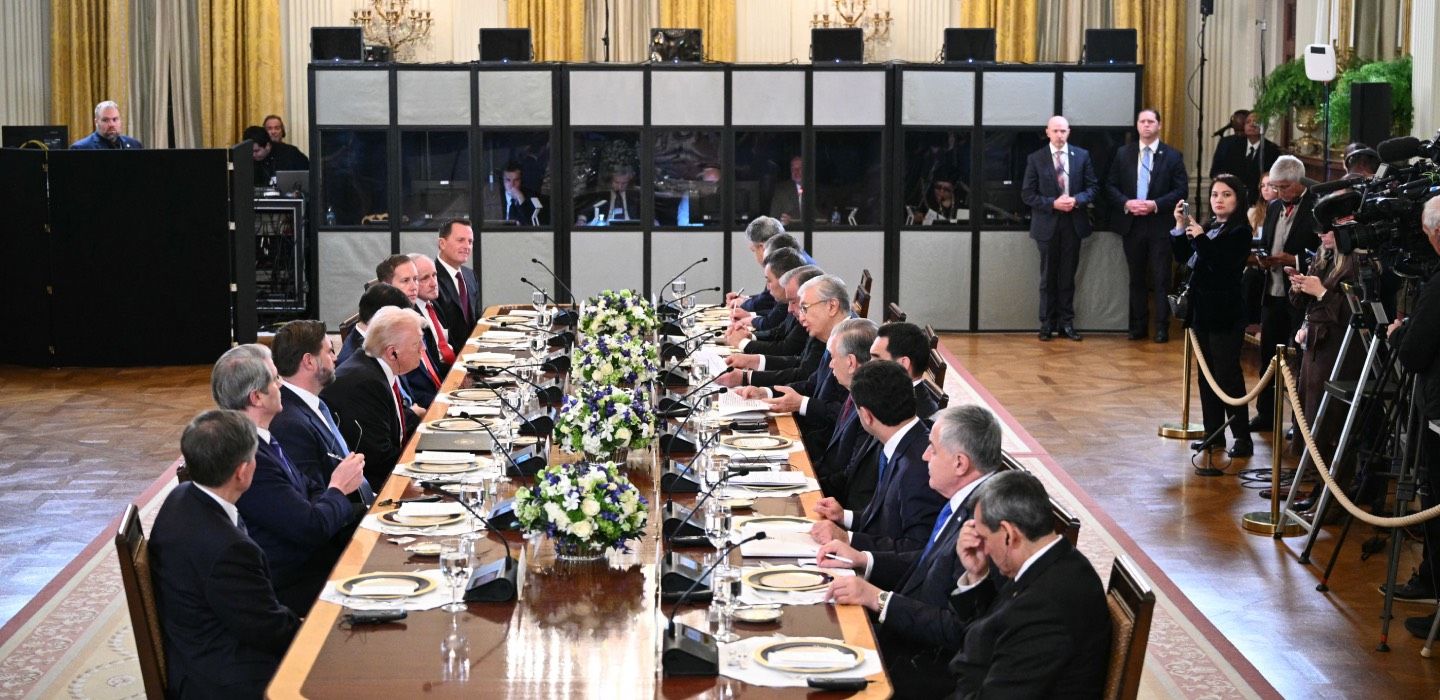
The November 6 summit between all five Central Asian leaders and the U.S. president to celebrate a decade of cooperation in the C5+1 format marked the first time the six leaders had met at the U.S. White House. If there were any remaining doubts as to how serious the United States is about Central Asia following Donald Trump’s brief meetings with the presidents of Uzbekistan and Kazakhstan and the billion-dollar agreements they signed, the C5+1 anniversary summit should have dispelled those doubts.
Never before has the United States been so successful in its attempts to convince Central Asia that cooperation with Washington is worth the inevitable irritation it will elicit from the region’s two powerful neighbors, China and Russia. It remains to be seen, however, whether this new approach will bear fruit.
Attention from Washington has always been a valuable asset for the governments of post-Soviet countries. It lends them additional weight on the international stage, while at home it underscores who’s in charge. This is particularly important for the countries of Central Asia, where the United States is the only power that Russia and China are willing to take seriously, unlike the EU, Turkey, or any other middle power.
Accordingly, Central Asia has always been willing to adapt to the U.S. ideological agenda, even when Washington’s talk of promoting democracy could not have been further from the real priorities of Central Asia’s rulers. And when Trump himself began to crush organizations like the U.S. Agency for International Development, the National Endowment for Democracy, and Radio Free Europe/Radio Liberty that had long irritated the region’s ruling regimes, that automatically guaranteed him their ardent support.
Neither the U.S. president’s extremely hazy knowledge of the region nor the additional tariffs he imposed (25 percent for Kazakhstan, 10 percent for the rest) could alienate Central Asia’s leaders after that. On the contrary, the region’s presidents became even more active in adapting to Washington’s new agenda, publicly criticizing NGOs and the fight against climate change.
Trump may be less than a year into his presidency, but this adaptation has already yielded results. In September, the U.S. president briefly met with the leaders of Uzbekistan and Kazakhstan on the sidelines of the UN General Assembly in New York, and now he has held a C5+1 summit with all five Central Asian leaders in Washington.
Although Trump administration officials are keen to emphasize that their approach to Central Asia is fundamentally different from that of their predecessors, the foundation for the current U.S. rapprochement with Central Asia was laid under Joe Biden. The main topics at last week’s summit differed little from previous C5+1 meetings, and even the dialogue on rare earth metals, which Trump has described as key, was launched under his predecessor.
It was also under Biden that the B5+1 business format was created to identify new investment opportunities and the C5+1 meetings were elevated to the presidential level, though they were held in New York rather than the White House. Trump is simply more effective at implementing these ideas because he is ideologically much closer to the region’s leaders, who are eager to play along with his talk of a breakthrough.
At the White House dinner, Central Asia’s presidents competed to see who could heap the greatest praise on their U.S. counterpart. Kazakh President Kassym-Jomart Tokayev appeared to emerge victorious, declaring Trump a “great leader [and] statesman, sent by heaven to bring common sense and traditions that we all share and value back into the United States policy.”
This overwrought rhetoric may create the impression that U.S.-Central Asian relations are truly on the verge of reaching a fundamentally new level of cooperation, but achieving this in practice will be very difficult, even if both sides are willing.
Washington’s geopolitical goal in the region remains to contain China and Russia. With his conservative ideas, Trump may enjoy greater trust among Central Asian leaders than his predecessors, but that is unlikely to be enough to overcome the objective constraints that have been building for decades.
Despite all the talk about the vast potential for investment, the United States has yet to launch a single major project in Central Asia comparable to China’s investments under the Belt and Road Initiative or Russia’s recent plans to build nuclear power plants in Kazakhstan and Uzbekistan.
Even if Washington really wanted to increase its investment in the region, it wouldn’t be easy. The investment climate in Central Asia isn’t particularly favorable for Western partners, and the rules of the game are idiosyncratic and require understanding of the patron-client relationships among local elites.
Sometimes even having the go-ahead from the very top is no guarantee of success, as the Americans have already discovered for themselves. In 2020, SkyPower Global CEO Kerry Adler said that Uzbek President Shavkat Mirziyoyev’s personal invitation to invest in the country’s green energy sector had led to nothing but multimillion-dollar losses. Even countries well versed in the region’s business practices are not immune to having their assets appropriated, as regularly happens to Chinese and Russian investors.
Another challenge for potential U.S. investors is how saturated Central Asian economies are with Chinese and Russian projects. China is now present in virtually every sector and area of the region, which, among other things, hinders the advancement of the EU’s Global Gateway infrastructure initiative. It will be all but impossible to advance influence and investment in Central Asia without developing some form of coexistence with China and Russia.
The chances that the excitement caused by Trump’s attention will push Central Asia to distance itself from Russia are also slim. Moscow remains both the main security guarantor for the region’s political regimes and the main potential threat to their stability. Accordingly, it is too dangerous for local leaders to jeopardize their images as loyal allies in Moscow’s eyes. After all, U.S. leaders come and go, but Russia’s does not change.
The contrast between the optimistic atmosphere of the U.S. meetings and the modest practical results is fraught with risks for Central Asia itself. Trump may decide that the region’s countries are doing disproportionately little given the attention he’s devoting to them, and demand more—whether on the Chinese or Russian fronts. Moreover, he could demand it as an ultimatum, without delving into the subtleties of Central Asia’s dependence on its two giant neighbors.
Central Asia’s rapprochement with the United States has every chance of remaining at the level of empty promises and utopian projects with impressive-sounding figures. But it could also force the region to face a difficult choice between incurring the wrath of its traditional allies Russia and China, or disappointing Trump and becoming even more dependent on Moscow and Beijing.
For now, however, the region is unlikely to be concerned about this. The current task for Central Asia’s leaders is to squeeze as much capital as possible—even if it’s only symbolic—out of Trump’s interest. By the time they need to demonstrate practical success, there may already be someone else in the White House.

Fellow, Carnegie Russia Eurasia Center
Temur Umarov is an expert on China and Central Asia, and a fellow at the Carnegie Russia Eurasia Center.
Recent Work
Temur Umarov
Temur Umarov
Carnegie does not take institutional positions on public policy issues; the views represented herein are those of the author(s) and do not necessarily reflect the views of Carnegie, its staff, or its trustees.

Ex-president Gurbanguly Berdimuhamedov remains interested in politics, but his son Serdar, Turkmenistan’s current president, is becoming increasingly independent and willing to break with his father’s legacy. If their covert rivalry goes too far, both risk losing power.

Galiya Ibragimova

Despite a new textbook, an influx of Russian teachers and managers, and an end to the teaching of Ukrainian, the Kremlin is unlikely to have “reprogrammed” locals.

Konstantin Skorkin

Cargo traffic through Russia’s Northern Sea Route has increased because of the disruption caused by the conflict in the Middle East, the Ukraine war, and U.S.-China tensions.

Mikhail Korostikov

Trump has promised Belarus a massive potash deal. But Minsk is seeking something greater: restored Western transit and greater room for maneuver from Russia.

Balázs Jarábik

Minsk clearly expected the dialogue with Washington to yield more results, in particular the lifting of EU sanctions and permission to export potash.

Artyom Shraibman