

Commentary
Temur Umarov
{
  "authors": [
    "Temur Umarov"
  ],
  "type": "commentary",
  "blog": "Carnegie Politika",
  "centerAffiliationAll": "",
  "centers": [
    "Carnegie Endowment for International Peace",
    "Carnegie Russia Eurasia Center"
  ],
  "englishNewsletterAll": "",
  "nonEnglishNewsletterAll": "",
  "primaryCenter": "Carnegie Russia Eurasia Center",
  "programAffiliation": "",
  "regions": [
    "Kazakhstan",
    "Central Asia"
  ],
  "topics": [
    "Political Reform",
    "Domestic Politics"
  ]
}
Source: Getty
Tokayev’s predecessor, Nursultan Nazarbayev, outlined arrangements for a power transition too soon and in too much detail, ultimately losing control over the process. Tokayev is determined not to meet the same fate.
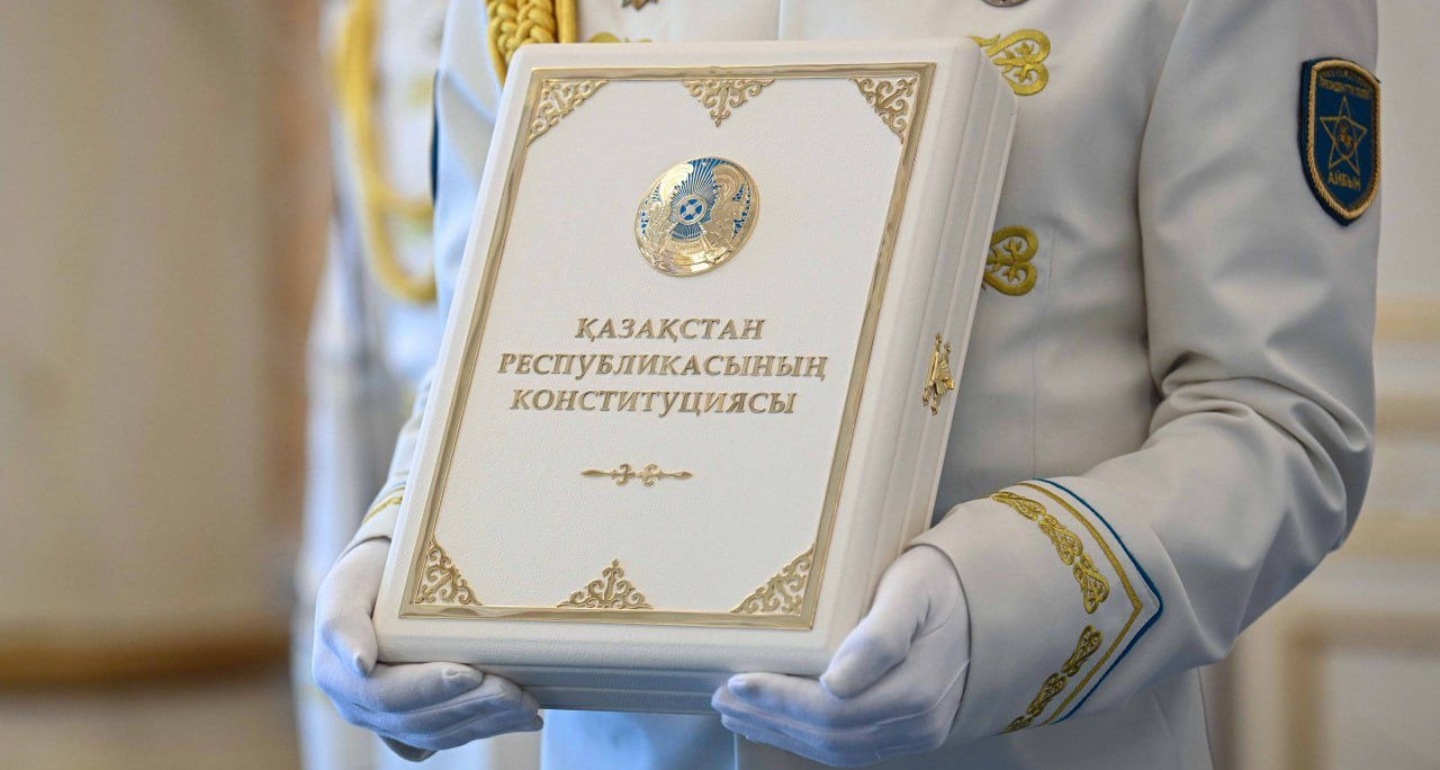
On July 1, a new constitution came into force in Kazakhstan which, according to President Kassym-Jomart Tokayev, symbolized the beginning of a new era in the country’s history. There are plenty of formal signs that this is the case: Kazakhstan now has a new unicameral parliament called the Quryltay, and a new ruling party, Adilet (Justice).
Yet New Kazakhstan (the country’s development concept) still rests on old foundations. The Constitutional Court recently ruled that Tokayev may nullify his presidential terms and run for office again in 2029: a scenario favored by autocrats worldwide. The president had stated previously that he did not intend to remain in power after 2029, but then again, promises made in interviews are not legally binding. Tokayev knows that experimenting with a successor could end badly, so he is keeping his options open.
The reset was preceded by a series of significant changes aimed at completely reorganizing Kazakhstan’s political system around Tokayev. First, the country adopted a new constitution. The president, in his own words, personally edited the final version. There has also been parliamentary reform: the Senate has been dissolved, and elections for the new unicameral Quryltay are slated for August 23.
Lastly, the party system has been restructured. The founding congress of the new ruling party, Adilet, was held in May, with the former head of the presidential administration Aibek Dadebay at its helm. Just one month later, the former ruling party, Amanat (Covenant of the Ancestors), which had approximately 800,000 members and was the successor to former president Nursultan Nazarbayev’s Nur Otan (Light of the Fatherland), dissolved itself and merged with Adilet. The new political force proudly announced that it had already received more than 810,000 membership applications. In all these moves, the authorities’ intentions are clear: They want to completely rid the ruling party of its Nazarbayev-era past.
After the August parliamentary elections, Tokayev will only need to add the finishing touches: reshuffle the government and appoint a vice president (a position that has returned to Kazakh politics after a long absence). In addition, he may set the record straight regarding the nullification of his terms—by announcing early presidential elections, for example.
By the end of 2026, Tokayev will have completely reshaped the political system to suit his own needs. At the same time, little will essentially change. The constitutional rewrite did not alter the fundamental reality of Kazakh politics: the president still controls all branches of government, and his powers are virtually unlimited. Parliament remains under the president’s thumb, passing only the laws the president deems necessary, and the new ruling party has simply absorbed the old one, along with most of its officials.
This is Tokayev’s second regime overhaul. It was needed to escape the sense that the system he put in place following the anti-Nazarbayev protests of January 2022 was merely a temporary measure. At that time, the changes were rushed and mainly boiled down to “de-Nazarbayevization.”
Tokayev took charge of the Security Council, forcing Nazarbayev to retire permanently. All references to the title of Elbasy (leader of the nation) held by Nazarbayev were expunged from the constitution. The capital was renamed from Nur-Sultan back to Astana, and the ruling party, Nur Otan, underwent a rebranding. At the same time, the presidential term was limited to a single seven-year term without the right to reelection, and relatives of the head of state were barred from holding high-ranking government positions. Four years later, Tokayev is cementing his position within this new political framework while trying to convince the public that the current rules of the game are here to stay.
On the surface, there is no trace left of Nursultan Nazarbayev in Kazakhstan’s political system. However, his legacy cannot be erased completely, since Nazarbayev’s protégé Tokayev remains at the heart of the regime.
The main slogan of the January 2022 protests in Kazakhstan was “get out, old man.” Tokayev capitalized on the energy of the streets and indeed got rid of all the old men in power. But in doing so, he himself became the new system’s most senior figure. His self-styling as the “new” president after Nazarbayev might make him appear younger, but Tokayev is seventy-three: the same age as Vladimir Putin. In this context, Kazakhstan’s elite appears relatively young: The average age of Security Council members is fifty-five, compared with sixty-four in Russia and fifty-seven in neighboring Uzbekistan.
After 2022, virtually no one of Tokayev’s generation was left at the pinnacle of power. The eighty-six-year-old Nazarbayev lost his status as Elbasy, along with all his lifetime privileges and political immunity. He remains in Kazakhstan but keeps a low profile.
Nazarbayev’s relatives and close associates have also faded into the background while managing to avoid the worst-case scenario for themselves. Neither the former president’s daughters, Dariga and Aliya, nor his sister Anipa have become the subject in criminal cases, though that possibility once loomed. However, they have virtually disappeared from the public eye.
Dinara and Timur Kulibayev—Nazarbayev’s middle daughter and her husband—have retained their business, but now bear an additional social responsibility to modernize infrastructure in the regions where they operate. The first president’s nephews—businessman Kairat Satybaldy and security official Samat Abish—faced court proceedings on various charges, but things turned out quite well for them: the former was released on parole, and the latter received a suspended sentence.
The prominent businessman Kairat Boranbayev avoided prison by returning nearly 150 billion tenge ($317 million) to the state budget. Other political heavyweights who failed to control financial flows faced quiet resignations. The former all-powerful head of the National Security Committee, Karim Masimov, drew the shortest straw: he was sentenced to eighteen years in prison for treason and attempting a coup in relation to the unrest of January 2022.
In time, Tokayev himself was the only member of Nazarbayev’s cohort left in power. He became the guarantor of the old elites’ security against the newcomers’ ambitions, but to build a truly post-Nazarbayev regime, Tokayev would have to rid the system of himself. That is too risky. During his seven years in power, the president has made plenty of enemies: To some, he is a man who betrayed Nazarbayev’s trust; to others, he is the embodiment of Nazarbayev’s legacy and the main obstacle on their path to absolute power.
Kazakhstan has seen a generational shift among its elites along with the dismantling of Nazarbayev’s legacy. Until recently, the country was ruled by people who had been in power since the Soviet Union’s collapse and the early days of independence. A new class has replaced them: young technocrats born in the 1980s and lacking their own political capital or financial empires.
Adilet’s political council is a microcosm of this new elite. Its leader, forty-six-year-old Aibek Dadebay, has spent his entire career working alongside Tokayev, from the Senate to the presidential administration. Adilet’s leadership also includes the architect of the “New Kazakhstan” ideology, deputy head of the presidential administration Yerlan Karin (forty-nine); Bagdat Musin (thirty-nine), the head of Kazakhstan’s largest telecommunications company, Kazakhtelecom; and prominent businessman Andrei Lavrentyev (forty-seven).
It is telling that thirty-five-year-old billionaire Shakhmurad Mutalip appears on this list. He has been systematically buying up the country’s largest industrial assets since late 2025. The businessman’s unclear funding sources and his ties to Tokayev’s inner circle have led investigative journalists to speculate that he is not, in fact, an independent oligarch, but rather a manager of other people’s capital.
Already, appointments are being made under New Kazakhstan’s personnel policy that do not quite align with its initial promises of renewal. The new constitution prohibits the president’s close relatives from holding high-level government positions. Yet in the first challenge to the new rules, businesswoman Dana Medeuova—Tokayev’s niece—has joined Adilet’s political council.
A new generation of leaders is also responsible for implementing these reforms: Prime Minister Olzhas Bektanov (forty-six), National Bank governor Timur Suleimenov (forty-eight), and chairman of the board of Samruk-Kazyna JSC Nurlan Zhakupov (at forty-six, he heads the country’s key holding company, overseeing structural reform of the quasi-public sector and the listing of non-core assets via IPOs). All these officials have risen through the ranks and owe their careers to Tokayev.
The new generation of leaders is a class of administrators, not politicians. They did not come to challenge the country’s leadership, limit the president’s power, or build democracy. They are here to create an effective form of state capitalism modeled after Singapore or China: a system where all key processes are automated, and the levers of control are tightly concentrated in the presidential administration’s hands.
Nullifying Tokayev’s term limits does not necessarily mean that he will run for reelection in 2029. That would be the simplest way to resolve the issue of a power transition, of course, but there are several other scenarios for Tokayev to choose from, depending on developments both domestically and abroad.
The president might run for reelection in 2029, or he might call for early elections right now. He might appoint a successor (presumably, that is why the office of vice president was reinstated in the constitution), or he might not. Or he could invent some kind of collective governing body to replace him altogether.
Even if Tokayev chooses the simplest option—a clean slate—it is important to him that the elites continue to believe that alternatives exist for as long as possible. Uncertainty allows him to maintain the upper hand.
But time is not on Tokayev’s side. It was no accident that Nazarbayev chose a rather elderly man as his successor. Tokayev looks younger than Nazarbayev, but seventy-three is too old to build a full-fledged personalistic regime and claim the status of new Elbasy.
That is precisely why Tokayev is demonstratively careful to preserve his predecessor’s legacy. After the unrest of 2022, he could have scored political points by publicly distancing himself from Nazarbayev. He chose a different path. The former president’s relatives remain free. Moreover, in July 2026—despite the potential reputational costs—the country’s main mosque was named after Nazarbayev. In doing so, Tokayev is establishing an unspoken agreement with his future successor: His own legacy ought to receive the same treatment someday.
Kazakh political analysts like to describe Tokayev as a thoughtful strategist who plans his moves years in advance and deliberately keeps those around him in a state of uncertainty. However, this air of mystery likely masks indecisiveness.
Nazarbayev outlined arrangements for a power transition too soon and in too much detail, ultimately losing control over the process. Tokayev is determined not to meet the same fate. So for now, his plan is to improvise—or at least to avoid broadcasting his intentions.

Fellow, Carnegie Russia Eurasia Center
Temur Umarov is an expert on China and Central Asia, and a fellow at the Carnegie Russia Eurasia Center.
Recent Work
Temur Umarov
Temur Umarov
Carnegie does not take institutional positions on public policy issues; the views represented herein are those of the author(s) and do not necessarily reflect the views of Carnegie, its staff, or its trustees.

Ex-president Gurbanguly Berdimuhamedov remains interested in politics, but his son Serdar, Turkmenistan’s current president, is becoming increasingly independent and willing to break with his father’s legacy. If their covert rivalry goes too far, both risk losing power.

Galiya Ibragimova

For every ruble allocated to social policy, health, and education in 2027, double that amount is earmarked for the army, the police, and the security services.

Alexandra Prokopenko
An analysis of traffic accident data suggests that Ukrainian drone attacks caused a material but not disastrous fall in Russian gasoline consumption over the summer.

Sergey Vakulenko

Sergei Kiriyenko used Russia’s parliamentary vote to further hone his strategy of corporate mobilization that is designed to maximize votes for United Russia.

Andrey Pertsev

The European far right might fail to steer EU policy in the direction Russia wants, but they will create enough chaos inside Europe to benefit the Kremlin.

Dimitar Bechev