

Commentary
Maxim Starchak
{
  "authors": [
    "Maxim Starchak"
  ],
  "type": "commentary",
  "blog": "Carnegie Politika",
  "centerAffiliationAll": "",
  "centers": [
    "Carnegie Endowment for International Peace",
    "Carnegie Russia Eurasia Center"
  ],
  "englishNewsletterAll": "",
  "nonEnglishNewsletterAll": "",
  "primaryCenter": "Carnegie Russia Eurasia Center",
  "programAffiliation": "",
  "programs": [],
  "projects": [],
  "regions": [
    "Russia",
    "United States"
  ],
  "topics": [
    "Nuclear Policy",
    "Arms Control",
    "Global Governance"
  ]
}
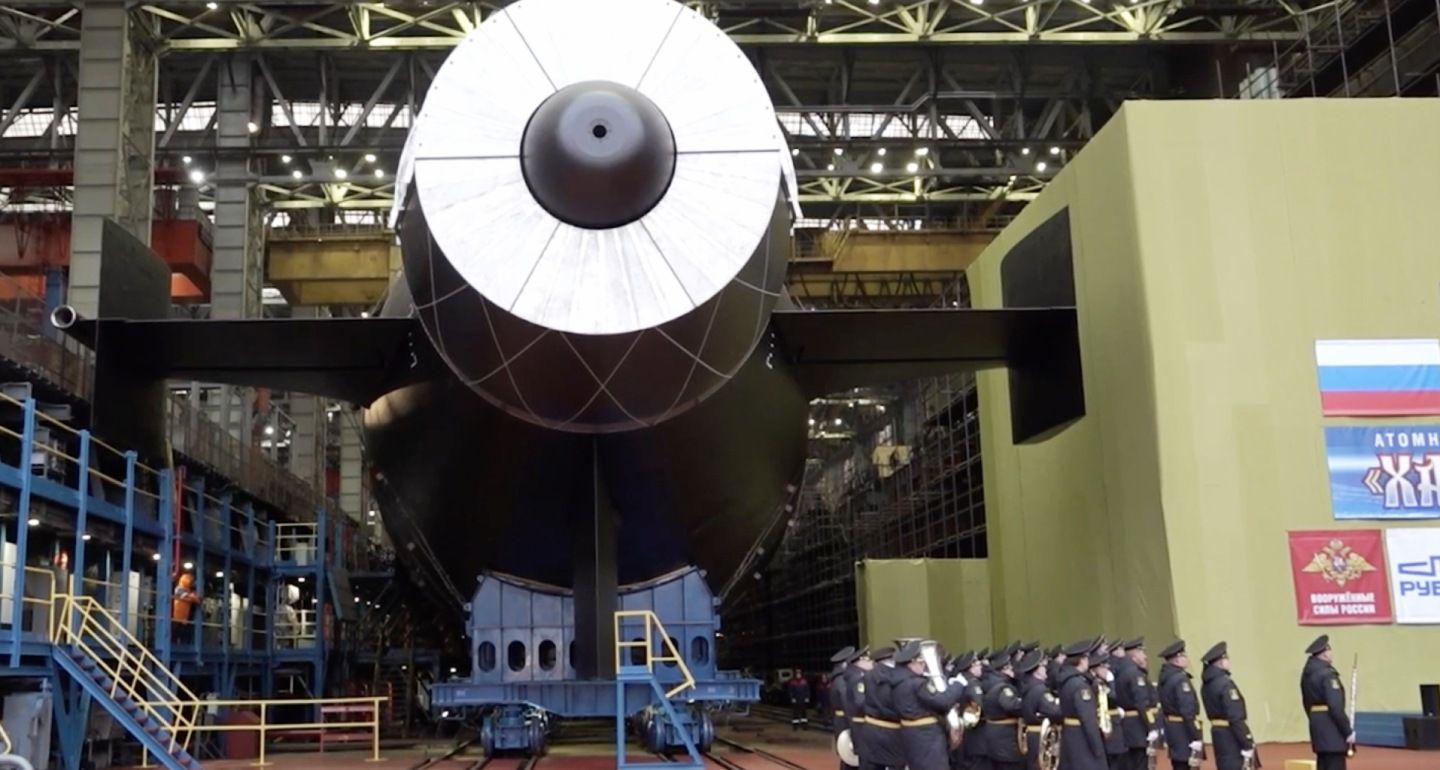
Source: Getty Images
The Kremlin will only be prepared to negotiate strategic arms limitations if it is confident it can secure significant concessions from the United States. Otherwise, meaningful dialogue is unlikely, and the international system of strategic stability will continue to teeter on the brink of total collapse.
Vladimir Putin likes to boast that Russia’s Burevestnik strategic cruise missile and Poseidon autonomous underwater vehicle are “unique” and “one-of-a-kind” nuclear-powered weapons systems. According to the Russian president, these nuclear weapon delivery systems were successfully tested in late October 2025. The Kremlin is confident that Poseidon and Burevestnik give the country a military advantage—and therefore leverage—over the United States.
Russia’s weapons development has not gone unnoticed by the United States. President Donald Trump has declared the need to resume nuclear testing, though he has so far avoided being more specific. The world is once again facing the threat of a new arms race and the conclusive collapse of strategic stability.
When the United States announced it was withdrawing from the Anti-Ballistic Missile Treaty (ABM) back in 2001, Putin had already warned that Russia would respond by developing non-ballistic nuclear delivery systems. Many experts in Russia and the United States argued that the U.S. missile defense system—both back then and in the future—would be incapable of significantly reducing the effectiveness of Russia’s nuclear potential. But Putin insisted that it could be completely devalued if Moscow simply stood by and observed the qualitative and quantitative development of the U.S. missile defense system from a distance.
The second motive was the United States’ development of precision-guided munitions (PGM): long-range cruise missiles. As early as the 1980s, Soviet and Western experts had noted that the growing power and precision of conventional weapons made them comparable to some types of nuclear weapons. After the collapse of the Soviet Union, Russia lost its leadership in the realm of conventional weapons and could no longer compete with the United States in the development of PGM.
During the presidency of Dmitry Medvedev (2008–2012), many Russian experts hoped that the New START (Strategic Arms Reduction Treaty) negotiations with the United States would resolve issues related to U.S. PGM and missile defense. But much to the indignation of many conservative Russian experts, the New START signed in April 2010 did not cover the development of U.S. strategic non-nuclear weapons. That bitter disappointment was exacerbated by the collapse of missile defense negotiations begun after the signing of the New START.
Gradually, a paranoid conviction set in in Russia that the U.S. PGM and missile defense system diminished the deterrence value of Russia’s nuclear arsenal. There were fears that despite Moscow’s nuclear parity with Washington, Russia could lose in a hypothetical conflict because the United States could use its superior strategic non-nuclear weapons to strike first and then use its missile defense system to repel retaliatory attacks.
That led to the development of weapons designed not only to offset Russia’s lag behind the United States, but also to counter new threats that would inevitably arise as technology advanced, including in the realm of missile defense.
As Putin prepared to return to the presidency for a third term in 2012, he named the development of the military and the defense industry as a key priority. In 2014, Russia’s new official military doctrine emphasized the dangers of strategic missile defense systems (which it said “undermine global stability and disrupt the established balance of power in the nuclear missile sphere”), as well as of strategic non-nuclear PGM systems. The state armament program for 2016–2025 outlined ways of countering this.
Russia’s lagging behind where PGM were concerned was partially offset by the development of cruise missiles and hypersonic weapons. As a result, Putin declared in 2017 that universal nuclear disarmament was not only possible, but that Russia would strive for it, as Moscow was in any case able to effectively respond to all challenges.
However, the disparity in economic potential between Russia and the United States made it impossible to maintain parity in conventional weapons. Furthermore, conventional missiles and their launch vehicles were insufficient to constitute an effective strategic deterrent. A different option was needed: something extremely powerful but more cost-effective. Accordingly, the decision was made to revive Soviet nuclear-powered superweapons.
By 2018, Russia had stopped working on combat rail-mobile missile systems and RS-26 Rubezh missiles: classic nuclear weapons that were covered by the existing START system. That allowed it to redirect resources to more advanced developments that are not covered by any international agreements (elements of the U.S. missile defense system and the PGM being developed by Washington are not covered by them either).
Thanks to their nuclear propulsion systems, the Poseidon underwater vehicle and Burevestnik cruise missile have a potentially unlimited range and flexibility in terms of their attack trajectory. Poseidon can strike a variety of targets—from groups of aircraft carriers to coastal fortifications—with both conventional and nuclear warheads. Poseidons will be carried by specialized submarines, which makes the drones less autonomous but allows them to be used for the widest possible range of tactical missions.
As for the Burevestnik missiles, Putin has said they have yet to be classified as a specific class of weapon. That means Russia could view these missiles as multipurpose: not only as an element of strategic deterrence, but also as a viable means of combat.
According to the rhetoric of the Russian leadership and pro-government experts, the advent of the Poseidon and Burevestnik systems does not mean the country will be dragged into another arms race. The logic is that even a very small number of these systems is enough to constitute the “active defense doctrine” promoted by Russian Chief of the General Staff Valery Gerasimov: that threats from the West must be met by “creating new threats.”
In this regard, the Russian Foreign Ministry’s statements that current agreements with the United States do not require Russia to notify the other country of planned Poseidon tests are very telling. Unlike intercontinental ballistic missile tests, which have long been viewed as a formality, this could keep the United States on constant alert. In other words, a torpedo that hasn’t even entered service yet has shown itself to be a means of projecting strength and of nuclear escalation. De facto, this could lead not only to an escalation in the nuclear sphere, but also to a new qualitative and quantitative arms race.
Back in 2015, the Kremlin decided that given the threats posed by U.S. PGM and missile defense, Russia could no longer reduce its nuclear arsenal. The following year, the Foreign Ministry said Moscow was not prepared to resume START negotiations, explaining that Russia now had minimum levels of nuclear warheads and delivery systems, while the United States continued to develop systems capable of “inflicting disarming strikes without the use of nuclear warheads, but with a range equal to that of strategic assets.” In other words, the prospect of further strategic arms reductions was linked to resolving the issue of PGM.
Since then, Russia has developed nuclear-powered systems and—at least in the Kremlin’s interpretation—gained a strategic advantage: the United States is now supposedly losing the nuclear arms race. The Poseidon and Burevestnik, effectively ready for permanent combat duty, are perceived as a way to compensate for the United States’ numerical superiority in conventional PGM (primarily cruise missiles and potentially medium-range missiles close to Russia’s borders). Moreover, for Moscow, this has become an alternative to establishing military bases in Latin America, in the United States’ backyard.
Moscow’s conviction that the global strategic balance is shifting in its favor reinforces its reluctance to enter into serious discussions about arms reductions. Russian defense industry representatives and experts are convinced that having obtained a military advantage over the United States, Russia must now continue this game of catch-up for as long as possible. Even an end to the war in Ukraine, they argue, will not lead to peace, so Russia’s nuclear arsenals must not be reduced under any circumstances.
In many ways, nuclear-powered weapons are intended to play the same role as tactical nuclear weapons (TNW). After the Soviet collapse, Russia began to view TNW primarily as a way to offset NATO countries’ superiority in terms of conventional weapons. Putin has made it clear that the Kremlin has no intention of abandoning TNW, as they provide additional security guarantees. Russia may also consider Poseidon and Burevestnik to be cornerstones of its security, as well as a good way to compensate for U.S. superiority in PGM.
Just as growth in the production of Russian PGM didn’t initially open the door to an agreement on TNW, the emergence of nuclear-powered weapons is unlikely to create the conditions for negotiations. The United States’ overall military superiority could become an evergreen excuse for Putin to refuse to enter into substantive dialogue. Furthermore, the financial factor is greatly diminished. Several decades ago, one of the benefits of arms control agreements was the savings they offered, but today that aspect is negligible: the small number of advanced weapons does not put significant pressure on the budget.
Against this backdrop, conservative American experts are advocating for a resumption of nuclear testing and the expansion of U.S. nuclear forces. The country’s need to develop its own nuclear-powered underwater drones is also being discussed. President Trump has expressed his support for many of these proposals. Such trends on both sides cannot help but undermine global strategic stability even further.
The accumulated challenges to strategic stability could be resolved through negotiations. But in Putin’s Russia, the negotiating process is seen primarily as a means of obtaining concessions from the United States. Without concessions, negotiations lose all value for Moscow.
Before the start of the full-scale war against Ukraine, Russian Foreign Minister Sergey Lavrov said that limitations on new weapons could only be discussed in the context of the reasons that had led to their creation. Among these, he included the development of the U.S. missile defense system and concept of a “prompt global strike” (now known as a conventional prompt strike, which envisages the ability to strike anywhere in the world using precision-guided conventional weapons within one hour). Russia attempted to push through a resolution that would have given it an advantage on these issues at the 2021 Geneva summit between Putin and then U.S. president Joe Biden, but failed to do so.
Following the Poseidon and Burevestnik tests, Russia’s desire to extract concessions from the United States has only intensified. Retired Major General Vladimir Dvorkin is confident that unless the United States develops comparable systems, it will be extremely difficult, if not impossible, to include these new weapons in the next strategic arms treaty (the New START expires on February 5). Experience has shown that asymmetry in strategic arms significantly complicates nuclear arms control negotiations.
Many Russian experts are working on the basis that the United States will not develop analogues of the Poseidon and Burevestnik missiles purely to maintain parity. The implication is that it will lack any technological advantages in potential negotiations on a successor to the New START. Therefore, these experts argue, Russia will retain leverage in any potential dialogue for many years to come.
Putin’s proposal to maintain the quantitative ceilings stipulated in New START for one more year is intended to demonstrate Russia’s willingness to negotiate, but in practice, it changes nothing. It would be impossible to develop and finalize a new agreement in that time. Meanwhile, Moscow would retain its strategic arms advantage for another year, while preventing the United States from increasing its own nuclear arsenal.
If Washington decides to enter into negotiations, Russia, confident in its advantage, will demand concessions. Yet there are no grounds to believe the United States is prepared to compromise on missile defense or PGM. Russia stands to gain in any scenario: it will be able to accuse the other side of intractability both if the United States declines to negotiate and if Washington agrees to talk but then does not make concessions.
Since the 1980s, the international community has been accustomed to ongoing bilateral dialogue on arms control, and its absence is now perceived as an anomaly. However, past successes in this area were linked to democratic reforms in the Soviet Union and then Russia: the country was willing to compromise. Now, despite the contact between Putin and Trump, the preconditions for this are absent. Moscow is focused not on reaching agreements, but on strengthening its dominance.
The emerging asymmetry in strategic weapons is creating a sense within the Russian government that the country is winning the new arms race. Confident of its superiority over the United States, Moscow is attempting to dictate the terms, format, and agenda of possible future arms control negotiations.
The Kremlin will only be willing to negotiate strategic arms limitations if it is confident it can secure significant concessions from the United States. Otherwise, meaningful dialogue is unlikely, and the international system of strategic stability will continue to teeter on the brink of total collapse: Russia will continue to develop its nuclear forces, and the United States will respond. A nuclear arms race will become an intrinsic part of international relations, especially if Washington concludes that attempts to agree control over new weapons with Moscow are futile.

Maxim Starchak
Expert on Russian nuclear policy
Recent Work
Maxim Starchak
Maxim Starchak
Carnegie does not take institutional positions on public policy issues; the views represented herein are those of the author(s) and do not necessarily reflect the views of Carnegie, its staff, or its trustees.
Most of Moscow’s military resources are tied up in Ukraine, while Beijing’s foreign policy prioritizes economic ties and avoids direct conflict.


Alexander Gabuev, Temur Umarov
With the White House only interested in economic dealmaking, Georgia finds itself eclipsed by what Armenia and Azerbaijan can offer.

Bashir Kitachaev

If the regime in Tehran survives, it could be obliged to hand Moscow significant political influence in exchange for supplies of weapons and humanitarian aid.

Nikita Smagin
The interventions in Iran and Venezuela are in keeping with Trump’s strategy of containing China, but also strengthen Russia’s position.

Mikhail Korostikov
Arms supplies from Russia to Iran will not only continue, but could grow significantly if Russia gets the opportunity.
Nikita Smagin