

Other
Fiona Hill, Anatol Lieven, Thomas de Waal
{
  "authors": [
    "Anatol Lieven"
  ],
  "type": "legacyinthemedia",
  "centerAffiliationAll": "dc",
  "centers": [
    "Carnegie Endowment for International Peace"
  ],
  "collections": [],
  "englishNewsletterAll": "ctw",
  "nonEnglishNewsletterAll": "",
  "primaryCenter": "Carnegie Endowment for International Peace",
  "programAffiliation": "russia",
  "programs": [
    "Russia and Eurasia"
  ],
  "projects": [],
  "regions": [
    "United States",
    "United Kingdom"
  ],
  "topics": [
    "Political Reform",
    "Democracy"
  ]
}
REQUIRED IMAGE
Garton Ash's account of Britain's position, and the responses adopted to their national dilemma by British citizens, is the strongest part of his book. He is particularly good at demolishing myths, such as the re-creation of Churchill by the British and American Right as an anti-European Atlanticist.
Source: The Tablet (London)
I would very much like to believe in the core message of Timothy Garton Ash's latest book, Free World: that a renewed and strengthened Euro-Atlantic partnership is possible, as part of a wider movement to bring democracy and freedom to the whole world. That such a partnership is desirable is beyond question.
A complete collapse of the European-American alliance, involving "the end of the West" as a meaningful ideological and geopolitical concept, would be a disaster for humanity. Garton Ash's book takes its point of departure from the dilemma of "Janus Britain", caught between the conflicting imperatives of cooperation with the European Union and with the United States. His account of Britain's position, and the responses adopted to their national dilemma by British citizens, is the strongest part of his book. He is particularly good at demolishing myths, such as the re-creation of Churchill by the British and American Right as an anti-European Atlanticist.
Garton Ash's conclusion is that Britain simply cannot choose between the United States and Europe: that the divisions in British society on this issue are so profound, and reflect such old, strong British traditions, that a definitive choice one way or the other is out of the question. Whether we like it or not, Britain is doomed to go on trying to provide a bridge between the United States and Europe and to seek a stronger role both in the European Union and in cooperation with the United States. Of course, as Garton Ash also argues very cogently, "Europe" and "America" are anything but opposed monolithic cultural blocs. Under Clinton, many Europeans may have had numerous problems with American international policies, but they did not feel that the President himself embodied an alien political and moral culture.
America after all has one of the oldest, most powerful liberal traditions in the world, intimately related to those of Britain and western Europe. Today, a great many Americans are bitterly alienated by both the policies and the culture represented by George Bush and the dominant forces in his administration. There is nonetheless every chance that he will be re-elected in November. If so, this will be a black day for American democracy and its image in the world, for it will be thanks in large part to an election campaign of quite exceptional coarseness and sheer mendacity on the part of the Republicans.
It will also be a black day for the American-European relationship, for some of the American groups most strongly represented in this administration possess cultures which while certainly not characteristic of a majority of Americans, are radically alien to the dominant culture of contemporary Europe. This is especially true of the overlapping worlds of fundamentalist Christianity and radical American nationalism. But of course, Bush's re-election, though extremely damaging if it happens, will not be the end of the story. There is even an argument that it could be for the best in the long term for the Republicans to have to take responsibility for the consequences of their actions. In this case, there is more chance that a Democrat victory in 2008 or 2012 could lead to a true generational shift in American politics and political culture. In this case, the prospects for long-term trans-Atlantic cooperation would look considerably brighter.
So, like Garton Ash, I continue to hope. But hope, alas, is not the same as analysis. When Garton Ash describes the real chances in the short-to-medium term of Britain acting as a bridge, and of renewed co-operation between the United States and Europe, if only we wish for this strongly enough, the quality of his analysis declines sharply. His tone meanwhile assumes a kind of brave but desperate Blairite chirpiness, like the ragtime played on that great Anglo-American institution the Titanic.
This is above all true of the two most important issues facing the United States and Europe today, namely global warming and the threat of Islamist terrorism. On neither is there much real chance of the kind of shift in American attitudes and power structures which would bring the United States much closer to Europe. I fear that it will take many years and many disasters for this to change.
On the question of the war on terror and relations with the Muslim world, Garton Ash's hopefulness leads him very largely to ignore the greatest obstacle to European support for the United States in the region, namely the role of Israel and America's support for Israel. This is not just a matter of the effect of Israeli policies on Muslim public opinion. The Israeli lobby in the US has also played the central role in preventing any rational American policy towards Iran and Syria. To judge by the election campaign, this is likely to continue under a Democrat administration -especially if the Republicans go on controlling Congress.
The deep hostility of the rulers of these countries to al-Qaida-style Sunni extremism has given the United States tremendous opportunities to rally Muslim support. It is wantonly, criminally, throwing this opportunity away. In consequence, it is extremely difficult for intelligent and well-informed European leaders to have any real confidence in US leadership in this region; and without such confidence, how can they ask their publics to make sacrifices and run risks in support of American strategy?
It must also be stated that even where European and other countries have supported the US in Iraq, for example, with the sole exception of Britain their contributions have been pathetic. Even Britain's much greater contribution has brought Blair limited visible influence and many all too visible snubs and humiliations. It has sometimes seemed that he has bought a place at America's "top table" by becoming an American cabinet minister and accepting cabinet discipline - rather like Colin Powell. An argument can indeed be made that this is in Britain's national interests. Whether it accords with British national dignity and self-respect is another matter.

Former Senior Associate
Recent Work

Fiona Hill, Anatol Lieven, Thomas de Waal
Carnegie does not take institutional positions on public policy issues; the views represented herein are those of the author(s) and do not necessarily reflect the views of Carnegie, its staff, or its trustees.

The greater threat to Zelensky comes not from Fedorov alone, but from the convergence between the former defense minister’s political campaign and the anti-corruption investigations moving ever closer to the presidential administration.

Balázs Jarábik

With his public call for new elections in Ukraine, ex-defense minister Mykhailo Fedorov has opened Pandora’s box.

Konstantin Skorkin

In the discussions made possible by the State Duma election campaign, one question is being asked more and more loudly. “What next?”

Andrey Pertsev

Two divergent trends—Putin’s hardline vision of how to prosecute the war in Ukraine, and a growing desire for change in Russia—could tear the regime apart.

Tatiana Stanovaya
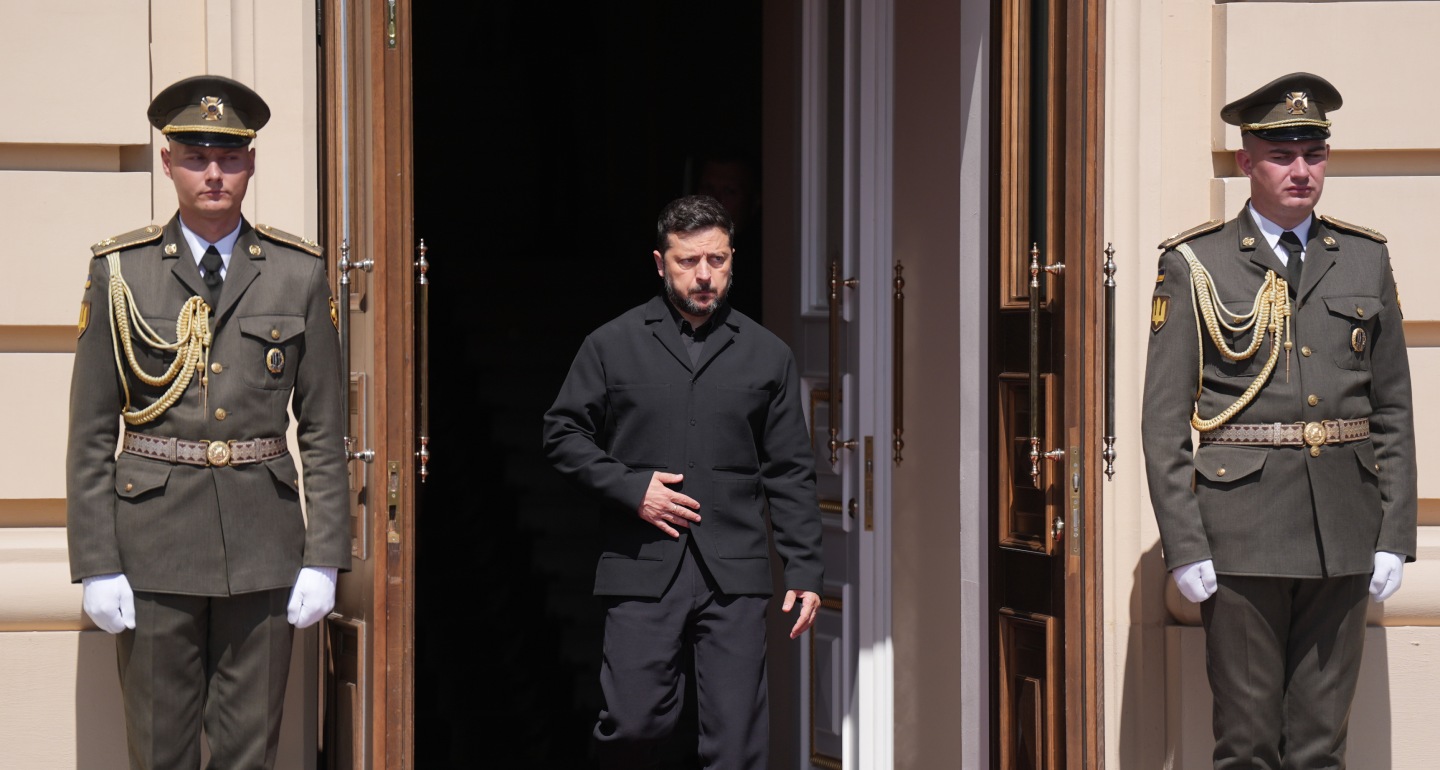
Ultimately, Zelensky sided neither with the reform camp nor with the military establishment as such, but with political control.
Balázs Jarábik