

Paper
Ashley J. Tellis
{
  "authors": [
    "Ashley J. Tellis"
  ],
  "type": "legacyinthemedia",
  "centerAffiliationAll": "dc",
  "centers": [
    "Carnegie Endowment for International Peace"
  ],
  "collections": [
    "U.S. Nuclear Policy"
  ],
  "englishNewsletterAll": "ctw",
  "nonEnglishNewsletterAll": "",
  "primaryCenter": "Carnegie Endowment for International Peace",
  "programAffiliation": "NPP",
  "programs": [
    "Nuclear Policy",
    "South Asia"
  ],
  "projects": [],
  "regions": [
    "North America",
    "United States",
    "India"
  ],
  "topics": [
    "Nuclear Policy"
  ]
}
Source: Getty
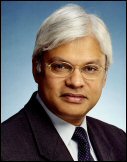
Dr. Ashley J. Tellis, who has been intimately involved in the negotiations of the Indo-U.S. civilian nuclear agreement, believes 'this is the last chance the two sides have to get the impasse over the 123 Agreement resolved and get going on the next phase of the deal before problems arise with the Congressional calendar.'
Source: Aziz Haniffa interviewing Ashley J. Tellis in India Abroad

On the eve of the visit to Washington by a high-powered Indian negotiating team led by National Security Adviser M K Narayanan and also comprising Foreign Secretary Shiv Shankar Menon and Atomic Energy Commission chairman Anil Kakodkar, who will meet over two days with the U.S. team led by National Security Adviser Stephen Hadley and Burns, Tellis said, "Both sides are aware of the need to complete the agreement quickly."
In an exclusive interview with rediff.com, Tellis, currently senior associate at the Carnegie Endowment for International Peace -- one of the leading think tanks in U.S., acknowledged: "The fact that M K Narayanan himself is coming indicates a desire to reach agreement and move on to the next step."
"As you know, there are still many things that need to be done before Indo-U.S. nuclear cooperation actually materializes," he added.
Tellis said he disagreed with the contention in many quarters in New Delhi, including the establishment, that the U.S. has moved the goal-posts on the agreement and said the reason why 123 Agreement has remained in limbo and yet to be sealed is because "what most people don't realize about the 123 is that this is a very challenging agreement for both sides."
He explained that "all the 123 agreements we have concluded before have been done either with non-nuclear weapons states or with nuclear weapons states. There are standard templates that apply to each of these cases. India, in contrast, is in a very odd category all by itself: it is, formally speaking, a non-nuclear weapons state that happens to have nuclear weapons."
"So, coming up with language that addresses India's unique circumstances is something that has taken longer than people expected initially," he said, adding, "It is this structural difficulty of finding legal language to express India's unique circumstances that has been the most difficult part of this negotiation."
Tellis said that 'unlike a joint statement, which is a political declaration where one can afford to use loose formulations, the 123 Agreement is a document really drafted by lawyers for lawyers and so the precision that is required is really remarkable."
He predicted that India's offer of the reported proposal to put a dedicated facility under safeguards, could be a positive contribution to moving the process forward during the talks led by Narayanan.
"In fact, I suspect this will be the subject of discussions," Tellis said, adding, "I have seen what has appeared so far in the press -- and it will be interesting to see what Narayanan and Menon, bringing in terms of specifics. I am sure the US side will be waiting for details on that."
He said that be strongly believed that this proposal "could be an enormously helpful way forward."
Tellis, who has been one of the leading cheerleaders of the deal, said he simply could not comprehend the agreement failing because of the adverse ramifications it could have for the envisaged strategic partnership between India and the United States.
"It is the centerpiece of everything that the two countries are trying to do for the simple reason that it goes fundamentally to the President's and the prime minister's efforts to build a new sense of trust," he said.
Tellis said: "From both ends, this is a very high-stakes gamble that the President and the prime minister have undertaken. That's why it cannot fail, why it must not fail. For both sides, it is absolutely imperative that we do not fail."
This article originally appeared in India Abroad, July 20, 2007.
Former Senior Fellow
Ashley J. Tellis was a senior fellow at the Carnegie Endowment for International Peace.
Recent Work
Ashley J. Tellis
Ashley J. Tellis
Carnegie does not take institutional positions on public policy issues; the views represented herein are those of the author(s) and do not necessarily reflect the views of Carnegie, its staff, or its trustees.

Trump has promised Belarus a massive potash deal. But Minsk is seeking something greater: restored Western transit and greater room for maneuver from Russia.

Balázs Jarábik

Minsk clearly expected the dialogue with Washington to yield more results, in particular the lifting of EU sanctions and permission to export potash.

Artyom Shraibman

With the growth in points of friction between the great powers, organizations like the SCO will continue to play a role in the strategic adaptation of the smaller powers caught between them.

Temur Umarov

Ongoing uncertainty in the Middle East allows Moscow to both increase its influence in Tehran and continue to enjoy the financial windfall of higher oil prices.

Nikita Smagin
The demands of the Kremlin’s war in Ukraine, demographic problems, and public hostility toward Central Asians mean Russia does not have enough workers.
Salavat Abylkalikov