

Paper
Omayma Abdel-Latif
{
  "authors": [
    "Omayma Abdel-Latif"
  ],
  "type": "legacyinthemedia",
  "centerAffiliationAll": "dc",
  "centers": [
    "Carnegie Endowment for International Peace",
    "Malcolm H. Kerr Carnegie Middle East Center"
  ],
  "collections": [],
  "englishNewsletterAll": "menaTransitions",
  "nonEnglishNewsletterAll": "",
  "primaryCenter": "Malcolm H. Kerr Carnegie Middle East Center",
  "programAffiliation": "MEP",
  "programs": [
    "Middle East"
  ],
  "projects": [],
  "regions": [
    "Lebanon"
  ],
  "topics": [
    "Political Reform"
  ]
}
Source: Getty
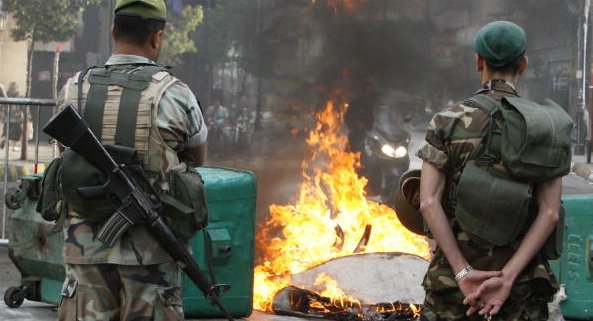
The decision made by the Special Tribunal for the Lebanon Court to release four generals held by the Lebanese authorities since August 2005 without trial has increasingly exacerbated political polarisation in the country one month away from parliamentary elections.
Source: Al Ahram Weekly

It was hoped that the ruling would have calmed the waters, erasing doubts about the politicisation of the Special Tribunal, but it seems to have added fuel to the political fire. The forces of March 14 insisted that the ruling was stunning evidence of the de-politicisation of the Special Tribunal, crushing the opposition's allegations against the international Court. The March 8 forces are not so easily deterred, arguing that the ruling is not so much evidence of the court's objectivity, as it is the result of a lack of sufficient evidence to indict the generals, a conclusion which, they say, the Lebanese judiciary system should have reached long ago, but precisely because of the influence of politics, it failed to do, instead waiting for it to come from an international court. The ruling raises pressing questions regarding the fate of the four-year investigation led by the International Investigation Committee.
The four generals -- former head of the presidential guard Mustafa Hamdan, Security Services Director Jamil Sayed, Domestic Security chief Ali Hajj and Military Intelligence Chief Raymond Azar -- were detained at the orders of Detlev Mehlis, the first prosecutor of the UN International Independent Investigation Committee (IIIC) investigating the killing of former prime minister Rafik Al-Hariri after testimonies by a former Syrian officer Mohamed Zuhair Al-Sadiq and Hossam Hossam.
The release of the four generals fuelled doubts over the fate of the four-year investigation carried out by the IIIC and the Lebanese courts. Also in light of crucial challenges such as the lack of suspects or detainees, the fate of the Special Tribunal investigation remains in question. The investigation has been dogged right from the beginning with a bad reputation.
During the era of the first IIIC presided over by Judge Detlev Mehlis, the investigation was accused of being politicised and even following the orders of the Bush administration which wanted to use the international court as a tool to pressure Syria. Mehlis himself made press leaks which suggested that the investigation was moving to conclude that Syria played an active role in the assassination. It was during this stage when witnesses such as Al-Sidiq and Hossam came into the limelight. Later both turned out to have provided the investigation with false testimonies. While Hossam went back to Syria and retracted his statements, Al-Sidiq, protected by French intelligence for the past four years, was arrested a month ago in the United Arab Emirates, and Syria is seeking to extradite him.
The second stage of the investigation took place when Belgian Judge Serge Brammertz was installed as the new investigation commissioner in January 2006. The investigation began to look more professional. And the third phase began with the launch of the Special Tribunal for Lebanon.
The opposition based its argument on the fact that the false witnesses upon whose testimonies the investigation was based for four years should be brought for trial before the Lebanese court. The opposition argues that unless the two judges responsible for the officers' detention without charge -- Said Mirza and Saqr Saqr -- take responsibility and unless those false witnesses are brought to justice, there could be no guarantee that the investigation will not rely on false witnesses yet again.
In his speech, Hizbullah Secretary-General Hassan Nasrallah said the ruling "ended a dark period" although he said he would not pre-judge the next stage of the investigation. He remains sceptical. Nasrallah set three conditions he believed will put the investigation on the right track. First the false witnesses who misled the investigation and undermined it should be brought to justice in a Lebanese court. Secondly, all possibilities in the investigation should be opened, including the possibility of Israel being behind the assassination in order to invoke a civil strife in the country. The third and most important condition is the building up of a national consensus over the investigation. Such a national consensus existed in the early days of the assassination but Lebanese were split over who should carry out the investigation.
It is very hard to conceive how such a national consensus could be restored in light of the extreme level of political polarisation in the country. The opposition's call for the resignation of Mirza and Saqr was portrayed by the majority as an attempt to undermine one of the state's institutions. But high-level opposition sources said that the opposition's battle is not with the judiciary as the majority claims, but is rather with these two particular judges. It was the majority which chose to refer the investigation of Al-Hariri's assassination to an international court because it had little or no faith in the Lebanese judiciary.
The opposition's call to take to the street in protest against Mirza and Saqr raised questions about the fate of the forthcoming parliamentary elections only a month from now. A consensus inside the opposition over street activity failed to materialise. Both General Michel Aoun, the key Christian ally in the opposition coalition, as well as Hizbullah's ally, parliament speaker Nabih Berry, refused to participate in such activity.
The Higher Judicial Council convened on Tuesday to address the consequences on the four generals' release. But the opposition's campaign against the council to force it to reform by purging the two judges is unlikely to yield the intended consequences. The council itself will terminate in five weeks. Only the chairman of the council Judge Ghaleb Ghanem will remain in his place, and following the elections a new council will have to be selected. According to the Taif Agreement only two out of the 10 judges comprising the council are selected by judges and the other eight are selected by the government, which leaves the highest judicial body under the influence of politics. The new government will then appoint a new district attorney.
Former Research and Program Associate, Middle East Center
Abdel-Latif, formerly the assistant editor-in-chief at Al-Ahram Weekly, has done extensive work on Islamist movements with special emphasis on the Muslim Brotherhood of Egypt.
Recent Work
Omayma Abdel-Latif
Omayma Abdel-Latif
Carnegie does not take institutional positions on public policy issues; the views represented herein are those of the author(s) and do not necessarily reflect the views of Carnegie, its staff, or its trustees.
The return of parliamentary politics reflects a broader shift from earlier expectations of a settlement and elections toward the reality of a prolonged war.
Balázs Jarábik
The Russian state has opted for complete ideological control of the internet and is prepared to bear the associated costs.

Maria Kolomychenko
After four years of war, there is no one who can stand up to the security establishment, and President Vladimir Putin is increasingly passive.

Tatiana Stanovaya
It’s true that many Armenians would vote for anyone just to be rid of Pashinyan, whom they blame for the loss of Nagorno-Karabakh, but the pro-Russia opposition is unlikely to be able to channel that frustration into an electoral victory.
Mikayel Zolyan
The front-runner to succeed Ilia II, Metropolitan Shio, is prone to harsh anti-Western rhetoric and frequent criticism of “liberal ideologies” that he claims threaten the Georgian state. This raises fears that under his leadership the Georgian Orthodox Church will lose its unifying role and become an instrument of ultraconservative ideology.

Bashir Kitachaev