

Report
- +3
James M. Acton, Alexey Arbatov, Vladimir Dvorkin, …
{
  "authors": [
    "Petr Topychkanov"
  ],
  "type": "other",
  "centerAffiliationAll": "dc",
  "centers": [
    "Carnegie Endowment for International Peace",
    "Carnegie Russia Eurasia Center"
  ],
  "collections": [],
  "englishNewsletterAll": "democracy",
  "nonEnglishNewsletterAll": "",
  "primaryCenter": "Carnegie Russia Eurasia Center",
  "programAffiliation": "DCG",
  "programs": [
    "Democracy, Conflict, and Governance",
    "South Asia"
  ],
  "projects": [
    "Eurasia in Transition"
  ],
  "regions": [
    "South Asia",
    "Afghanistan",
    "Pakistan"
  ],
  "topics": [
    "Political Reform",
    "Democracy",
    "Economy",
    "Security"
  ]
}
Source: Getty
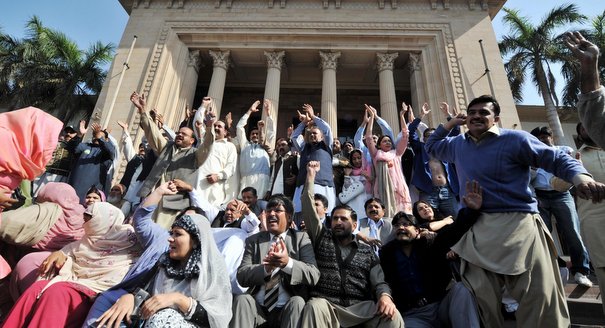
Islam alone will not aid Pakistan’s political development; instead, national stability will improve with better administrative, security, economic, and social services.
This paper analyzes the current situation in Pakistan through the prism of the country’s historical experience, proposing new approaches to the threats to Pakistan’s territorial integrity and the stability and security of South Asia as a whole.
Conventional political science labels, such as authoritarianism, democracy, Islamism and secularism, are of little use when applied to Pakistan. “Pakistan’s history shows that giving priority to Islam can be combined with a democratic system of government, as well as with an authoritarian regime,” Topychkanov writes. Islam’s supremacy in Pakistani society has manifested itself primarily through Muslim nationalism and Islamic socialism, as well as through various radical forms of Islamic ideology. Experiments with Islam, which is the foundation of the country’s national identity, are therefore not the solution to Pakistan’s problems. Resolving these problems requires comprehensive solutions that encompass the political, economic and social spheres.
Pakistan’s history shows that giving priority to Islam can be combined with a democratic system of government, as well as with an authoritarian regime.
Topychkanov also notes that the external environment, particularly problems in Afghanistan, has had a negative impact on Pakistan’s political development. Protracted or failed operations of the International Security Assistance Force in Afghanistan would strengthen pro-Taliban forces in Pakistan, while stabilization in Afghanistan would help weaken these groups and stop the rise of support for religious extremism. The escalation of tensions between Pakistan and India also contributes to the spread of extremism in Pakistan.
Topychkanov proposes a number of policy approaches, suggesting that the planning and implementation of aid programs for Pakistan should meet three main criteria:
Former Fellow, Nonproliferation Program, Moscow Center
Topychkanov was a fellow in the Carnegie Moscow Center’s Nonproliferation Program.
Recent Work


James M. Acton, Alexey Arbatov, Vladimir Dvorkin, …
Petr Topychkanov
Carnegie does not take institutional positions on public policy issues; the views represented herein are those of the author(s) and do not necessarily reflect the views of Carnegie, its staff, or its trustees.

If the Russian-speaking community in Latvia cannot articulate their interests without being seen as disloyal, they could end up embracing a pro-Kremlin agenda.

Sergejs Potapkins

Russia’s ruling party would have benefited from Putin appearing as its distant patron, but as an active frontman imposing his views on the public, he has done nothing but harm both the party’s election campaign and the ruling system overall.

Andrey Pertsev

Depleted financial reserves and a shrinking tax base mean it is no longer possible to simultaneously deliver high defense spending, price stability, and economic growth.

Alexandra Prokopenko

In the tenth year of his presidency, President Mirziyoyev’s system is becoming even more personalized than that of his predecessor Karimov.

Galiya Ibragimova

With the growth in points of friction between the great powers, organizations like the SCO will continue to play a role in the strategic adaptation of the smaller powers caught between them.

Temur Umarov