

Commentary
Michael Pettis
{
  "authors": [
    "Michael Pettis"
  ],
  "type": "legacyinthemedia",
  "centerAffiliationAll": "dc",
  "centers": [
    "Carnegie Endowment for International Peace",
    "Carnegie Russia Eurasia Center"
  ],
  "collections": [],
  "englishNewsletterAll": "asia",
  "nonEnglishNewsletterAll": "",
  "primaryCenter": "Carnegie Endowment for International Peace",
  "programAffiliation": "AP",
  "programs": [
    "Asia"
  ],
  "projects": [],
  "regions": [
    "North America",
    "United States",
    "East Asia",
    "China",
    "Southeast Asia",
    "Western Europe"
  ],
  "topics": [
    "Economy",
    "Trade",
    "Foreign Policy"
  ]
}
Source: Getty
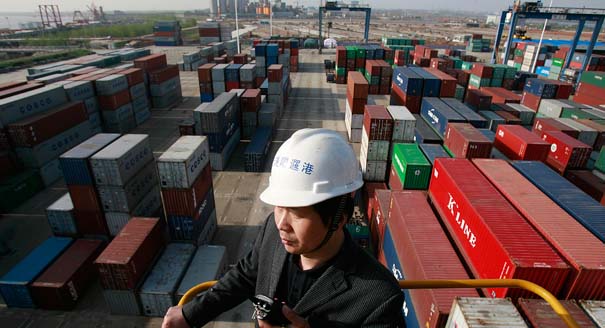
As Asian countries seek to maintain trade advantage by manipulating their currencies, the United States and Europe, who have little room to devalue, may respond with protectionist measures that will hurt global trade.
Source: Financial Times

In the 1930s many, but not all, major economies imposed draconian constraints on trade which sharply contracted international commerce and almost certainly slowed the global recovery. It was widely understood then that the collapse in international trade would only worsen the crisis, and yet countries, seeking to protect their own positions, collectively engaged in behaviour that left them worse off.
American economists Barry Eichengreen and Douglas Irwin recently published a paper examining the roots of the post-1930 surge in protection. They argue that during the 1920s and shortly after the onset of the 1929 crisis, several countries abandoned the gold standard and engaged in beggar-thy-neighbour competitive devaluations. These countries subsequently experienced rapid improvements in their trade balances and suffered much less from the ravages of the global contraction of the 1930s.
But others, most obviously the US and European “gold bloc” countries, were sharply constrained in their ability to adjust their currencies. These countries suffered much of the brunt of the adjustment as imports became more competitive against their domestic industries, especially in relation to countries that were less constrained. These were also the countries that were most likely to resort to what the authors call the “second-best” adjustment mechanisms – tariffs, import quotas, exchange controls, and so on.
“The exchange rate regime and economic policies associated with it were key determinants of trade policies of the early 1930s,” they wrote. “Countries that remained on the gold standard, keeping their currencies fixed against gold, were more likely to restrict foreign trade. With other countries devaluing and gaining competitiveness at their expense, they adopted such policies to strengthen the balance of payments and fend off gold losses.”
That should not surprise us. In a world of contracting global demand policymakers were concerned not just with measures to boost domestic demand but also with measures that allowed them to acquire a greater share of foreign net demand. The easiest way to do this was by devaluation. But countries that were unable to realign their currencies remained under pressure to find alternative ways of helping their domestic industries. They resorted to tariffs and import quotas.
The same thing may be happening again. Of course no currency is any longer tied to gold, so there is no country whose ability to devalue, as in the 1930s, is limited by a commitment to maintain gold parity. But there are countries whose abilities to manage their currencies are nonetheless severely constrained.
The US dollar, for example, is widely believed to be overvalued, especially in relation to the currencies of Asian nations. Because of massive intervention by Asian central banks, however, it is proving almost impossible for the dollar to adjust sufficiently, except against floating currencies such as the euro.
This creates a similar problem for Europe. Although few analysts believe the euro to be undervalued against the dollar – indeed, most believe it is more likely to be overvalued – it is nonetheless forced to bear the brunt of US dollar adjustment by further appreciation. This means that both the US and eurozone countries suffer from currency intervention and competitive devaluations elsewhere, with little room to adjust.
What can the US and Europe do? If Messrs Eichengreen and Irwin are right, they are likely to resort to the same “second-best” options available to them as countries locked into overvalued gold exchange rates in the 1930s. They will raise tariffs or otherwise intervene directly in trade, and it is pretty clear already that as US and European anger over currency misalignment grows, the recourse to protectionism is also growing.
Nearly everyone agrees that a world that retreats into direct and indirect forms of trade protection is a world that is worse off and likely to recover more slowly from the global crisis. But the fact that everyone seems to agree on this point should not allay our worries. In the 1930s, it was also well understood that the crisis would be exacerbated by plunging international trade. This did not stop a descent into protectionism which put the “Great” into the Great Depression.
Once again it seems we are going to make the same mistake. Countries that can expand their share of global demand by competitive devaluations are seeking to do so. Countries that cannot will almost certainly consider more direct forms of intervention. We should worry. Without serious global co-ordination, in which the US and Europe forswear protectionism in exchange for significant appreciation of undervalued currencies, rising tariffs appear inevitable.

Nonresident Senior Fellow, Carnegie China
Michael Pettis is a nonresident senior fellow at the Carnegie Endowment for International Peace. An expert on China’s economy, Pettis is professor of finance at Peking University’s Guanghua School of Management, where he specializes in Chinese financial markets.
Recent Work
Michael Pettis
Michael Pettis
Carnegie does not take institutional positions on public policy issues; the views represented herein are those of the author(s) and do not necessarily reflect the views of Carnegie, its staff, or its trustees.

When faced with fuel shortages in the past, Central Asian governments could always count on additional supplies from Moscow. That safety net no longer exists.

Galiya Ibragimova

Despite unhappiness on the ground, Moscow is determined to use both carrot and stick to ensure there is record support for United Russia in occupied Ukraine.

Konstantin Skorkin

The recent damage inflicted by Ukrainian drones and missiles on Russia has made Belarus aware of its own vulnerabilities—and surprisingly amenable to Kyiv’s demands.

Artyom Shraibman
Russia looks set to reap economic benefits from closer ties with Southeast Asian countries that are keen to find reliable energy suppliers and diversify trade ties.

Alexander Gabuev

Ongoing uncertainty in the Middle East allows Moscow to both increase its influence in Tehran and continue to enjoy the financial windfall of higher oil prices.

Nikita Smagin