A year of attempts by U.S. officials to engage with Iran has not yet yielded any change in Iran’s nuclear position, but it has succeeded in demonstrating to both the Iranian people and the international community that the problem lies in Tehran, not in Washington.
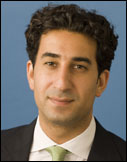
STEVE INSKEEP(Host): Okay. This document emerged as the United States nears the end of a year of trying to engage with Iran. Some positive gestures were followed by a disputed election and Iran's repression of its citizens. An apparent nuclear agreement ended with Iran rejecting it. So let's discuss all this with Karim Sadjadpour. He analyses Iran for the Carnegie Endowment for International Peace.
Welcome back to the program.
Mr. KARIM SADJADPOUR (Carnegie Endowment for International Peace): Thank you, Steve. Great to be here.
INSKEEP: Good morning. President Obama tried a different approach, famously extending his hand this year. What has the U.S. gained?
Mr. SADJADPOUR: You know, on the nuclear issues, Steve, we ostensibly haven't gained much, because Iran hasn't changed its nuclear position at all. But I would argue the overtures that the Obama administration have made have really borne fruit, in the sense that we've made it clear to both the Iranian people and to our friends in the international community, whether the Europeans or the Russians or Chinese, that the problem lies in Tehran not Washington.
I think many people during the Bush administration pointed to United States and said, well, you really haven't made an effort at engaging Iran. You haven't really made an effort at reaching out, and I think under the Obama administration everyone recognizes that the United States has reached out. It's the Iranians who have refused to reciprocate, and I think we have a much more robust international coalition now than we did before. And I would just add in the context of domestic Iranian politics, whereas the Bush administration's more hardline approach united Iran's disparate factions against a common threat. I think the Obama administration's overtures have accentuated these deep internal divides within Iran, both amongst political elites and between the population and the regime.
INSKEEP: Although when we hear that Iran launched another missile this week, it suggests that the people who are really in charge are still very firmly in charge and determined on their course.
Mr. SADJADPOUR: Well, that's very true in the sense that you have a hardline cartel running the country post June 12th, post election. And many of these hardliners believe that enmity towards the United States was a fundamental pillar of the 1979 revolution and essential to the identity of the Islamic Republic. I would argue, however, that the Iranian government is probably less stable than it's ever been in its three decade history, and we have never seen the types of opposition protests that we continue to see now, even six months after the election.
INSKEEP: Well, what's changing if anything with those protests, as time goes on?
Mr. SADJADPOUR: It's an important question, Steve. Because certainly the scale of the protest has decreased since we've seen last June. Because the Iranian government is very good at repression, and they are able to prevent large masses of people from congregating in one area. But what we have seen is that the protests have continued in smaller number, in the thousands, but the intensity of the protests has increased, in a sense that four months ago if you look at the slogans people were chanting, they were very much related to the elections. They would say, I want my vote back. Now they are saying much more strident slogans like to death to Khamenei, and they are calling for an Iranian republic instead of an Islamic republic. So I think the demands have grown stronger with time.
INSKEEP: And Karim, when you say that this government seems less stable now than at any time since the revolution 30 years ago, are you suggesting that there is some possibility these protests could lead to Iran's regime being toppled?
Mr. SADJADPOUR: Steve, I think we are still not there yet and I think the opposition themselves recognize that this is not going to be an overnight process, but I would simply argue that the regime has far fewer supporters than it's ever had, and part of that is, part of that reason is because they have purged the system of any moderate or pragmatic elements. And I think we could, you know, it could be on simmer for quite a long time but we could reach this tipping point which could change things quite abruptly.
INSKEEP: And very briefly, Karim, you're talking with us from Washington, of course. You get a chance I'm sure to speak with U.S. officials. Is it your sense that American officials feel that they have figured out or are figuring out how to deal with Iran?
Mr. SADJADPOUR: I don't think so. I think that there is still a great deal of frustration, and the Obama administration would have preferred not to pursue this path of sanctions and punitive measures because they believe they need Iran's help to help stabilize Afghanistan and Iraq. But I think they no longer have the luxury of patience and they're now going to move forward with a more hardline approach.
INSKEEP: Karim Sadjadpour, thanks very much.
Mr. SADJADPOUR: Anytime, Steve.
INSKEEP: He's the Iran analyst for the Carnegie Endowment for International Peace in Washington, D.C.
Karim Sadjadpour is a senior fellow at the Carnegie Endowment for International Peace, where he focuses on Iran and U.S. foreign policy toward the Middle East.
Carnegie does not take institutional positions on public policy issues; the views represented herein are those of the author(s) and do not necessarily reflect the views of Carnegie, its staff, or its trustees.
With the growth in points of friction between the great powers, organizations like the SCO will continue to play a role in the strategic adaptation of the smaller powers caught between them.
The greater threat to Zelensky comes not from Fedorov alone, but from the convergence between the former defense minister’s political campaign and the anti-corruption investigations moving ever closer to the presidential administration.
When faced with fuel shortages in the past, Central Asian governments could always count on additional supplies from Moscow. That safety net no longer exists.