

Commentary
Nikolay Petrov
{
  "authors": [
    "Nikolay Petrov"
  ],
  "type": "legacyinthemedia",
  "centerAffiliationAll": "",
  "centers": [
    "Carnegie Endowment for International Peace",
    "Carnegie Russia Eurasia Center"
  ],
  "collections": [],
  "englishNewsletterAll": "",
  "nonEnglishNewsletterAll": "",
  "primaryCenter": "Carnegie Russia Eurasia Center",
  "programAffiliation": "",
  "programs": [],
  "projects": [],
  "regions": [
    "Caucasus",
    "Russia"
  ],
  "topics": [
    "Political Reform"
  ]
}
Source: Getty
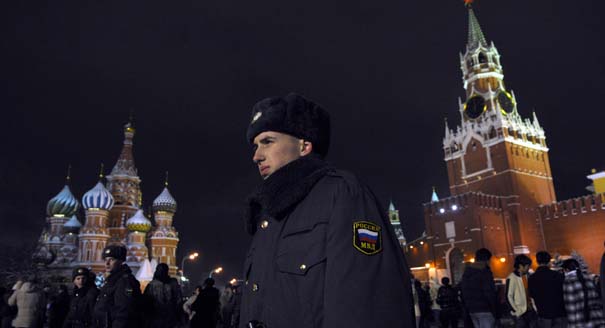
On January 30, 10,000 people protested in Kalingrad against the policies of United Russia and, in particular, the region's governor, millionaire Georgy Boos. The large protest demonstrates a disconnect between the authorities and the people of the region.
Source: The Moscow Times

But the most important event this year was marked by the 10,000 protesters who gathered in Kaliningrad on Jan. 30 to protest the policies of Kaliningrad’s millionaire Governor Georgy Boo, Prime Minister Vladimir Putin and United Russia. This is clearly a huge number for a city of only 400,000 people, but it is also a big number for much larger cities like Moscow and St. Petersburg, where opposition protests have been able to attract no more than 1,000 people.
The administration was maneuvering all of that time to try to dissuade the protest. On the eve of the protest, the Kaliningrad authorities canceled plans to increase the transportation tax, one of the protesters’ chief complaints, but it was too late. By that time, the protests caught the attention of Boos, the leaders of United Russia and the Kremlin. The authorities then hoped to organize a pro-government rally by requiring that people attend from every district, but then they quickly canceled that plan. The region is small, everyone knows one another and, as an exclave it is not possible to bus in large numbers of hired protesters from other regions, which United Russia has done in other Russian cities.
Objectively speaking, the economic situation in Kaliningrad is not great, but it is far from being the worst. There are, however, several complicating factors that have stoked the protest mood. Small and medium-size businesses in the region profit from Kaliningrad’s international borders. The import of used cars from other countries and export-import operations that take advantage of the region’s status as a special economic zone have actually undermined the federal government to some extent. Also, Boos is a typical “Varangian,” who was sent from Moscow to rule the detached Kaliningrad region. To make things worse, he brought his own business partners with him, thereby disrupting the existing business connections among the local elite.
What should the Kremlin do in this situation? It would seem that the simplest solution would be to switch the governor for a local person, especially since Boos’ term ends in the fall anyway. But it is dangerous to set such a precedent. And previous experience with Vladivostok showed that applying an ad hoc solution in one city does not preclude the same problems from arising in other cities.
What is surprising about the Kaliningrad protest is not only the authorities’ inability to cope with a crisis situation, but also their lack of basic political instincts to manage the political system as a whole.
When a relatively experienced governor who was appointed to Kaliningrad can assert in the State Council that Russia’s political system is highly effective, and then turn his back on a huge protest rally at home and happily go on vacation, then either the Kremlin doesn’t know what is happening or has still not recovered from the New Year’s holidays.
Former Scholar-in-Residence, Society and Regions Program, Moscow Center
Nikolay Petrov was the chair of the Carnegie Moscow Center’s Society and Regions Program. Until 2006, he also worked at the Institute of Geography at the Russian Academy of Sciences, where he started to work in 1982.
Recent Work
Nikolay Petrov
Nikolay Petrov
Carnegie does not take institutional positions on public policy issues; the views represented herein are those of the author(s) and do not necessarily reflect the views of Carnegie, its staff, or its trustees.

The truth of the strategic situation is that Europe and Russia are extremely unlikely to be able to “turn the page” on their confrontation within the next two decades.
Arkady Moshes

Russia spent years building a “sovereign internet,” concentrating web infrastructure exclusively within Russian territory. Ukrainian drone attacks have shown how vulnerable that approach has left the Russian internet.

Maria Kolomychenko

Putin’s conservative staffing policies and search for ever greater control have cemented parliament’s transformation into a bureaucratic appendage of the executive branch.

Andrey Pertsev

Russia’s AI-driven propaganda campaigns operate in a fragmented, chaotic, and often illogical manner. That’s not necessarily a problem for the Kremlin, though: It’s much easier to mimic genuine public debate that way.

Ilya Klishin

Russian strikes are weakening the economy sustaining Ukraine’s war effort. Closing the growing funding gap will require more European support and politically contentious reforms in Kyiv.

Balázs Jarábik