

Commentary
The European far right might fail to steer EU policy in the direction Russia wants, but they will create enough chaos inside Europe to benefit the Kremlin.
Dimitar Bechev
{
  "authors": [
    "Michele Dunne",
    "Konstantin Eggert"
  ],
  "type": "legacyinthemedia",
  "centerAffiliationAll": "dc",
  "centers": [
    "Carnegie Endowment for International Peace",
    "Carnegie Russia Eurasia Center"
  ],
  "collections": [],
  "englishNewsletterAll": "menaTransitions",
  "nonEnglishNewsletterAll": "",
  "primaryCenter": "Carnegie Endowment for International Peace",
  "programAffiliation": "MEP",
  "programs": [
    "Middle East"
  ],
  "projects": [
    "Eurasia in Transition"
  ],
  "regions": [
    "Middle East",
    "Israel",
    "Palestine"
  ],
  "topics": [
    "Security",
    "Foreign Policy"
  ]
}
Source: Getty
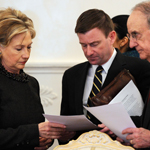
The United Nations, the United States, the European Union, and Russia have called for a freeze on all Israeli settlement activity, increasing the international pressure on Israel in the hopes of reinvigorating indirect peace talks.
Source: BBC World Service

The quartet continues to play an important role in that it “prevents the Israelis, Palestinians, Syrians, etc. from trying to play one international power off the other,” notes Michele Dunne. It allows the international powers "to meet, agree, and formalize their approach."
For Russia, membership in the quartet requires walking a delicate balance between maintaining their credentials as friends of the Palestinians while avoiding undermining their strong relationship with Israel. Konstantin Eggert suggests that there shouldn't be high hopes for the quartet meeting. "I think that this quartet meeting is going to produce exactly what other meetings have produced before, and that's pretty much nothing," he said.

Former Nonresident Scholar, Middle East Program
Michele Dunne was a nonresident scholar in Carnegie’s Middle East Program, where her research focuses on political and economic change in Arab countries, particularly Egypt, as well as U.S. policy in the Middle East.
Konstantin Eggert
Carnegie does not take institutional positions on public policy issues; the views represented herein are those of the author(s) and do not necessarily reflect the views of Carnegie, its staff, or its trustees.

The European far right might fail to steer EU policy in the direction Russia wants, but they will create enough chaos inside Europe to benefit the Kremlin.

Dimitar Bechev

Minsk clearly expected the dialogue with Washington to yield more results, in particular the lifting of EU sanctions and permission to export potash.

Artyom Shraibman

With the growth in points of friction between the great powers, organizations like the SCO will continue to play a role in the strategic adaptation of the smaller powers caught between them.

Temur Umarov

When faced with fuel shortages in the past, Central Asian governments could always count on additional supplies from Moscow. That safety net no longer exists.

Galiya Ibragimova

Two divergent trends—Putin’s hardline vision of how to prosecute the war in Ukraine, and a growing desire for change in Russia—could tear the regime apart.

Tatiana Stanovaya