

Paper
Matthew Rojansky
{
  "authors": [
    "Matthew Rojansky"
  ],
  "type": "legacyinthemedia",
  "centerAffiliationAll": "dc",
  "centers": [
    "Carnegie Endowment for International Peace",
    "Carnegie Russia Eurasia Center"
  ],
  "collections": [],
  "englishNewsletterAll": "ctw",
  "nonEnglishNewsletterAll": "",
  "primaryCenter": "Carnegie Endowment for International Peace",
  "programAffiliation": "russia",
  "programs": [
    "Russia and Eurasia"
  ],
  "projects": [],
  "regions": [
    "North America",
    "United States"
  ],
  "topics": [
    "Security",
    "Foreign Policy",
    "Nuclear Policy"
  ]
}
Source: Getty
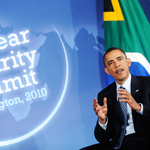
The Nuclear Security Summit is the largest U.S.-hosted gathering of world leaders in 65 years. Its focus was on the threat of nuclear terrorism and the importance of global cooperation in the effort to secure nuclear materials.
Source: Russia Today: The Alyona Show
The leaders of nearly fifty nations have come to Washington, D.C. to attend the Nuclear Security Summit. This is the largest U.S.-hosted gathering of world leaders since 1945 founding of the United Nations in San Francisco. The goal of the summit is to address the role of nuclear weapons in the world and to discuss how to keep them out of the hands of terrorists. President Obama has made nuclear nonproliferation one of his top priorities and this summit comes right on the heels of the Obama administration’s release of their Nuclear Posture Review and the signing of the replacement START treaty with Russia.
Live on Russia Today, Carnegie's Matthew Rojansky explained the significance of this summit, which gathered world leaders together and excluded those leaders whose countries are believed to be engaged in the illicit development of nuclear weapons, like North Korea and Iran. While last week’s new START treaty was about existing nuclear weapons, Rojansky stated, the Nuclear Security Summit is about the potential to create nuclear weapons and securing the nuclear material found in a number of nations with advanced civilian nuclear capabilities.
Rojansky suggested that the exclusion of Iran had two potential benefits. On the one hand, Iran’s presence could have pulled attention away from nuclear materials and onto nuclear weapons. On the other hand, he pointed out, bringing American, Chinese, Russian, European, and other world leaders together builds a momentum that could be used in the future to engage with Iran as a unified front.
The chief challenge for Obama is to separate the long-term goals, and keep the focus of the summit on nuclear materials security rather than nuclear weapons.
Former Deputy Director, Russia and Eurasia Program
Rojansky, formerly executive director of the Partnership for a Secure America, is an expert on U.S. and Russian national security and nuclear-weapon policies.
Recent Work
Matthew Rojansky
Matthew Rojansky
Carnegie does not take institutional positions on public policy issues; the views represented herein are those of the author(s) and do not necessarily reflect the views of Carnegie, its staff, or its trustees.

Despite a new textbook, an influx of Russian teachers and managers, and an end to the teaching of Ukrainian, the Kremlin is unlikely to have “reprogrammed” locals.

Konstantin Skorkin

Cargo traffic through Russia’s Northern Sea Route has increased because of the disruption caused by the conflict in the Middle East, the Ukraine war, and U.S.-China tensions.

Mikhail Korostikov

Trump has promised Belarus a massive potash deal. But Minsk is seeking something greater: restored Western transit and greater room for maneuver from Russia.

Balázs Jarábik

The European far right might fail to steer EU policy in the direction Russia wants, but they will create enough chaos inside Europe to benefit the Kremlin.

Dimitar Bechev

Minsk clearly expected the dialogue with Washington to yield more results, in particular the lifting of EU sanctions and permission to export potash.

Artyom Shraibman