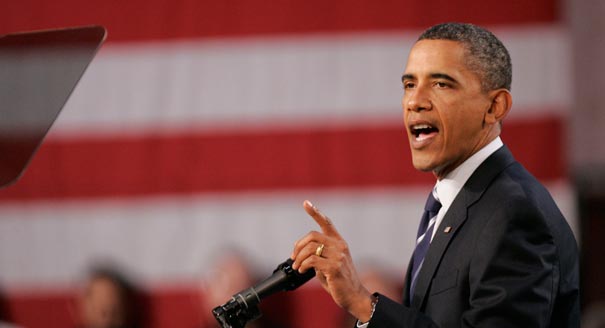
In the month of June, the Obama administration achieved a number of foreign policy successes regarding Afghanistan, Iran, Japan, South Korea, and Russia.
Obama's 5 Foreign-Policy VictoriesAll administrations have ups and downs in foreign policy. It's like hitting a baseball: When you fail 70 percent of the time, you make the all-star team. So when the Obama administration has a month like this past one, it deserves recognition.
President Obama's biggest move, of course, was naming Gen. David Petraeus commander in Afghanistan. The decision signaled Obama's determination to succeed in Afghanistan, despite the growing chorus of wise men counseling, as our wise men always seem to do, a rapid retreat. Those in the region who have been calculating on an American departure in July 2011, regardless of conditions on the ground, should think again. That date was never realistic, and the odds that Petraeus will counsel a premature withdrawal -- or be ordered to withdraw regardless of his assessment of the situation -- is infinitesimal.
The second success was the U.N. Security Council resolution on Iran. Yes, it was too mild, badly watered down by China and Russia. Yes, the administration oversold how much Russia acceded to American desires. But the administration did get a resolution, only a little later than planned, and passage kicked off additional sanctions by Europeans and others. Will this by itself stop Iran from getting a bomb? No. But it does increase the pressure on the Tehran regime, which may indirectly help those Iranians who dare to struggle for a new kind of government.
Nor did Turkey and Brazil's votes against the resolution, following their pro-Iranian diplomacy, do more than discredit their leaders in decent world opinion -- imagine voting no even as China and Russia vote yes. The idea that their actions heralded their emergence as world powers is off the mark. If anything, they diminished and slowed what had been their rise to global respectability. Brazil's Luiz Inácio Lula da Silva looked silly and out of his depth. Prime Minister Recep Tayyip Erdogan solidified Turkey's image as the lone NATO member that chooses Iran and Syria over its allies. Good work.
But the administration handled that well, too. A Jimmy Carter might have felt compelled to applaud Turkey and Brazil. An administration determined to avoid confrontation with Iran might even have swung behind their diplomatic efforts. Led by Hillary Clinton, this administration gave them the back of its hand and made clear that they were not ready to play in the big leagues. Going a step further, it has declared that Turkey's behavior is damaging its relationship with the United States and its NATO allies. Assistant Secretary of State Philip Gordon warned last week that Turkish actions have placed its "orientation" in doubt and were making it "harder for the United States to support some of the things that Turkey would like to see us support." That was exactly the right message.
The administration's policy toward Japan hasn't been pretty, but it has worked. Prime Minister Yukio Hatoyama's resignation this month had to do with his mishandling of the dispute over the American base in Okinawa and his broader attempt to reorient Japanese foreign policy toward a middle course between the United States and China. The Obama administration was firm but engaged, and the result has been Japanese reaffirmation of its commitment to the U.S. alliance. This has more to do with Japan's fear of China than anything else, but the administration deserves credit for helping steer it in the right direction.
Separately, President Obama signaled a new determination to achieve a free-trade agreement with South Korea. After many hollow claims by administration officials that the United States "is back" in Asia, this would be the first actual evidence. If Congress can be persuaded to pass the agreement -- and Obama's own party has been the chief obstacle -- it will help correct this administration's excessive and largely unsuccessful efforts to make China the cornerstone of U.S. policy in Asia.
Finally, on an issue where the administration has been weakest, there was a sign of a shift. Amid the happy talk and hamburgers last week, the administration made clear that there is one area of continuing disagreement between the United States and Russia: Georgia. In its public "Reset Fact Sheet," the White House declared that the "Obama Administration continues to have serious disagreements with the Russian government over Georgia. We continue to call for Russia to end its occupation of the Georgian territories of Abkhazia and South Ossetia." The word "occupation" is a clear sign that the administration has not swept this issue under the rug. Maybe Obama understands that the "reset" will never be a success so long as Russian troops continue to occupy their neighbors' territories.
Is there much to criticize in the administration's overall handling of foreign and defense policy? Of course, and there will be in the future. But it was a good month. For now the administration deserves congratulations for getting a number of things right.
Kagan, author of the recent book, The Return of History and the End of Dreams (Knopf 2008), writes a monthly column on world affairs for the Washington Post and is a contributing editor at both the Weekly Standard and the New Republic.
Carnegie does not take institutional positions on public policy issues; the views represented herein are those of the author(s) and do not necessarily reflect the views of Carnegie, its staff, or its trustees.
Trump has promised Belarus a massive potash deal. But Minsk is seeking something greater: restored Western transit and greater room for maneuver from Russia.
With the growth in points of friction between the great powers, organizations like the SCO will continue to play a role in the strategic adaptation of the smaller powers caught between them.
When faced with fuel shortages in the past, Central Asian governments could always count on additional supplies from Moscow. That safety net no longer exists.
Despite unhappiness on the ground, Moscow is determined to use both carrot and stick to ensure there is record support for United Russia in occupied Ukraine.