• Research
  • Politika
  • About
Carnegie Russia Eurasia center logoCarnegie lettermark logo
  • Donate
{
  "authors": [
    "Tiffany Ng"
  ],
  "type": "other",
  "centerAffiliationAll": "dc",
  "centers": [
    "Carnegie Endowment for International Peace"
  ],
  "collections": [],
  "englishNewsletterAll": "asia",
  "nonEnglishNewsletterAll": "",
  "primaryCenter": "Carnegie Endowment for International Peace",
  "programAffiliation": "AP",
  "programs": [
    "Asia"
  ],
  "projects": [],
  "regions": [
    "South Asia",
    "Afghanistan",
    "East Asia",
    "China"
  ],
  "topics": [
    "Economy",
    "Security"
  ]
}
Source: Getty

Other

China’s Role in Shaping the Future of Afghanistan

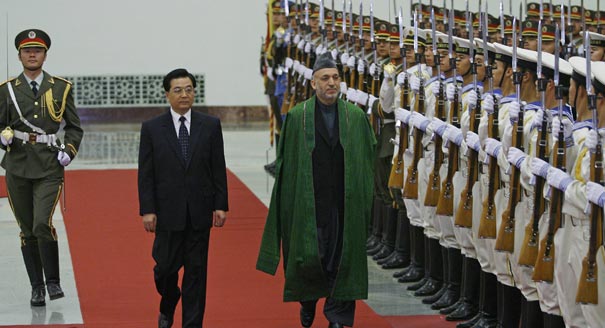
China's economic investment in Afghanistan provides an opportunity for Afghan development that could help stabilize the country—an outcome that would benefit not only Afghanistan and China, but also the United States.

Link Copied
By Tiffany Ng
Published on Sep 1, 2010

  • China has steadily increased its economic aid and investment in Afghanistan, most notably with a $3.5 billion deal to develop the Aynak copper mine. At the same time, it plays a very limited security role and has refused any direct military involvement.
  • Western commentators have eyed China’s approach to Afghanistan with suspicion and resentment, accusing China of “free-riding” and snapping up investment deals at the expense of the United States, which is paying dearly in blood and treasure.
  • While the United States and China share the goal of a stable and prosperous Afghanistan, fundamental differences in their basic strategies exist. China does not want to pressure Pakistan, nor does it want to align itself too closely with the United States, for fear of exacerbating the terrorist threat to itself or facilitating a long-term American presence in the region. By maintaining its distance and even-handed diplomacy, Beijing is positioning itself to work with whoever controls Kabul.
  • China has the potential to make important contributions to Afghan stability. State-owned Chinese corporations are uniquely risk-tolerant and can help pave the way for future investments. The Chinese also enjoy a more positive relationship with Afghans, making their investments less likely to be targeted for attack by insurgents. These investments can stimulate economic growth that aid money alone cannot.
  • U.S. policy makers should work with Afghanistan to ensure that such investment benefits the local people. Given China’s reluctance to openly cooperate with the United States in Afghanistan, Washington should help Kabul to effectively manage and maximize the positive impact of China’s involvement in Afghanistan through better aid coordination, transparency, and training.

About the Author

Tiffany Ng

Former Junior Fellow, Asia Program

Tiffany Ng
Former Junior Fellow, Asia Program
EconomySecuritySouth AsiaAfghanistanEast AsiaChina

Carnegie does not take institutional positions on public policy issues; the views represented herein are those of the author(s) and do not necessarily reflect the views of Carnegie, its staff, or its trustees.

More Work from Carnegie Russia Eurasia Center

  • Commentary
    Carnegie Politika
    Why Has Kazakhstan Started Deporting Political Activists?

    The current U.S. indifference to human rights means Astana no longer has any incentive to refuse extradition requests from its authoritarian neighbors—including Russia.

      Temur Umarov

  • Commentary
    Carnegie Politika
    Why Are China and Russia Not Rushing to Help Iran?

    Most of Moscow’s military resources are tied up in Ukraine, while Beijing’s foreign policy prioritizes economic ties and avoids direct conflict.   

      • Alexander Gabuev

      Alexander Gabuev, Temur Umarov

  • Commentary
    Carnegie Politika
    How Trump’s Wars Are Boosting Russian Oil Exports

    The interventions in Iran and Venezuela are in keeping with Trump’s strategy of containing China, but also strengthen Russia’s position.

      • Mikhail Korostikov

      Mikhail Korostikov

  • Commentary
    Carnegie Politika
    How Far Can Russian Arms Help Iran?

    Arms supplies from Russia to Iran will not only continue, but could grow significantly if Russia gets the opportunity.

      Nikita Smagin

  • Commentary
    Carnegie Politika
    Can the Disparate Threads of Ukraine Peace Talks Be Woven Together?

    Putin is stalling, waiting for a breakthrough on the front lines or a grand bargain in which Trump will give him something more than Ukraine in exchange for concessions on Ukraine. And if that doesn’t happen, the conflict could be expanded beyond Ukraine.

      Alexander Baunov

Get more news and analysis from
Carnegie Russia Eurasia Center
Carnegie Russia Eurasia logo, white
  • Research
  • Politika
  • About
  • Experts
  • Events
  • Contact
  • Privacy
Get more news and analysis from
Carnegie Russia Eurasia Center
© 2026 Carnegie Endowment for International Peace. All rights reserved.