{
  "authors": [
    "Henri J. Barkey"
  ],
  "type": "legacyinthemedia",
  "centerAffiliationAll": "dc",
  "centers": [
    "Carnegie Endowment for International Peace",
    "Malcolm H. Kerr Carnegie Middle East Center"
  ],
  "collections": [],
  "englishNewsletterAll": "menaTransitions",
  "nonEnglishNewsletterAll": "",
  "primaryCenter": "Carnegie Endowment for International Peace",
  "programAffiliation": "MEP",
  "programs": [
    "Middle East"
  ],
  "projects": [],
  "regions": [
    "Middle East",
    "Iran",
    "Türkiye",
    "Gulf"
  ],
  "topics": []
}
Source: Getty
In The Media
Iran Primer: Iran and Turkey
While Turkey and Iran share geography, culture, religion, and a long history of conflict and cooperation, they also symbolize two opposite poles in the Islamic world.
Iran Primer: Iran and TurkeyIn many ways, Turkey and Iran are mirror images of each other. They share geography, culture, religion and a long history of conflict and cooperation. They both straddle multiple geopolitical regions. Between the two, they span two continents and border five of the world’s most volatile regions—the Middle East, the Caucasus, the Balkans, Central Asia and the South Asian subcontinent. They are both descendants of empires with hegemonic histories that occasionally pitted them against each other. In the 16th century, Persia converted to Shiite Islam in part to distinguish itself from the Sunni caliphate of the Ottoman Empire. Both countries today are also profoundly insecure about real and imaginary enemies at home and abroad. As inheritors of great civilizations, they both feel their importance has been largely unappreciated.
Yet the two countries also symbolize two opposite poles in the Islamic world. For the first two decades after Iran’s 1979 revolution, Turkey behaved as a status quo power. Its enduring secular Kemalist ideology was named for the founder of modern Turkey, Mustafa Kemal Ataturk, who turned Turkey toward the West. Ankara changed little in its alliance commitments or political structures dating back to the Cold War. In contrast, Iran became a leading agitator for change. It persistently pushed its ambitious Islamic ideology directly and through a new network of surrogates. Tehran also wanted Muslim countries to form their own bloc independent of either East or West. So each viewed the other as a menace.
The 2002 victory of Turkey’s Justice and Development Party (AKP) changed Turkey dramatically—and led to role reversal between Ankara and Tehran. As it shed its inward economic and political policies, Turkey emerged as a local superpower ruled by a party willing to muscle its way into the Middle East and beyond. Turkey is also fully integrated into the global economic system, while Iran finds itself increasingly isolated politically and economically.
Three phases
Relations between Ankara and Tehran have gone through three broad phases:
Phase 1: Post-revolution
The Iranian Revolution shocked the international system and, along with the 1979 Soviet invasion of Afghanistan, increased Turkey’s importance to the West. Turkey’s strategic value was especially enhanced because the United States lost its early warning stations in Iran to monitor Soviet missile tests.
Turkey quickly recognized Tehran’s new regime and did not participate in U.S. sanctions imposed after the hostage crisis. A Turkish junta assumed power in a September 12, 1980 military coup and had no time to formulate a new policy on Iran when Iraq invaded Iran 10 days later. Turkey, which bordered both countries, remained neutral during the eight-year conflict. But the war provided an important boost to the Turkish economy, which had undergone one of its worst crises to date. Both countries relied on Turkey for basic goods. By 1983, Turkish exports to Iran constituted 19 percent of all Turkey’s exports, surpassing Germany, which was then Turkey’s leading trading partner. As the war petered out, so did Turkish exports, although they remained higher than in the late 1970s.
Phase 2: The 1990s
Iranian-Turkish relations became more confrontational after the Iran-Iraq war ended, in part because of ideological differences. Each viewed the other through the narrow prism of their secular-religious divide. The Turks were particularly suspicious of Iranian support for fundamentalist movements in Turkey. The Iranian ambassador to Ankara was declared persona non grata after he criticized the Ankara’s ban on Muslim women wearing headscarves in universities and government offices, and even participated in demonstrations against the ban. Ankara was also bitter about Iranian aid to insurgents in the Kurdistan Workers’ Party (PKK), which operated bases deep in Iranian territory. In 1991, Turkey detained an Iranian-flagged vessel on suspicion of carrying weapons destined for the PKK.
Iran harbored parallel suspicions of the Turks. Ayatollah Ruhollah Khomeini once quipped that secular Kemalism was worse than communism. The Turkish regime, he charged, held on to power largely through the power of bayonets. Echoing Turkey’s concerns, Tehran specifically complained that Ankara was not doing enough to control Iranian dissidents operating on Turkish soil. Iran was also suspicious of Turkish interference in its own province of Azerbaijan, as well as in the post-Soviet republic of Azerbaijan. The Azeri populations in both have close linguistic ties to Turkey.
But Iran focused more on Turkey as an external threat. As a member of NATO, Turkey brought the world’s mightiest military alliance to their common border. After the Soviet Union’s collapse, the West also turned to Turkey to counter Iranian influence in the newly independent Central Asian states that had been part of Moscow’s empire. They also differed seriously on Iraq, despite agreement about containing Kurdish ambitions in Iraq. Turkey wanted Saddam Hussein to cooperate with the international community to end economic sanctions. Ankara also wanted Baghdad to reestablish control over all Iraqi territory. But after its eight-year war with Iraq, Iran wanted the Baghdad regime weakened and hamstrung by stringent U.N. sanctions.
Phase 3: Erdogan and the AKP
The AKP, which had Islamist roots, took a different approach to the Middle East. Anxious to develop new trade opportunities and become the leading actor in regional politics, Ankara developed a policy based on “zero-problems” with its neighbors, including Iran. Even deep sectarian differences—Turkey is overwhelming Sunni, Iran is largely Shiite—were not obstacles to improving relations. Ankara’s new vision of the Middle East seemed less antagonistic to Iran and Iranian allies, demonstrated by frequent visits by both Turkish and Iranian heads of state.
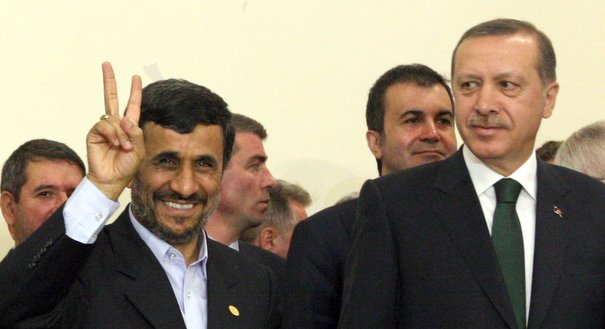
The Turks provided Iran with important support at its most vulnerable time. Ankara was one of the first governments, along with Russia and Venezuela, to offer unqualified support for President Mahmoud Ahmadinejad after the disputed June 2009 elections. The Turkish government was also silent when the Iranian regime violently suppressed Green Movement protesters to regain political control.
Iran also slowly shifted its stance, particularly on the sensitive Kurdish question. After years of tolerating PKK activities in Iran, Tehran gradually began to prevent the movement’s access to its territory. Tehran’s policy shift emerged after a PKK affiliate, the Free Life Party of Kurdistan (PJAK), successfully attacked Iranian security forces. In response, Iran launched artillery strikes against both the PKK and PJAK in their hideouts in northern Iraq’s remote Qandil mountains. Iran’s new policy was a way to begin intelligence cooperation and ingratiate itself with Turkey; it was also a way to embarrass the United States, which occupied Iraq at the time but had been reluctant to militarily act against the PKK.
Nuclear diplomacy
Turkey’s changed approach has been most apparent on Iran’s nuclear controversy. The Turks have historically been ambivalent about Tehran’s program. In 2010 President Abdullah Gül expressed misgivings about the Islamic Republic’s ultimate objectives. At the same time, Prime Minister Recep Tayyip Erdogan publicly vouched for Tehran’s peaceful intentions on nuclear energy at a time the international community and Turkey’s allies expressed growing alarm about the dangers of Iran developing a nuclear weapon. Erdogan repeatedly argued that Iran’s program was not the real problem and instead tried to make Israel the issue, to the annoyance of the United States. This would prove to be an important psychological boost to Tehran since the central issue was its lack of compliance with international safeguards and rules.
In May 2010, Turkey and Brazil negotiated an agreement with Iran to ship 1,200 kg of low enriched uranium to Turkey for safekeeping. In exchange, the Iranians would receive fuel rods for the Tehran Research Reactor, which produces isotopes for medical use. This was part of Ankara’s strategy to burnish its diplomatic credentials internationally and establish itself as a major actor capable of resolving some of the world’s most difficult problems. The deal was heralded in Turkey. But it was rejected by the United States and Europeans because it represented a watered down version of their own proposal, which Iran had walked away from eight months earlier. In the first deal, 1,200 kg represented some 80 percent of Iranian stocks. But Tehran had produced so much more low enriched uranium in the intervening months that 1,200 kg was closer to 50 percent when Iran accepted the Turkey-Brazil package.
The new diplomacy played out just as the U.N. Security Council was about to vote to impose new sanctions on Iran. The deal was widely interpreted as an attempt to derail sanctions and give Tehran more breathing room. Turkey argued that sanctions were counterproductive; it said persuasion was more effective than punitive measures in getting Tehran to change its behavior. (Turkey also believed it they would suffer disproportionately from sanctions on Iran.) The United Nations went ahead with the vote on new sanctions. Turkey, which had one of the 15 Security Council seats, voted against the resolution. Turkey’s decision to side with Iran at the expense of its traditional Western allies caused a major crisis of confidence with the United States.
Factoids
Iran accounts for 20 percent to 30 percent of Turkey’s gas imports. But the Iranians have not been reliable partners. Twice in 2010, for example, cold weather forced Iran to indefinitely suspend deliveries, which led the Turks to look for alternative supplies.
Trade between Turkey and Iran totaled $10 billion in 2008. Iran exported $8.2 billion in goods, mostly hydrocarbons. Turkey exported $2 billion. In 2009, Iranian exports to Turkey declined precipitously to $3.4 billion, although Turkish exports remained stable. Turkey’s exports to Iran represent no more than 2 percent of its total exports.
Turkey has the largest Kurdish population, estimated to be up to 20 percent of the population or 14 million. Iran has the third largest population, estimated at almost 5 million. The two Kurdish communities have little contact.
Turkey is one of the few countries Iranians can travel to without a visa.
Iran and Turkey are members of the Economic Cooperation Organization, a 10-nation alliance created in1985, with members stretching from Turkey through Central and South Asia. Tehran and Ankara are also members of the Developing-8, an association of mid-income Muslim nations created by the Turks in the 1990s.
Balance of power
Turkey and Iran have emerged as the two rival models for much of the Islamic world. They represent disparate ways of blending Islam and democracy. Turkey has engaged in gradual evolutionary change. Its ruling party has Islamist roots but governs a strictly secular system. Its foreign policy has become increasingly multi-faceted. It is already a member of the world’s most powerful military alliance, NATO, and is a candidate to join the European Union. It is a rising mid-level power. And its economic reforms have made it the 16th largest economy in the world.
In contrast, Iran’s political transformation was fraught with turmoil throughout its first three decades. Its foreign policy long defied both East and West. Its closest allies were often militias rather than governments. Vast oil resources produced wealth, but international sanctions made it increasingly difficult to develop. By 2010, its failure to compromise with the international community led to growing isolation.
Relations between the two are also uneven. Turkey’s AKP government, with its boundless self-confidence, has been an enigma to Iran. The Turks stood up to their own allies to extend Iran an economic lifeline and support Tehran’s nuclear program. Yet Turkey’s growing regional ambitions challenge Tehran’s alliances. The Iranians have the upper hand in Iraq, Lebanon and Syria, for example, but the Turks are challenging them in all three countries. In the Arab world, public opinion polls now indicate that Turkish Prime Minister Erdogan is the single most admired leader.
The future
Turkey’s principal concern is the stability of the Iranian regime. President Ahmadinejad’s erratic behavior has irritated Ankara, but the AKP government is unlikely to be sufficiently offended to disrupt its bourgeoning ties with Tehran.
Yet the current Turkish government—despite its sympathies and expectations of greater trade opportunities—is not an ally of Iran. It sees itself in a long-run competition with Iran for influence.
In the region, Turkey can use its assets, its improved diplomatic position, a robust economy and a willingness to engage with all parties to eclipse Iran. Turkish inroads into Syria have the long-term ability to influence Syrian society. Ankara has opened its borders to Syrians, and Turkish border towns are doing brisk business with Syrians.
Iran rhetorically welcomes Turkey’s attempts to mediate, especially when they weaken international consensus. In reality, however, Tehran also perceives itself as a rising power of great significance that ought not need a mediator, especially by a mid-level power or neighbor.
Barkey served as a member of the U.S. State Department Policy Planning Staff, working primarily on issues related to the Middle East, the Eastern Mediterranean, and intelligence from 1998 to 2000.
Carnegie does not take institutional positions on public policy issues; the views represented herein are those of the author(s) and do not necessarily reflect the views of Carnegie, its staff, or its trustees.
Ongoing uncertainty in the Middle East allows Moscow to both increase its influence in Tehran and continue to enjoy the financial windfall of higher oil prices.
The Russian leadership wants to avoid a dangerous precedent in which it is squeezed out of Iran by the United States and Israel—and left powerless to respond in any meaningful way.
The future trajectory of the U.S.-Iran war remains uncertain, but its impact on global energy trade flows and ties will be far-reaching. Moscow is likely to become a key beneficiary of these changes; the crisis in the Gulf also strengthens Russia’s hand in its relationships with China and India, where advantages might prove more durable.