

Commentary
Putin’s conservative staffing policies and search for ever greater control have cemented parliament’s transformation into a bureaucratic appendage of the executive branch.
Andrey Pertsev
{
  "authors": [],
  "type": "other",
  "centerAffiliationAll": "",
  "centers": [
    "Carnegie Endowment for International Peace"
  ],
  "collections": [],
  "englishNewsletterAll": "",
  "nonEnglishNewsletterAll": "",
  "primaryCenter": "Carnegie Endowment for International Peace",
  "programAffiliation": "",
  "programs": [],
  "projects": [],
  "regions": [
    "North Africa",
    "Egypt"
  ],
  "topics": [
    "Political Reform"
  ]
}
Source: Getty
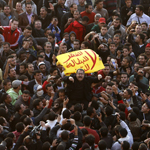
The recent large protests in several Egyptian cities show that Egyptians' patience is nearly at an end with a government that has consistently failed to respond to their legitimate aspirations.
Source: January 27

In his State of the Union address, President Obama said that the United States “stands with the people of Tunisia, and supports the democratic aspirations of all people.” These words are welcome. But if the administration truly wants that message to be received by the Mubarak government, and the Egyptian people, it needs to speak with greater clarity and back its words with actions. Noticeably absent from its reactions to the demonstrations in Egypt were specific calls for changes to Egypt’s constitution, an end to the state of emergency, or other measures that would enable upcoming presidential elections this year to be actually democratic. The administration should spell out to the Egyptian government the consequences of a violent crackdown and of a refusal to reform. It should also ensure that no U.S. assistance or equipment is used in the violent suppression of peaceful protests.
We urge the administration to press the Mubarak government to lift the state of emergency that restricts freedom of assembly and to end police brutality and torture. The administration should also press for constitutional and administrative changes necessary for a free and competitive presidential election open to candidates without restrictions, supervised by judges and monitored by domestic and international observers.
The United States has a strong relationship with Egypt and the Egyptian people. The choice is not between a stable and predictable but undemocratic Egypt on the one hand, and dangerous instability and extremism on the other. Rather, the choice appears to be whether the will of the people is made manifest through democratic change implemented via the enlightened self-interest of the Egyptian leadership or via mass protest and popular action.
The demonstrations in Tunisia have given hope and inspiration to people throughout the Middle East. But victories for human rights and democracy should not merely be celebrated after they happen, when it is easy for the U.S. government to speak its mind; they must be championed before they happen. It is time for the Obama administration to move from the rhetoric of speeches in Cairo, Doha and elsewhere, to policies and actions that have an effect on the ground.
The Working Group on Egypt is a bipartisan initiative bringing substantial expertise on Egyptian politics and political reform, and aimed at ensuring that Egypt’s elections are free and fair and open to opposition candidates.
Carnegie does not take institutional positions on public policy issues; the views represented herein are those of the author(s) and do not necessarily reflect the views of Carnegie, its staff, or its trustees.

Putin’s conservative staffing policies and search for ever greater control have cemented parliament’s transformation into a bureaucratic appendage of the executive branch.

Andrey Pertsev

Ex-president Gurbanguly Berdimuhamedov remains interested in politics, but his son Serdar, Turkmenistan’s current president, is becoming increasingly independent and willing to break with his father’s legacy. If their covert rivalry goes too far, both risk losing power.

Galiya Ibragimova

Sergei Kiriyenko used Russia’s parliamentary vote to further hone his strategy of corporate mobilization that is designed to maximize votes for United Russia.
Andrey Pertsev

The European far right might fail to steer EU policy in the direction Russia wants, but they will create enough chaos inside Europe to benefit the Kremlin.

Dimitar Bechev

If the Russian-speaking community in Latvia cannot articulate their interests without being seen as disloyal, they could end up embracing a pro-Kremlin agenda.

Sergejs Potapkins