

In The Media
Shahram Chubin
{
  "authors": [
    "Shahram Chubin"
  ],
  "type": "legacyinthemedia",
  "centerAffiliationAll": "dc",
  "centers": [
    "Carnegie Endowment for International Peace",
    "Carnegie Europe"
  ],
  "collections": [
    "Arab Awakening"
  ],
  "englishNewsletterAll": "ctw",
  "nonEnglishNewsletterAll": "",
  "primaryCenter": "Carnegie Endowment for International Peace",
  "programAffiliation": "NPP",
  "programs": [
    "Nuclear Policy",
    "Middle East"
  ],
  "projects": [],
  "regions": [
    "Middle East",
    "Iran",
    "North Africa",
    "Egypt",
    "Gulf"
  ],
  "topics": [
    "Political Reform"
  ]
}
Source: Getty
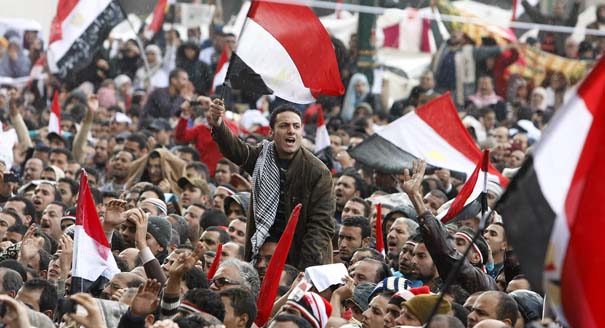
As Egypt begins its efforts to create a more democratic and inclusive government, Iran seems to be moving in the opposite direct.
Source: Le Temps

The euphoria, unfortunately, may be premature. The army in Egypt may not have been willing to intervene and spill blood but that does not mean that it is willing to renounce its economic and social privileges and go quietly back to the barracks. Indeed, just as the armed forces’ intentions are unclear, so are those of other social classes who comprise Egyptian society: workers, peasants, civil servants, professionals, and students, all of whom still need to be heard as to the kind of government and society they want.
For Egypt, the challenges are very much in the future and the unity of the current phase will inevitably lead to hard bargaining in defining a new and inclusive order.
In Iran, the situation is a little different. An objective appraisal of the situation reveals a society that is deeply polarized—in part deliberately fragmented by the regime’s policies, in part, probably honestly divided on what sort of political/social system it wants and the place of religion in this system. Thus, when Egypt may be leaving the ranks of the “security states,” Iran may be joining them. Now let’s step back and explain how this occurred.
For the last three decades the fragile consensus on the Iranian revolution has been eroding. Fifteen years ago the election of a very popular reformist president signaled as much. A decade ago the opponents of reform (the hardliners and conservatives) started tampering with the electoral system, especially where the legislature was concerned through the Guardian Council.
In 2000, 2002, and 2004, this tampering was evident and undisguised. However it was the blatant rigging of the presidential election in June 2009 that was the last straw. The regime committed political hara-kiri by lying to the populace and then demonstrating its contempt for them by a vicious repression of peaceful demonstrations, whose only slogan was: ”Where is my vote?” In so doing the regime lost the last vestige of legitimacy that it claimed: popular support.
Certainly there are other forms of legitimacy, pale substitutes for the real thing. China can claim a form of “performance legitimacy” from its economic growth and the improvement of the lot of the average Chinese citizen. But this kind of legitimacy is fragile and reversible. And the Iranian regime cannot claim a comparable economic performance.
What the current regime is doing, however, is something more cynical. In light of the divisions within Iran—a rough guess would be something like 70 percent of citizens favor change and 30 percent support the current regime—the regime is targeting its foes and rewarding its constituency. Instead of seeking an inclusive system representative of all tendencies, it is narrowing its base, giving subsidies and privileges to its supporters and squeezing the others. It is thus becoming more dependent on the security and intelligence services and state-sponsored vigilantes/thugs. In short, it is going in exactly the wrong direction compared to Egypt.
Turkish President Abdullah Gul was in Tehran when major demonstrations were held on February 14. He pointedly observed: “We see sometimes when the leaders and heads of countries do not pay attention to the people’s demands, the people themselves take action to achieve their demands.”
If Iran is to reclaim its position as a serious nation-state, its government cannot avoid listening to all of its people and must stop the pretense that it knows better than them. The record of the past thirty-odd years demonstrates that it emphatically does not.
Former Nonresident Senior Fellow, Nuclear Policy Program
Chubin, who is based in Geneva, focuses his research on nonproliferation, terrorism, and Middle East security issues. He was director of studies at the Geneva Centre for Security Policy, Switzerland, from 1996 to 2009.
Recent Work
Shahram Chubin
Shahram Chubin
Carnegie does not take institutional positions on public policy issues; the views represented herein are those of the author(s) and do not necessarily reflect the views of Carnegie, its staff, or its trustees.

Ex-president Gurbanguly Berdimuhamedov remains interested in politics, but his son Serdar, Turkmenistan’s current president, is becoming increasingly independent and willing to break with his father’s legacy. If their covert rivalry goes too far, both risk losing power.

Galiya Ibragimova

Sergei Kiriyenko used Russia’s parliamentary vote to further hone his strategy of corporate mobilization that is designed to maximize votes for United Russia.

Andrey Pertsev

The European far right might fail to steer EU policy in the direction Russia wants, but they will create enough chaos inside Europe to benefit the Kremlin.

Dimitar Bechev

If the Russian-speaking community in Latvia cannot articulate their interests without being seen as disloyal, they could end up embracing a pro-Kremlin agenda.

Sergejs Potapkins

Russia’s ruling party would have benefited from Putin appearing as its distant patron, but as an active frontman imposing his views on the public, he has done nothing but harm both the party’s election campaign and the ruling system overall.
Andrey Pertsev