Why Did Protests in Algeria Fail to Gain Momentum?
Despite sporadic demonstrations and calls for change from prominent intellectuals and political figures, the widespread protests that brought down leaders in Tunisia and Egypt are still largely absent in Algeria.
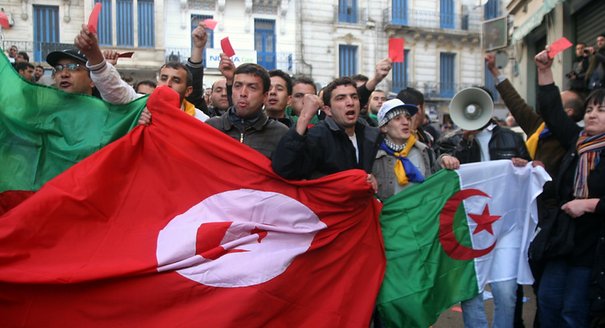
Why Did Protests in Algeria Fail to Gain Momentum?Protests in Algeria erupted at the same time as in Tunisia. Like Tunisia, Algeria witnessed several self-immolations of unemployed youth. It also faces similar socio-economic conditions to Egypt and Tunisia--including high levels of unemployment, particularly among youth; widespread corruption and a large bureaucracy; and a lack of transparency. Unlike elsewhere in the region, however, social unrest in Algeria did not spread throughout the country. Demonstrators were vastly outnumbered by the police. Protests failed to gain momentum, as they did in Tunisia, Egypt, Libya, and, to a large extent, Yemen.
One explanation for this difference lies in Algeria's rich oil and gas resources, which gave the regime more resources to address the public's dissatisfaction without resorting to violence. The government has allocated more money for food subsidies, awarded pay increases to court clerks and municipal civil servants, and helped young entrepreneurs by offering them interest-free loans to establish their businesses, granting them a three-year tax exemption, and likely reserving a quota of local public contracts for them. The president also promised cash transfers and furniture for poor families in 14 isolated regions. And the government lifted the state of emergency after 19 years.
Economic aid packages, however, are only part of the reason why Algerians have shown little enthusiasm for radical changes in the country. Five other factors also seem to be at play.
First, the public does not share a common set of grievances. Calls for national protests mobilized only about 2,000 demonstrators. Instead, concerns tend to be specific to particular groups. Associations of petroleum workers, public health employees, telecommunications professionals, fire fighters, religious preachers, municipal civil servants, and the unemployed protested separately to defend their own economic and social interests. Protests by graduate students opposing university reform since mid February, and an open-ended strike by physicians in public hospitals, were able to mobilize more people compared to anti-regime protests.
Second, the opposition appears divided and constrained by regulations that restrict the right to demonstrate. Independent trade unions, human rights organizations, opposition parties, and youth associations established an ad-hoc coalition in January--the National Coordination for Democratic Change (CNCD in French)--to push for change through peaceful protests. The coalition favors weekly organized protests instead of the kind of spontaneous daily demonstrations that proved so effective in Egypt and Tunisia. Internal disagreements within the CNCD have already emerged between human rights organizations and trade unions on the one hand, and political parties on the other. The bone of contention is on maintaining demonstrations every Saturday in Algiers despite their ban by the regime and the inability of the Rally for Culture and Democracy (RCD) and the Socialist Forces Front to mobilize people on common grounds.
Third, protestors have faced a strong security apparatus. Algeria has expanded its security forces in recent years, from 50,000 police officers in the mid-1990s to about 170,000 officers now. Officers are both well-paid--they earn 65 percent more than average public civil servant (U.S. $470 compared to U.S. $280 per month)--and enjoy good career prospects, making it unlikely they would turn against the government. Their tactic of dividing protesters into small groups also prevents any sense of power that would come from mass mobilization. The police in Algeria relied on anti-riot trucks and have not so far, unlike in most other countries in the region, fired on crowds.
Fourth, the military in Algeria is more integrated into the country's political sphere than in Tunisia or Egypt--making any potential resignation by the president irrelevant for regime change. The People's National Army counts approximately 140,000 active members and 100,000 reservists, and has always played a leading role in the country's affairs. All of Algeria's presidents have been supported by the army. The emergency law that was lifted earlier this month after being in force for two decades only strengthened the military's authority. In addition, many general officers manage the largest public-sector companies, giving them privileged access to strategic sectors in the economy.
Fifth, the specter of the civil war in the 1990s is still very fresh in people's minds. Fears of another period of violence and insecurity keep Algerians from seeking a radical change despite their economic and social grievances. The civil war, which took place in the nineties led to between 100,000 and 120,000 deaths, with most families losing at least one member. Although in September 1999, the Islamic Salvation Army (AIS) announced the end of its attacks and Algerians approved massively a National Reconciliation initiative, sporadic violence continues to erupt in the country threatening peace and stability.
These factors do not mean Algeria won't experience regime change at some point. The upheaval in the region could still lead to unexpected effects. But the widespread calls for change that so forcefully brought down leaders in Tunisia and Egypt are largely absent in Algeria now. In spite of the sporadic demonstrations and of the calls for change from prominent intellectuals and political figures, a unifying movement that transcends societal divisions is yet to be seen in Algeria.
Carnegie does not take institutional positions on public policy issues; the views represented herein are those of the author(s) and do not necessarily reflect the views of Carnegie, its staff, or its trustees.
If the Russian-speaking community in Latvia cannot articulate their interests without being seen as disloyal, they could end up embracing a pro-Kremlin agenda.
Russia’s ruling party would have benefited from Putin appearing as its distant patron, but as an active frontman imposing his views on the public, he has done nothing but harm both the party’s election campaign and the ruling system overall.
Depleted financial reserves and a shrinking tax base mean it is no longer possible to simultaneously deliver high defense spending, price stability, and economic growth.
The greater threat to Zelensky comes not from Fedorov alone, but from the convergence between the former defense minister’s political campaign and the anti-corruption investigations moving ever closer to the presidential administration.