

In The Media
Vikram Nehru
{
  "authors": [
    "Vikram Nehru"
  ],
  "type": "legacyinthemedia",
  "centerAffiliationAll": "dc",
  "centers": [
    "Carnegie Endowment for International Peace",
    "Carnegie China"
  ],
  "collections": [],
  "englishNewsletterAll": "asia",
  "nonEnglishNewsletterAll": "",
  "primaryCenter": "Carnegie China",
  "programAffiliation": "AP",
  "programs": [
    "Asia"
  ],
  "projects": [],
  "regions": [
    "North America",
    "United States",
    "East Asia",
    "China",
    "Southeast Asia"
  ],
  "topics": [
    "Economy",
    "Foreign Policy",
    "Arms Control",
    "Security"
  ]
}
Source: Getty
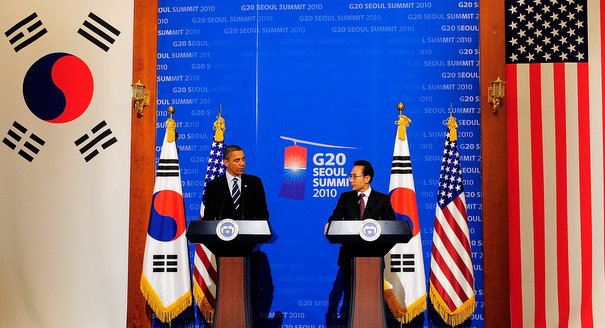
President Obama's trip to the Pacific will be an important milestone in his administration’s steady and determined effort to re-establish a diplomatic presence and develop closer ties with a region that is driving the world economy and unsettling the established global balance of power.
Source: Straits Times

The trip across the Atlantic to Cannes for the G20 meeting focussd on the vicissitudes of a hobbled eurozone.
In sharp contrast, his trip across the Pacific will be to engage with a robust and resurgent East Asia and his meetings there will probably prove more important for the long-term economic and security concerns of the United States. They will be an important milestone in the Obama Administration’s steady and determined effort to re-establish a diplomatic presence and develop closer ties with a region that is driving the world economy and unsettling the established global balance of power.
The first stop on the president’s pacific itinerary will be Honolulu for the APEC Economic Leader’s Meeting at which the United States will chair discussions on trade, regulatory convergence, and green growth.
At the East Asia Summit (EAS) in Bali the agenda is likely to include maritime security, a broad enough rubric permitting discussion of simmering tensions in the South China Sea. Both meetings have taken on added significance for two reasons. First, Obama’s personal involvement signals America’s seriousness in strengthening its Asian presence, challenging China’s pre-eminent role in the region, and providing an alternative point of reference to ASEAN countries.
Second, this will be the first time that the United States (and Russia) have been included as members of the EAS, a development resisted by China but encouraged by key ASEAN members seeking to counterbalance China’s growing role in the region and its recent muscular projection of power, particularly in the South China Sea.
From ASEAN’s perspective, there are several reasons why it welcomes the re-engagement of the United States in the region. First, the United States continues to project an important military presence in the region, offering some measure of comfort against China’s growing regional clout.
Second, the United States may be suffering its worst economic crisis since the Great Depression, but it remains the world’s largest market, an important final destination for much of the region’s exports, and a key source of foreign direct investment.
Third, the recent ratification of the U.S.-Korea free trade agreement potentially opens the door for either a similar free trade agreement with ASEAN or a broader APEC-wide free trade area for Asia and the Pacific—an arrangement that would serve the interests of the region as well as the United States.
And fourth, the presence of the United States in regional forums such as APEC and EAS could potentially transform them into decision-making bodies rather than just “talking shops”.
But recent developments also give ASEAN reason to doubt U.S. commitment toward the region. The U.S. Senate’s recent passage of the Currency Exchange Rate Oversight Reform Act is designed to punish China for alleged currency manipulation but if it becomes law (admittedly a distant possibility), it will hurt Southeast Asian economies that are part of the East Asian production chain in which China is the final link.
America’s crippling fiscal problems, the seeming inability of Washington to take decisive action, and a politically weakened President Obama, stand in stark contrast to the strength of the Chinese economy, the relatively smooth manner in which China’s leadership transition in 2012 is being engineered, and the government’s impressive ability to take collective action when necessary.
While President Obama will be welcomed in Bali, the staying power of the United States in the region is being questioned, especially when juxtaposed with China’s seemingly unstoppable ascendancy. Will the United States have the fiscal strength to increase—or even maintain—its presence in the Pacific to match China?
These concerns leave ASEAN countries in a difficult situation. Their economic future is inextricably linked to China. ASEAN’s ambition to develop a free trade area by 2015 and build an infrastructure network to facilitate intra-regional trade is supportive of a broader East Asian regionalism in which China is an integral part. At the same time, several ASEAN countries are uncomfortable with China’s rise as a military power and the dispute over the Spratly Islands is only one of several security issues that cloud the future — and where the security presence of the United States brings some comfort.
The region is transitioning to a new balance of power in which equilibrium is yet to be established. Searching for that equilibrium will require constructive engagement from all sides—especially that of China and the United States. The November APEC and EAS meetings are significant milestones in that long road ahead.
Former Nonresident Senior Fellow, Asia Program
Nehru was a nonresident senior fellow in the Carnegie Asia Program. An expert on development economics, growth, poverty reduction, debt sustainability, governance, and the performance and prospects of East Asia, his research focuses on the economic, political, and strategic issues confronting Asia, particularly Southeast Asia.
Recent Work
Vikram Nehru
Vikram Nehru
Carnegie does not take institutional positions on public policy issues; the views represented herein are those of the author(s) and do not necessarily reflect the views of Carnegie, its staff, or its trustees.

Russian strikes are weakening the economy sustaining Ukraine’s war effort. Closing the growing funding gap will require more European support and politically contentious reforms in Kyiv.

Balázs Jarábik

Despite a new textbook, an influx of Russian teachers and managers, and an end to the teaching of Ukrainian, the Kremlin is unlikely to have “reprogrammed” locals.

Konstantin Skorkin

For every ruble allocated to social policy, health, and education in 2027, double that amount is earmarked for the army, the police, and the security services.

Alexandra Prokopenko

Cargo traffic through Russia’s Northern Sea Route has increased because of the disruption caused by the conflict in the Middle East, the Ukraine war, and U.S.-China tensions.

Mikhail Korostikov

Trump has promised Belarus a massive potash deal. But Minsk is seeking something greater: restored Western transit and greater room for maneuver from Russia.
Balázs Jarábik