

Paper
David Burwell
{
  "authors": [
    "David Burwell"
  ],
  "type": "legacyinthemedia",
  "centerAffiliationAll": "dc",
  "centers": [
    "Carnegie Endowment for International Peace"
  ],
  "collections": [],
  "englishNewsletterAll": "ctw",
  "nonEnglishNewsletterAll": "",
  "primaryCenter": "Carnegie Endowment for International Peace",
  "programAffiliation": "SCP",
  "programs": [
    "Sustainability, Climate, and Geopolitics"
  ],
  "projects": [],
  "regions": [
    "North America",
    "United States"
  ],
  "topics": [
    "Climate Change"
  ]
}
Source: Getty
Legislators should design transportation policies that support Americans' demand for cheaper, cleaner, and on-demand travel choices.
Source: Guardian

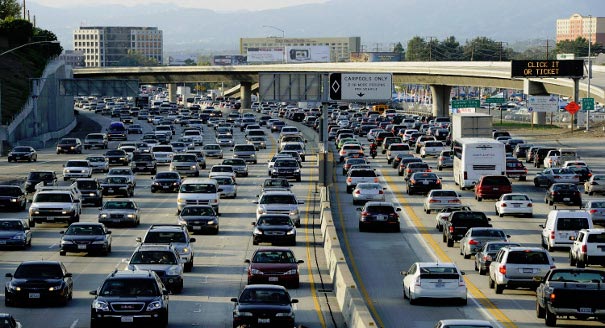
Wrong. In the early years of the 21st century, something very interesting happened. Individual vehicle travel in America lost its glamour – and its connection to economic growth. In 2003 when VMT was 2.9 trillion miles, US gross domestic product was just under $11tr. In 2011 GDP passed $15tr while total vehicle travel was still about 2.9 trillion miles. In 2011 alone GDP went up 1.5% while VMT went down 1.5%. VMT per capita is receding as well, with each American now travelling less than 9,500 miles annually.
America is not alone. The UK has experienced similar trends, with a 13% drop in annual trips by cars and vans since 1996, and a 4% reduction in annual distance travelled over the same time period. The ratio of vehicle miles travelled to GDP in the core EU 15 states has dropped by more than 10% since 2000.There are a number of explanations for why VMT is no longer growing at the same rate as GDP. Demand for shopping and business trips has slowed as these activities are increasingly conducted electronically. Internet-based social networks are fast replacing hanging out at the mall as a teenage pastime. Then there is the cost: fewer young people can afford car ownership – the cost of insurance, fuel, and maintenance on even a used car is simply too high.
Transportation policy has been slow to respond to this change in the way we prefer to travel and, at times, actively resists the shift in customer demand for cheaper, cleaner, on-demand travel choices. Forecasters continue to predict 1.6% annual increases in vehicular travel demand as far as the eye can see – and are designing road and highway expansions to match. The Congressional Budget Office still links travel demand (and thus fuel tax revenues) directly to GDP growth. Earlier this year House leaders in Congress tried to strip funding for transit, bicycling, and pedestrian travel from the Highway Trust Fund, causing a backlash within their own ranks that forced them to drop a floor debate on the measure.
In the absence of policy leadership, Americans are taking matters into their own hands. Baby boomers are giving up the suburbs for communities with more travel choices. Younger adults are delaying getting a driver's licence and, when they do, they are not buying cars or using them as much. Instead, they are embracing new forms of "collaborative consumption" – sharing vehicles through car-share and bike-share programmes. New "smart apps" allow users to identify travel options to places they want to go on a real-time basis, then guide them to the nearest available vehicle – whether bus, car, bicycle or train – to get them there.
All age groups appear to be moving toward mixed communities where schools, businesses, residences, and shops are in close proximity – even walking distance.
Failure to recognise this sea-change in travel behaviour leads to massive misallocation of scarce infrastructure capital. If vehicular travel is, as it seems, decoupling from GDP growth, then transportation investments should respond by supporting a much broader array of travel behaviour than driving, including bus, bus rapid transit, shared ride services, cycling and safe pedestrian travel.
America still stands for freedom – but it is no longer just the freedom of the open road. Freedom to multitask while we travel. Freedom to access social networks, buy goods and services, and conduct business without sitting in traffic. Freedom to live in clean, healthy environments. In such a world, planning to accommodate more and more driving when the customer is signalling a desire for new transportation services makes no sense.
The stagnation in VMT growth is an important indicator of how lifestyles are changing in America. It's about time our legislators designed transportation policies that suit our needs in the 21st century.
Former Nonresident Senior Fellow, Energy and Climate Program
Burwell focused on the intersection between energy, transportation, and climate issues, as well as policies and practice reforms to reduce global dependence on fossil fuels.
Recent Work
David Burwell
David Burwell
Carnegie does not take institutional positions on public policy issues; the views represented herein are those of the author(s) and do not necessarily reflect the views of Carnegie, its staff, or its trustees.
Official discussions about mini oil refineries are unlikely to come to anything—but the mere fact they’re happening reveals the regime is failing to deliver a functioning economy.

Sergey Vakulenko

Ongoing uncertainty in the Middle East allows Moscow to both increase its influence in Tehran and continue to enjoy the financial windfall of higher oil prices.

Nikita Smagin

Governments in Estonia, Latvia, and Lithuania want to ensure that a U.S. military withdrawal would not leave them dangerously exposed to a Russian attack.

Sergejs Potapkins
Tokyo would have to surmount a lot of obstacles—not least Western sanctions—if it wanted to return Russian oil imports to even modest pre-2022 volumes.
Vladislav Pashchenko

Powerful lobbyists and inertia led to Russia’s coal-mining sector missing an excellent opportunity to solve its structural problems.
Alexey Gusev