

Paper
Ibrahim Saif, Ahmed Ghoneim
{
  "authors": [
    "Ibrahim Saif"
  ],
  "type": "legacyinthemedia",
  "centerAffiliationAll": "",
  "centers": [
    "Carnegie Endowment for International Peace",
    "Malcolm H. Kerr Carnegie Middle East Center"
  ],
  "collections": [],
  "englishNewsletterAll": "",
  "nonEnglishNewsletterAll": "",
  "primaryCenter": "Malcolm H. Kerr Carnegie Middle East Center",
  "programAffiliation": "",
  "programs": [],
  "projects": [],
  "regions": [
    "Egypt",
    "Gulf",
    "Levant",
    "Maghreb"
  ],
  "topics": [
    "Economy"
  ]
}
Source: Getty
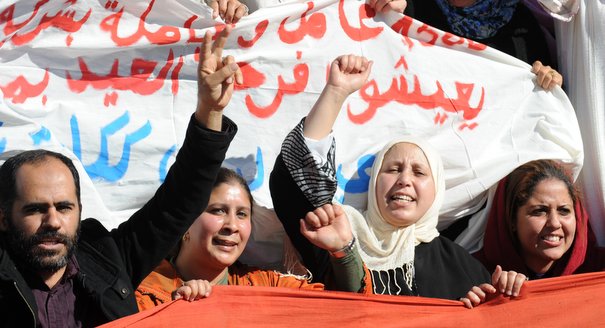
The Arab Spring revolutions and the declining role of the security apparatuses in the region have allowed for more successful labor activism, an emergence of a bottom-up approach for activism, and a shift away from traditional structures of organization.
Source: Al-Monitor

The shifts we speak of have their roots in the imbalances that existed prior to the outbreak of the Tunisian revolution, at a time when the governing regimes were praised for their achievements. Back then, life in these countries took place behind a facade that hid a number of imbalances, including income inequality between the rich and the poor and the relationship between employers and employees. In fact, a look at income distribution indicators over several decades reveals no sign of progress, despite consistent reform efforts on the part of state institutions. In fact, the market power in many Arab countries is concentrated in the hands of a few dominant producers, who control prices and make huge profits. Meanwhile, workers - in the absence of anyone defending their rights, including the unions who supposedly represent them - are paid minimal wages.
The micro revolutions reflect a social movement and collective action whose approach can be described as “bottom-up,” contrary to the other movements which emerged during the years of authoritarianism. Free elections within workers unions and professional associations have allowed long-marginalized workers to perform sit-ins and strikes to voice their demands.Prior to the changes that swept the Arab region as well as the emergence of political openness, these kinds of activities were considered taboo. The security authorities saw them as a threat, while governments avoided the subject entirely given that these types of events threatened their image as effective governing bodies worthy of praise. Moreover, the private sector feared the financial and social consequences of such protest movements - an improvement of working conditions, the imposition of a minimum wage and other benefits would cut into profits. The bottom line was that the main forces of production and the security apparatus were allied against the workers, who were left dispersed as they suffered from perpetual injustice.
Nowadays, with the various changes being witnessed by many Arab states, we can perceive a significant decline in the state’s role as an enforcer of internal security, which is built around supressing social and political forces. In fact, certain states witnessed a complete collapse of the security apparatuses, whose members were, in the end, only concerned with preserving their own interests and gains. This consequently opened the way for activists and unionists to organize their ranks and take new initiatives to achieve collective gains. The “lower-cost” of assembling collectively facilitated a greater action on the part of these groups, while a decline in real income, brought on by a rise in commodity prices over recent years helped set the stage for this type of mobilization.
A more nuanced view into the events in Egypt shows that from May 2011 to April 2012, Egypt bore witness to 1398 protest - including 373 sit-ins and 407 strikes - the highest number in recent years. These protests mobilized employees from both the public and private sectors, and participation rates have sometimes reached over 80 percent of workers in some institutions. In many cases, these protests achieved the minimum demands of the protesters, which centered on better wages, working conditions, employee-employer interaction and the legislation governing the relationship between various actors in the production process.
In Tunisia, the situation has not been much different. Primary school teachers went on strike when the finance ministry refused to improve their financial situation in May 2012. Some cities in the Kabili Governorate were paralyzed by protests against — in the words of the residents there — “marginalization.” Repeated incidents of this sort in Tunisia forced the government to acquiesce to the protesters’ demands with an increase in public spending. Last month, approximately an additional $1 billion were allocated to projects meant to create employment opportunities in remote areas.
In Morocco, official statistics demonstrate that the country experiences one strike per day on average - the highest rate in 10 years. Some employers are now pushing for legislation to regulate general strikes, unlike the past when the workers used to ask for such legislation.
The Jordanian Labor Observatory - which is tasked with documenting labor violations against workers - reported that the total number of labor protests during the first half of last year is 607 protests. This number is unprecedented in a country where new workers’ unions are replacing old ones. According to the new unionists, the old institutions failed to accomplish their objectives.
In the same context, Jordan has witnessed the formation of a teachers’ union, which will be the largest in the public sector. Only two years ago, the formation of such a body would have been considered unconstitutional. An 80 percent participation rate in teachers’ strikes contributed to their success.
Across many Arab countries, these kinds of activities have led to a new balance between social forces, as well as a new-found awareness of the importance of working together. It has highlighted how difficult it is to go back and impose custodianship over state institutions.
Now, a reliance on the state should no longer be seen as the key to progress. Civil society organizations are discovering that they are capable of improving their own conditions as they move out from under the cloak of political parties and existing union structures. The shift away from traditional organizational structures may spread to a wide range of sectors, which until recently have had little hope of achieving any gains for their members. In many countries, workers’ union affiliation rates have not exceeded 5 percent in past years, but it is very likely to expand in the future. Unions are building collective negotiation skills within the new political frameworks. This step toward greater awareness of labor activism constitutes an important shift that is being overlooked when talking about the major transformations in the Arab countries.

Former Senior Associate, Middle East Center
Saif is an economist specializing in the political economy of the Middle East. His research focuses on international trade and structural adjustment programs in developing countries, with emphasis on Jordan and the Middle East.
Recent Work
Ibrahim Saif, Ahmed Ghoneim
Ibrahim Saif, Muhammad Abu Rumman

The cost of air defense has become an unregistered tax on revenue for businesses. While military rents are consolidated in the federal budget, the costs of defense are being spread across the balance sheets of companies and regional governments.

Alexandra Prokopenko

Powerful lobbyists and inertia led to Russia’s coal-mining sector missing an excellent opportunity to solve its structural problems.
Alexey Gusev
The Russian army is not currently struggling to recruit new contract soldiers, though the number of people willing to go to war for money is dwindling.

Dmitry Kuznets
The paradox of the European Commission’s decision is that the main victims will not be those it formally targets. Major Russian businesses associated with the Putin regime have long adapted to sanctions with the help of complex schemes involving third countries, offshore companies, and nonpublic entities.
Alexandra Prokopenko

A new book by Alexandra Prokopenko looks at why the Russian ruling class became the regime’s willing servants—and how they might fare in a post-Putin world.
Vladislav Gorin