

Commentary
Judy Dempsey
{
  "authors": [
    "Judy Dempsey"
  ],
  "type": "legacyinthemedia",
  "centerAffiliationAll": "",
  "centers": [
    "Carnegie Endowment for International Peace",
    "Carnegie Europe"
  ],
  "collections": [],
  "englishNewsletterAll": "",
  "nonEnglishNewsletterAll": "",
  "primaryCenter": "Carnegie Europe",
  "programAffiliation": "",
  "programs": [],
  "projects": [],
  "regions": [
    "Europe"
  ],
  "topics": [
    "Foreign Policy"
  ]
}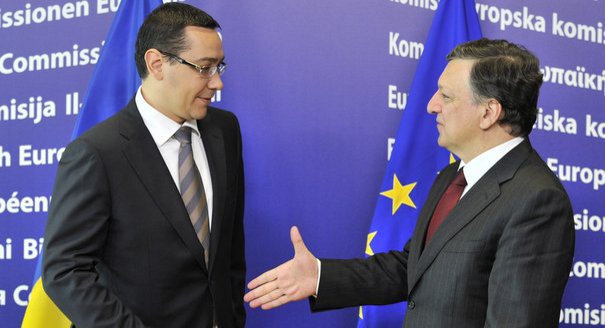
Source: Getty
What can realistically be done to persuade the governments of Romania and Bulgaria to embrace long-term commitments to establishing the rule of law and fighting corruption?
Source: New York Times

But what can realistically be done to persuade the two governments to embrace long-term commitments to establishing the rule of law and fighting corruption?
As I explain in my latest Page Two column, Bulgaria and Romania were allowed to join the Union in 2007, though these problems were evident then — and reported by the E.U. — because of the belief that joining the Union would encourage the reformers while exclusion would hurt efforts to modernize the countries.But now the European Commission has a responsibility to act. It can do several things. It might withhold the special structural and development funds that amount to several hundred million euros. It has already delayed both countries’ access to the Schengen accord that would allow their citizens to cross most European Union borders without passports.
The ultimate sanction would be to suspend the voting rights of Bulgaria and Romania. In practice it would mean that neither country would be able to vote along with the other E.U. member states on issues that affect them.
It would, however, be extremely difficult for the member states to reach agreement on suspending voting rights.
But if the E.U. is true to its word about upholding democracy, the rule of law and human rights, then the option to suspend voting rights should be taken seriously.
Doing so would also send a signal to countries applying to join the bloc, such as Serbia, that the E.U. is not going to allow its strategy of enlargement to be tainted by corruption.
Indeed, if anything, say analysts, the unfinished transitions in Bulgaria and Romania point to the difficulties the E.U. will encounter when dealing with other Balkan candidate countries.

Nonresident Senior Fellow, Carnegie Europe
Judy Dempsey is a nonresident senior fellow at Carnegie Europe
Recent Work
Judy Dempsey
Judy Dempsey
Carnegie does not take institutional positions on public policy issues; the views represented herein are those of the author(s) and do not necessarily reflect the views of Carnegie, its staff, or its trustees.

With the growth in points of friction between the great powers, organizations like the SCO will continue to play a role in the strategic adaptation of the smaller powers caught between them.

Temur Umarov

When faced with fuel shortages in the past, Central Asian governments could always count on additional supplies from Moscow. That safety net no longer exists.

Galiya Ibragimova

Andrey Melnichenko’s essay offers no answer to the fundamental question of how, under any kind of negotiated settlement, Europe can protect itself from the Russian ressentiment that is inevitable in all scenarios except for an outright victory for Putin.

Leonid Bershidsky

Despite unhappiness on the ground, Moscow is determined to use both carrot and stick to ensure there is record support for United Russia in occupied Ukraine.

Konstantin Skorkin

Whether PAS can refocus on the unfinished business of state-building may ultimately prove more consequential for Moldova’s European future than the pace of its accession negotiations.

Balázs Jarábik