

Report
Iskander Rehman
{
  "authors": [
    "Iskander Rehman"
  ],
  "type": "other",
  "centerAffiliationAll": "dc",
  "centers": [
    "Carnegie Endowment for International Peace"
  ],
  "collections": [],
  "englishNewsletterAll": "ctw",
  "nonEnglishNewsletterAll": "",
  "primaryCenter": "Carnegie Endowment for International Peace",
  "programAffiliation": "NPP",
  "programs": [
    "Nuclear Policy"
  ],
  "projects": [],
  "regions": [
    "South Asia",
    "India",
    "Pakistan"
  ],
  "topics": [
    "Nuclear Policy"
  ]
}
Source: Getty
Since 1998, the evolution of nuclear postures and arsenals in both New Delhi and Islamabad no longer appears to evoke the same degree of international concern, or even interest.
Source: Naval War College Review

More than ten years later, however, the international community’s sense of urgency seems to have waned, and the evolution of the nuclear postures and arsenals of both New Delhi and Islamabad no longer appear to evoke the same degree of concern, or even interest.
Symptomatic of this ebbing attention is the detached, disinvested manner in which much of the world has witnessed the ongoing shift of South Asian nuclear capabilities from land to sea.
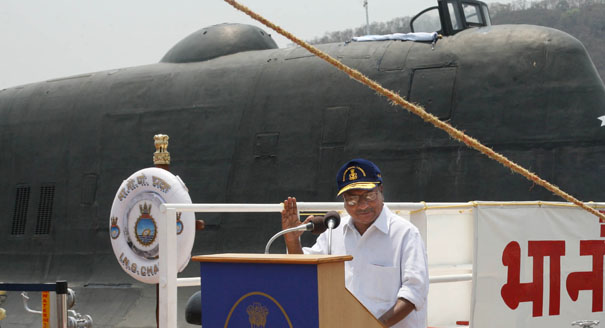
When in July 2009 India launched its first nuclear submarine, S-2 (also known as the Advanced Technology Vessel, or ATV, and ultimately named Arihant), in a dry dock in the eastern port of Visakhapatnam, the reaction of much of the world to the event was remarkably subdued. The event was perfunctorily acknowledged abroad, and in India as well, as a technological and symbolic milestone in the nation’s rise to great-power status. Barring Pakistan, which reacted immediately and sharply to the news, scant commentary—scholarly or journalistic—was made about the impact that the introduction of sea-based delivery systems would have on the South Asian nuclear equation.
This article seeks to address this issue directly, asserting that it is only a matter of time before Pakistan formally brings nuclear weapons into its own fleet. The study first examines the key causes and motivations behind both nations’ lurches toward naval nuclearization. For both nations, a variety of factors explain the pursuit of sea-based deterrence. In particular, China’s nuclear role in the Indian Ocean is examined, both as a key enabler of Pakistani naval nuclearization and as a potential future military actor in the Arabian Sea. The second section charts the dangerous path that Indian and Pakistani navies appear to be taking, a path that combines dual-use systems (most notably nuclear-tipped cruise missiles), cultivated doctrinal ambiguity, and brinkmanship to render the future of nuclear stability in South Asia exceptionally bleak. It is argued that if this haphazard naval nuclearization remains unchecked, its destabilizing effect will spill over into the Persian Gulf and beyond. Without a concerted effort to integrate sea-based nuclear assets more effectively into both nations’ strategic thinking and into a bilateral dialogue, New Delhi and Islamabad may be unable to avoid escalation in a crisis and, ultimately, skirt nuclear disaster.

Former Associate, Nuclear Policy Program
Rehman was an associate in the Nuclear Policy Program at the Carnegie Endowment and a Stanton Nuclear Security Fellow. His research focuses on security and crisis stability in Asia, specifically the geopolitical ramifications of naval nuclearization in the Indian Ocean.
Recent Work
Iskander Rehman
Carnegie does not take institutional positions on public policy issues; the views represented herein are those of the author(s) and do not necessarily reflect the views of Carnegie, its staff, or its trustees.

With the growth in points of friction between the great powers, organizations like the SCO will continue to play a role in the strategic adaptation of the smaller powers caught between them.

Temur Umarov

The demands of the Kremlin’s war in Ukraine, demographic problems, and public hostility toward Central Asians mean Russia does not have enough workers.

Salavat Abylkalikov
Troubled by the growing salience of nuclear debates in East Asia, Moscow has responded in its usual way: with condemnation and threats. But by exacerbating insecurity, Russia is forcing South Korea and Japan to consider radical security options.

James D.J. Brown
Not only does the fighting jeopardize regional security, it undermines Russian attempts to promote alternatives to the Western-dominated world order.

Ruslan Suleymanov
For Putin, upgrading Russia’s nuclear forces was a secondary goal. The main aim was to gain an advantage over the West, including by strengthening the nuclear threat on all fronts. That made growth in missile arsenals and a new arms race inevitable.

Maxim Starchak