

Paper
Ibrahim Saif, Ahmed Ghoneim
{
  "authors": [
    "Ibrahim Saif"
  ],
  "type": "legacyinthemedia",
  "centerAffiliationAll": "",
  "centers": [
    "Carnegie Endowment for International Peace",
    "Malcolm H. Kerr Carnegie Middle East Center"
  ],
  "collections": [],
  "englishNewsletterAll": "",
  "nonEnglishNewsletterAll": "",
  "primaryCenter": "Malcolm H. Kerr Carnegie Middle East Center",
  "programAffiliation": "",
  "programs": [],
  "projects": [],
  "regions": [
    "Egypt",
    "Gulf",
    "Levant",
    "Maghreb"
  ],
  "topics": [
    "Economy"
  ]
}
Source: Getty
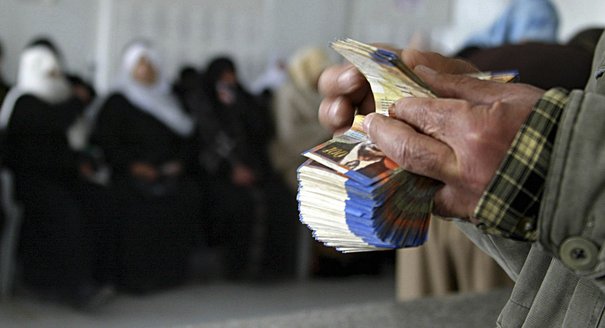
Since the outset of the Arab Spring, numerous initiatives have been launched to support and fund Arab governments in the process of economic transition.
Source: Al-Hayat

Another initiative came courtesy of the Gulf states, which, despite the global economic crisis, still possess substantial financial surpluses. The United Arab Emirates, Qatar, Saudi Arabia, and others promised to provide financial assistance and instruct their sovereign funds to invest in Arab Spring countries in order to contribute to the success of those states’ transitions.
These initiatives inspired optimism in countries like Egypt, Tunisia, Morocco, and Jordan; but the (promised) investments have yet to materialize. The Deauville Partnership was merely ink on paper, and the Arab states with financial surpluses chose to wait and monitor the political developments taking place in Arab Spring countries before beginning to explicitly allocate financial resources. This is in spite of the remarkable blossoming of the Qatari-Tunisian relationship, which has involved several Qatari missions to Tunisia during which the two states agreed to work together on numerous projects, at least some of which are likely to bear fruit.In light of the magnitude of foreign investment in the countries of the Arab Spring, two additional factors can be harnessed to encourage investment and economic growth: the private sector and public sector investment. Local investors in many Arab countries remain reluctant to put their money into ventures at home because of continued insecurity. In addition, some hold negative impressions of sectors that were once tied to oppressive political regimes, even though it is necessary to differentiate between an entrepreneurial, independent private sector and one whose wealth was accumulated through politics rather than independent creative initiatives. But the prevailing circumstances do not encourage the private sector to invest and play an effective role in building a future, the outcome of which remains shrouded in mystery. This means that the public sector must shoulder great responsibilities during this time of change.
Governments in Arab Spring countries, from Tunisia to Morocco, Egypt, Jordan, and further afield, are struggling with budget deficits and are in urgent need of the financial resources necessary to satisfy growing popular demands. In monitoring the behavior of these governments, it becomes clear that their main focus has been bolstering current spending in response to popular demands, rather than focusing on capital expenditures that could serve to create jobs and help restart growth. Governments should focus their spending on sectors that can create employment opportunities within a short time frame, while primarily relying on returns from local production to create and reinforce links with other economic sectors. Preferably, a matrix should be set up to identify the relative importance assigned to each goal, and how public investment can help to achieve them.
Equally crucial is developing the partnership between the public and private sectors. This will provide reassurances to the private sector and encourage it to engage in projects that primarily concern the state. But caution must be exercised to avoid repeating past mistakes that tarnished the private sector’s image. A clear and transparent framework is needed to guide investment policy and guarantee equal opportunities for all parties competing for public contracts. In looking to stimulate the private sector, traditional paradigms must be transcended and new strategies pursued that involve small and medium enterprises alongside established companies.
A number of conditions should be met to restore the private sector’s trust and encourage new investment. Security and legislative stability must be reestablished. Instability is not tied to security alone; legislation regulating the private sector lacks a clear economic vision outlining the relationship between the public sector’s and the private sector’s future economic goals.
What’s more, during transitional periods governments tend to prefer to borrow from local banks. This depresses the level of credit available to the private sector, regardless of the private sector firm’s size, and raises the cost of borrowing. This government tendency must be curbed in order to push banks toward the local market and facilitate the granting of credit and loans for local projects. In this context, initiatives that provide liquidity for ventures with high economic returns are needed.
As for foreign investment, governments must consider the types of guarantees that can be provided, including acceptance of the principle of international arbitration to end trade disputes. They must do so despite the inherent dangers present in these types of policies, such as the likely costs associated with them.
The difficult times that Arab Spring economies are passing through necessitates a search for extraordinary solutions until stability is restored. In the absence of these solutions, economic indicators will continue to slide, while the failure to create new jobs will hinder political change, prolong the time needed to achieve it, and perhaps even derail the process entirely.
This article was originally published in Arabic in Al-Hayat.
Former Senior Associate, Middle East Center
Saif is an economist specializing in the political economy of the Middle East. His research focuses on international trade and structural adjustment programs in developing countries, with emphasis on Jordan and the Middle East.
Recent Work
Ibrahim Saif, Ahmed Ghoneim
Ibrahim Saif, Muhammad Abu Rumman

Depleted financial reserves and a shrinking tax base mean it is no longer possible to simultaneously deliver high defense spending, price stability, and economic growth.

Alexandra Prokopenko
A much-discussed disagreement over internet restrictions in Russia was never an existential threat for Putin: It was about elite groups protecting their interests.
Alexandra Prokopenko

The demands of the Kremlin’s war in Ukraine, demographic problems, and public hostility toward Central Asians mean Russia does not have enough workers.
Salavat Abylkalikov
Minsk’s faith in the future of its larger neighbor’s economy is fading as Belarusian firms in Russia see record losses.

Olga Loiko

The cost of air defense has become an unregistered tax on revenue for businesses. While military rents are consolidated in the federal budget, the costs of defense are being spread across the balance sheets of companies and regional governments.
Alexandra Prokopenko