

Commentary
Judy Dempsey
{
  "authors": [
    "Judy Dempsey"
  ],
  "type": "legacyinthemedia",
  "centerAffiliationAll": "",
  "centers": [
    "Carnegie Endowment for International Peace",
    "Carnegie Europe"
  ],
  "collections": [],
  "englishNewsletterAll": "",
  "nonEnglishNewsletterAll": "",
  "primaryCenter": "Carnegie Europe",
  "programAffiliation": "",
  "programs": [],
  "projects": [],
  "regions": [
    "Europe"
  ],
  "topics": [
    "EU"
  ]
}
Source: Getty
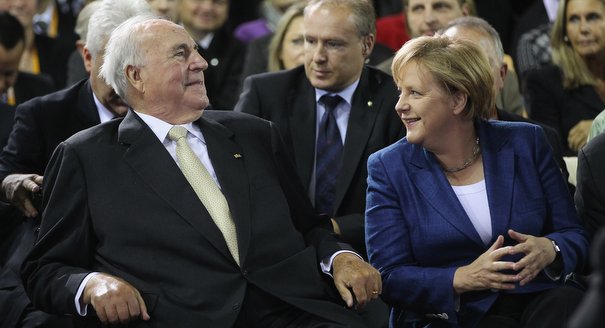
As the euro crisis reaches a critical stage, Angela Merkel is reaching out to her pro-Europe predecessor, Helmut Kohl.
Source: New York Times

The event, to be held in the German Historical Museum, marks the 30th anniversary of Mr. Kohl’s becoming chancellor, a reign that was to last 16 years.
It may seem puzzling for Ms. Merkel to take the lead, given how she fell out with Mr. Kohl in 1999 when she wrote a letter to Frankfurter Allgemeine Zeitung, Germany’s leading conservative daily, criticizing him over a party financing scandal.
Ms. Merkel’s public break with Mr. Kohl stunned many Christian Democrats at the time. They were not used to such disloyalty from the party’s secretary general. Her criticism was regarded as an act of betrayal of Mr. Kohl, who had fostered her political career, often referring to her as “the girl.”Now, as the euro crisis reaches a critical stage, Ms. Merkel is finally trying to make up. She is reaching out to Mr. Kohl because he is still considered to be one of the most committed and passionate pro-Europe figures in Germany.
“We need as much support as possible to campaign for the euro and Europe,” said Ruprecht Polenz, chairman of the German Parliament’s foreign affairs committee. “There is no other option for Germany.”
That does not reflect the mood among Germans or in Ms. Merkel’s center-right coalition.
According to opinion polls, euro-skepticism is increasing. Germans fear they will have to provide more financial guarantees to rescue Greece and other struggling countries that use the common currency. Ever more openly, German politicians are calling for Greece to leave the euro.
Not only that. Leading politicians — particularly Finance Minister Wolfgang Schäuble, a Christian Democrat — are calling for a referendum on Europe.
It is not just because Mr. Schäuble believes Germans should have a say on the direction Europe is taking. He and others are also desperately afraid of what might happen on Sept. 12.
That is when the Constitutional Court will announce its ruling on whether Germany can ratify the fiscal pact that Ms. Merkel negotiated with her partners in the European Union, and whether it may contribute to the bailout provision of the European Stability Mechanism.
German constitutional lawyers have already warned that both laws entail such a radical transfer of budget powers to Brussels that they would invalidate the German Constitution.
If the Constitutional Court rules against the laws, the only way out would be to rewrite the Constitution. For that to happen, a referendum would be needed in which Germans, for the first time, could have a say about Europe.
“This is such a dilemma,” said Niels Annen, director of European policy at the Friedrich Ebert Foundation, which is affiliated with the opposition Social Democratic Party. “What if there is a referendum? What if we lose? Then what happens to Europe?”
Ms. Merkel, typically, has not said what she thinks about a referendum. She has, however, repeatedly called for “more Europe,” even though she has never explained what that entails.
Given the divisions inside her party, the chancellor is adamant about one thing: Euro zone countries must first restructure their economies in order to become competitive. Only then can more integration follow.
Mr. Schäuble is more explicit. He wants a European Union that is accountable, legitimate and democratic. Analysts have warned that Germans are not prepared to give Brussels more of a say over national budgets, unless citizens have much more of a say over the way things are run.
Some German lawmakers also ask why Brussels should be given more powers when its previous record in managing the common currency has been so miserable.
For example, the European Commission, the bloc’s executive, scolded Germany and France eight years ago when they breached E.U. Stability Pact rules, which set budget deficits at 3 percent of gross domestic product.
But when member states, pushed by Germany and France, refused to impose penalties, the Commission quickly gave in. As for Greece, it has yet to implement essential structural overhauls, like a new tax system, despite its promises and billions of euros in bank guarantees.
Mr. Kohl has stuck by Greece and the common currency. In recent interviews, he has pleaded with Germans to support Greece out of European solidarity and because it is in Germany’s interests.
Yet one has to wonder whether Ms. Merkel’s decision to rope in Mr. Kohl to dampen euro-skepticism and unite her party could backfire. It was Mr. Kohl, after all, who gave up the beloved mark for a common European currency without sufficient controls and conditions.
But Germans have become more euro-skeptical than Mr. Kohl would have ever thought possible. Ms. Merkel’s headache, analysts say, is not going to go away with one big celebration for her predecessor, regardless of what the judges rule.

Nonresident Senior Fellow, Carnegie Europe
Judy Dempsey is a nonresident senior fellow at Carnegie Europe
Recent Work
Judy Dempsey
Judy Dempsey
For the Middle Corridor to fulfill its promises, one of these routes must become scalable. At present, neither is.
Friedrich Conradi
Orbán created an image for himself as virtually the only opponent of aid to Ukraine in the entire EU. But in reality, he was simply willing to use his veto to absorb all the backlash, allowing other opponents to remain in the shadows.
Maksim Samorukov
Moldova’s reintegration plan was drawn up to demonstrate to Brussels that Chișinău is serious about the Transnistria issue—and to get the West to react.
Vladimir Solovyov
What should happen when sanctions designed to weaken the Belarusian regime end up enriching and strengthening the Kremlin?

Denis Kishinevsky
The supposed threats from China and Russia pose far less of a danger to both Greenland and the Arctic than the prospect of an unscrupulous takeover of the island.
Andrei Dagaev