

Article
- +1
Toby Dalton, Mark Hibbs, Nicole Grajewski, …
{
  "authors": [
    "Mark Hibbs"
  ],
  "type": "legacyinthemedia",
  "centerAffiliationAll": "dc",
  "centers": [
    "Carnegie Endowment for International Peace"
  ],
  "collections": [],
  "englishNewsletterAll": "ctw",
  "nonEnglishNewsletterAll": "",
  "primaryCenter": "Carnegie Endowment for International Peace",
  "programAffiliation": "NPP",
  "programs": [
    "Nuclear Policy"
  ],
  "projects": [],
  "regions": [
    "Middle East",
    "Iran"
  ],
  "topics": [
    "Nuclear Policy"
  ]
}
Source: Getty
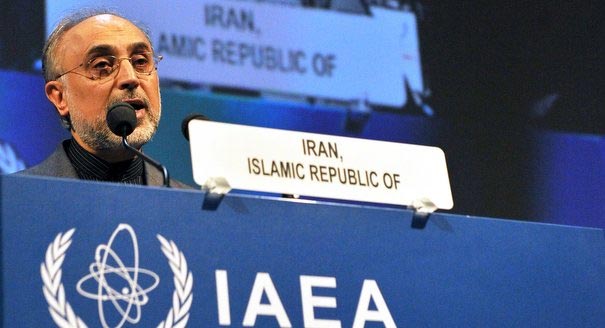
The recent report by the International Atomic Energy Agency makes it clear that Iran continues to enrich uranium in violation of Security Council resolutions, and it continues to obstruct the IAEA investigation mandated by those resolutions.
Source: Foreign Policy

It sought a meeting for two reasons. First, talks with Tehran to negotiate a so-called "structured approach" to wind down the IAEA's investigation and determine whether Iran had been working on nuclear weapons -- following evidence raised by Yukiya Amano, the agency's director general, back in November -- had ground to a halt in early June. Second, unless Iran made a significant goodwill gesture by the end of August, Amano would have to report to the agency's Board of Governors that, for nine months, Iran had refused to cooperate -- even as Israeli officials were signaling that they might attack Iran's nuclear installations without warning and soon because diplomacy had failed.
Now, Amano has done just that. Iran and the IAEA had a fruitless encounter in Vienna on August 24, and so six days later Amano filed his report to the IAEA governors. With war drums beating in Jerusalem, the report's language is sober and muted. The IAEA doesn't want to see a war in Iran. But the message of the report is clear: Iran continues to enrich uranium in violation of Security Council resolutions, and it continues to obstruct the IAEA investigation expressly mandated by those resolutions.
There are five salient points in the IAEA's 14-page document:Fordow Centrifuge Installation: Beginning late last year, Israeli officials have warned U.S. counterparts that an expansion of uranium enrichment activity at the underground Fordow Fuel Enrichment Plant was their main concern in part because the plant's product is uranium enriched to 20 percent -- much closer to bomb-grade product than the 3.5 percent enriched material Iran produces elsewhere. In the teeth of Israeli threats, earlier this summer, Iranian media reports citing President Mahmoud Ahmadinejad asserted that about 1,000 new centrifuges had been set up at Fordow. The math behind the new IAEA document confirms that Iranian claim. Of the nearly 3,000 centrifuges Iran has told the IAEA it intends to set up at Fordow, about two-thirds are now installed. However, so far none of the new machines is enriching uranium. Iran continues to produce 20 percent-enriched uranium with about 700 centrifuges it installed previously. If intensified enrichment activity at Fordow is an Israeli red line, the IAEA report says it hasn't been crossed.
Uranium Enrichment Continues Unabated: Charts at the back of the report show that in the three months since the IAEA's last report, and indeed for several years, Iran has steadily added to its inventory of enriched uranium at all three of its declared centrifuge plants. Iran's total stockpile of 20 percent-enriched uranium, including from the Fordow plant, is now nearly 200 kilograms, about 50 kilograms more than three months ago. Iran's biggest enrichment plant, at Natanz, has now put out just under 7,000 kilograms of uranium enriched to 3.5 percent, compared to about 3,500 kilograms at the beginning of 2011 and 1,000 kilograms at the beginning of 2010. If cyber warfare and sabotage attacks launched by Iran's adversaries over the last three years were meant to cripple Iran's enrichment plant output, they did not succeed.
No Iranian Cooperation on Weapons Allegations: In a report to the board last November, Amano aired detailed evidence suggesting that, since the late 1980s, Iran had carried out nuclear weapons-related research and development activities. The new IAEA report spells out that Iran has persistently refused to comply with IAEA requests to address these allegations: "Despite the intensified dialogue between the Agency and Iran since January 2012, no concrete results have been achieved in resolving the outstanding issues. Given the nature and extent of credible information available... [i]n the absence of such engagement, the Agency will not be able to resolve concerns... which need to be clarified to exclude the existence of possible military dimensions to Iran's nuclear program." The report also says that the IAEA has obtained new information which supports Amano's earlier allegations. It's anyone guess if and when Iran will answer the IAEA's questions, but many observers believe Iran is holding its cooperation hostage to advances in its negotiations with the P5 states and Germany. So far, that track has made little progress.
Cover-up at Parchin: During a meeting in Tehran in May, Amano asked Iran to let the IAEA inspect a specific location at a military installation at Parchin, after a former scientist working in the Soviet nuclear weapons complex, Vyacheslav Danilenko, told the IAEA he had helped Iran set up apparatus there which the IAEA suspects may have been used to conduct high-explosive testing for a nuclear weapons program. Iran told Amano that, unless the IAEA would agree to a new "work plan" that would terminate the investigation step by step, it would refuse. Meanwhile, the IAEA has obtained aerial reconnaissance data -- some publicly available, some not -- suggesting that Iran has sanitized the Parchin site to hide or remove escaping debris or emissions from such an explosive test: "Iran has not responded to the Agency's initial questions on Parchin and [Danilenko]; Iran has not provided the Agency with access to the location within the Parchin site to which the Agency requested access; and Iran has been conducting activities at the location that will significantly hamper the Agency's ability to conduct effective verification."
Uninterrupted Reactor Construction at Arak: In addition to Iran's enrichment plants, Security Council resolutions have ordered Iran to suspend construction at Arak of a heavy-water reactor typically used to generate weapons-grade plutonium. The new IAEA report documents that Iran has continued to defy those resolutions. On August 1, IAEA inspectors went to the site and saw workers installing reactor piping inside the reactor building. Separately, lack of cooperation by Iran is inhibiting the IAEA from drawing up an effective plan to inspect the reactor once it begins operating next year.
With the exception of the perhaps not insignificant detail that Iran's newly installed centrifuges at Fordow are idle, the IAEA report depicts an Iran that is defiant and determined not to bend to the will of the international community. That's where Israel enters the picture. The IAEA's eleventh-hour meeting with Iran this month testifies to Amano's understanding that an Israeli attack on Iran's nuclear installations would be the ultimate vote of no confidence in the IAEA's abilities. But Amano has little recourse. The IAEA's relationship with Iran deteriorated after his November disclosures, and the organization's mandate and mission gives Amano little negotiating leverage. The P5 and Germany have more, but there is no grand bargain on the horizon. The effects of an Israeli attack on Iran's nuclear installations would be profound and devastating, but if an attack happens -- as in 2003 in Iraq -- the IAEA would have little choice but to watch.

Nonresident Senior Fellow, Nuclear Policy Program
Hibbs is a Germany-based nonresident senior fellow in Carnegie’s Nuclear Policy Program. His areas of expertise are nuclear verification and safeguards, multilateral nuclear trade policy, international nuclear cooperation, and nonproliferation arrangements.
Recent Work


Toby Dalton, Mark Hibbs, Nicole Grajewski, …
Mark Hibbs
Carnegie does not take institutional positions on public policy issues; the views represented herein are those of the author(s) and do not necessarily reflect the views of Carnegie, its staff, or its trustees.

Ongoing uncertainty in the Middle East allows Moscow to both increase its influence in Tehran and continue to enjoy the financial windfall of higher oil prices.

Nikita Smagin
This year’s wars have made alternative routes to transit through Russia no less risky for Central Asian countries.

Galiya Ibragimova
Troubled by the growing salience of nuclear debates in East Asia, Moscow has responded in its usual way: with condemnation and threats. But by exacerbating insecurity, Russia is forcing South Korea and Japan to consider radical security options.

James D.J. Brown
The Russian leadership wants to avoid a dangerous precedent in which it is squeezed out of Iran by the United States and Israel—and left powerless to respond in any meaningful way.
Nikita Smagin
Not only does the fighting jeopardize regional security, it undermines Russian attempts to promote alternatives to the Western-dominated world order.

Ruslan Suleymanov