

Q&A
Sami Moubayed
{
  "authors": [
    "Sami Moubayed"
  ],
  "type": "legacyinthemedia",
  "centerAffiliationAll": "",
  "centers": [
    "Carnegie Endowment for International Peace",
    "Malcolm H. Kerr Carnegie Middle East Center"
  ],
  "collections": [],
  "englishNewsletterAll": "",
  "nonEnglishNewsletterAll": "",
  "primaryCenter": "Malcolm H. Kerr Carnegie Middle East Center",
  "programAffiliation": "",
  "programs": [],
  "projects": [],
  "regions": [
    "Levant",
    "Syria"
  ],
  "topics": [
    "Political Reform",
    "Security"
  ]
}
Source: Getty
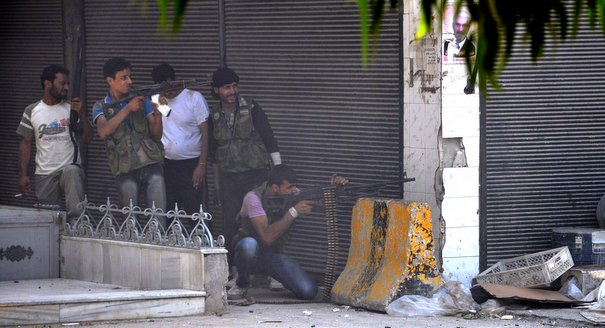
The conflict in Syria has entered a new, strategically crucial phase, as both sides fight to control Aleppo, a relatively late entry into the uprising.
Source: Huffington Post

Aleppo is no joke, with thousands of years of history looking over its shoulder. The city has legitimate political and economic needs that need to be addressed and has clearly parted ways, rather completely, with the Syrian regime. After having produced two presidents for Syria and a handful of historic prime ministers, it was reduced to a nonentity under the Baath party state and is keen on restoring its former status as a prime decision-maker in Syrian affairs, matched only by Damascus. Syrian state media is referring to the current battle for Aleppo, between the state-run Syrian Army and the Free Syrian Army (FSA) as the "Mother of all battles." Syrian authorities are promising that this will be the "final battle" after which, they will declare ultimate victory over what they claim is an "international conspiracy" being hatched against Syria. Syrian rebels, however, are promising "liberation" of Aleppo, within 2-3 weeks. Aleppo, after all, is extremely vital, both for the Syrian regime and the Syrian revolt. Throughout last week, regime troops were pouring into Aleppo for what seemingly was going to be a tough and long battle -- there were fully-equipped soldiers aided by tanks and helicopters.
Aleppo, as the people of Syria remember only too well, was the last Syrian city to join the Syrian revolt that broke out in mid-March 2011. One reason was the city's geographic distance from ongoing violence in the southern city of Daraa and midland city of Homs, which gave it a temporary immunity. Another was Aleppo's proximity to Turkey and Iraq, which for some time, provided a stable economy for the city. So long as money was still coming in, the state was able to control rising discontent on the streets of Aleppo. Additionally, the business elite of Aleppo was staunchly pro-regime although, ironically, it was this city's middle and upper class that suffered most from socialism of the Baath party when it first came to power in 1963. Aleppo remained calm for nearly one year, due to the weight of the Aleppo clerics (who are allied to, or created by the state), along with the political, social and economic interests of their nobility, which mostly was "new money" that rose to power and fame only after the Baathists came to power in 1963. The old Sunni families of Aleppo, like the Jabris, the Ebrahim Pashas, the Barmadas, the Mudaresses and the Qudsis, had been completely sidelined by the Baathists since 1963. Aleppo's new elite had overlapping interests with the Baathist elite and were often allied to them through business partnerships and marriages, giving them no reason to change the existing order. More important than all of the above, however, are powerful memories of punishment inflicted by the state upon Aleppo when its people supported the Muslim Brotherhood in 1979-1982. The world remembers only Hama, but Aleppo as well suffered terribly in the early 1980s. The people of Aleppo tried to prevent, or postpone, similar sufferings in 2011. The fate of sister cities that had taken part in the 2011 revolt spoke volumes of what was in store for Aleppo. All of this, however, was not enough to shelter the regime for too long from boiling anger in Aleppo. After much delay, the city erupted, much like a volcano -- thanks to rising unemployment, frustration, rage and the weakness of its regime-friendly community leaders, who could not provide calm and control the city forever.
The FSA is now focused on taking Aleppo, confident that if they succeed, other cities and towns will fall like the domino. Ultimately, they feel this will reduce the regime's authority to Damascus and the two port cities of Latakia and Tartous. A clear case from history surfaces here, being that of Adib Al Shishakli, who faced a popular revolt, backed by a military uprising, in late 1953. At first, he tried to suppress it by force, but slowly, cities began slipping away, one after another. When Aleppo fell, the regime quickly disintegrated from within, with the Druze Mountain, Homs and Latakia quickly following suite, shrinking Shishakli's power base to Hama and capital Damascus. Whether that will happen again or not is yet to be seen in the weeks ahead, as all eyes are trained on Aleppo for the rest of Ramadan.
This article was originally published in The Huffington Post.

Former Visiting Scholar, Carnegie Middle East Center
Moubayed, a political analyst and historian, focuses his research on Syria, Lebanon, Iraq, and the Arab-Israeli conflict.
Recent Work
Sami Moubayed
Sami Moubayed
Carnegie does not take institutional positions on public policy issues; the views represented herein are those of the author(s) and do not necessarily reflect the views of Carnegie, its staff, or its trustees.

The European far right might fail to steer EU policy in the direction Russia wants, but they will create enough chaos inside Europe to benefit the Kremlin.

Dimitar Bechev

If the Russian-speaking community in Latvia cannot articulate their interests without being seen as disloyal, they could end up embracing a pro-Kremlin agenda.

Sergejs Potapkins

Russia’s ruling party would have benefited from Putin appearing as its distant patron, but as an active frontman imposing his views on the public, he has done nothing but harm both the party’s election campaign and the ruling system overall.

Andrey Pertsev

In the tenth year of his presidency, President Mirziyoyev’s system is becoming even more personalized than that of his predecessor Karimov.

Galiya Ibragimova

With the growth in points of friction between the great powers, organizations like the SCO will continue to play a role in the strategic adaptation of the smaller powers caught between them.

Temur Umarov